Breathing
Breathe slowly and evenly. Exhale as you ease into a comfortable range, and never use the breath to force a deeper position.
Getting your next view ready…
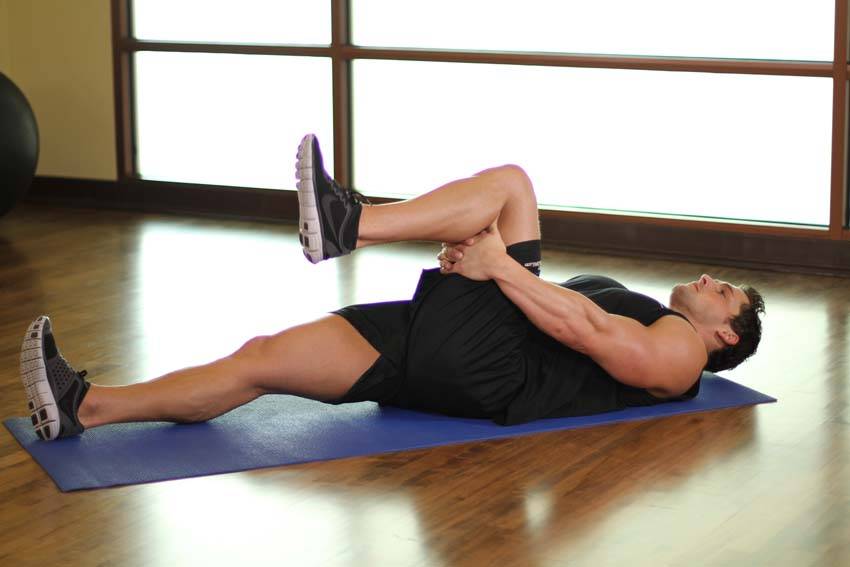
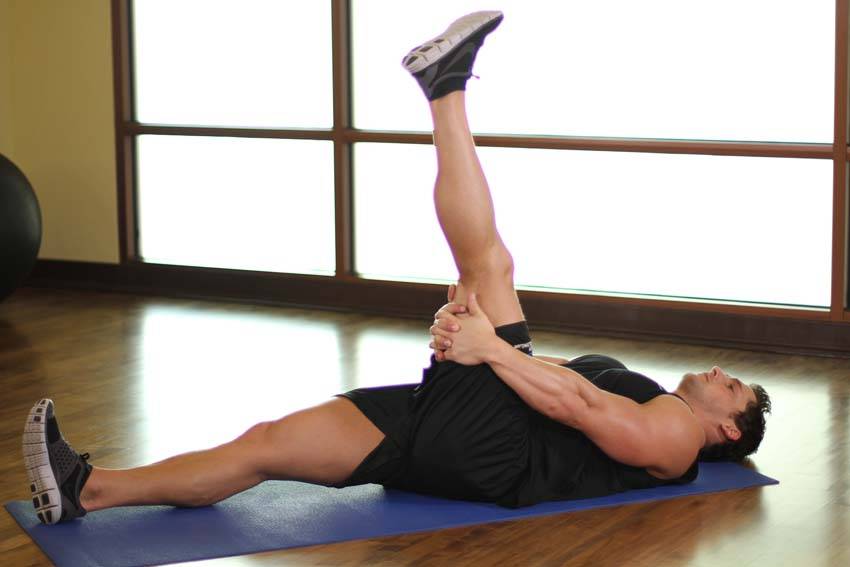
The 90/90 Hamstring primarily works the hamstrings, with the calves supporting the movement. It is a stretching movement that needs no equipment.
 1 / 2
1 / 2How to
Movement instructions
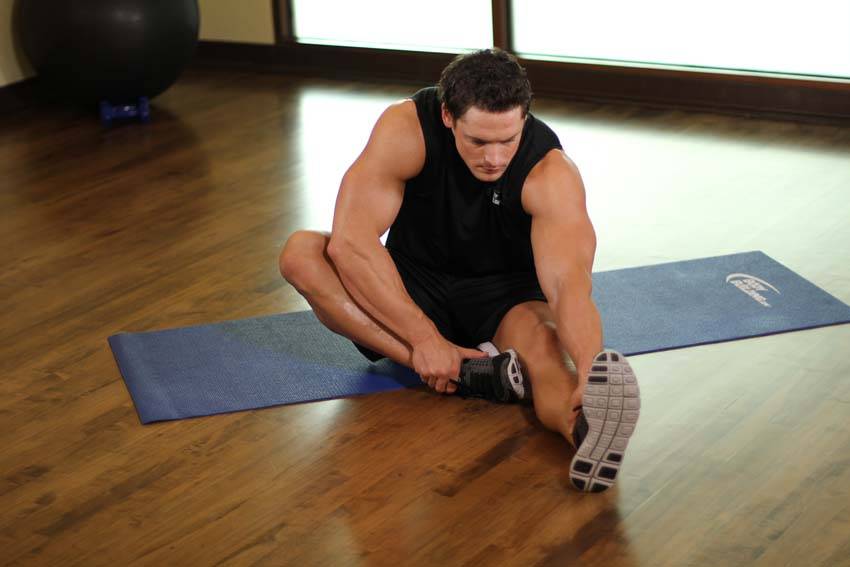
Lie on your back, with one leg extended straight out.
With the other leg, bend the hip and knee to 90 degrees. You may brace your leg with your hands if necessary. This will be your starting position.
Extend your leg straight into the air, pausing briefly at the top. Return the leg to the starting position.
Repeat for 10-20 repetitions, and then switch to the other leg.
Technique guidance
Breathe slowly and evenly. Exhale as you ease into a comfortable range, and never use the breath to force a deeper position.
General guidance based on the exercise and equipment. It is not personal coaching or medical advice.
Your progress
Keep the same exercise variation, range of motion and recording method when comparing 90/90 Hamstring sessions.
Repetitions and completed sets.
Example: 10, 9 and 8 completed reps. Keep each set separate instead of recording only the total.
Compare repetitions using the same variation and range. A different variation needs its own history; extra reps are not directly comparable if the movement changes.
Read the tracking guideThe examples show how to keep a record. They are not workout targets or a personalised training plan.
See how Jijibisha tracks your progressMuscles
Muscle guide
Hamstrings is the primary muscle group. The lighter highlights show the supporting muscles involved in the movement.
In depth
The 90/90 hamstring is a controlled mobility exercise performed while lying on your back. One leg remains extended on the floor while the other hip and knee begin at approximately 90 degrees. From this position, you straighten the raised knee until you feel tension along the back of the thigh, then bend it again and repeat.
The movement is often called the 90/90 hamstring stretch, 90/90 hamstring exercise, or lying 90/90 hamstring stretch. It primarily targets the hamstrings and may also create tension through the calf, depending on your ankle position and individual mobility.
Unlike a long static hamstring stretch, the standard version uses repeated knee extensions. This makes it a practical dynamic mobility exercise before running, lower-body training, sports, or any activity that requires comfortable hip and knee movement.
Quick answer: Lie on your back with one leg straight. Bring the other thigh above your hip and bend the knee to 90 degrees. Support the back of your thigh with your hands. Keep the thigh steady while slowly straightening the knee. Stop at a comfortable stretch, pause briefly, then bend the knee and repeat.
The 90/90 hamstring exercise is a supine hamstring mobility drill. Supine simply means that you perform it while lying face up.
The raised leg begins with two approximate right angles:
You then maintain the hip position while extending and bending the knee.
Straightening the knee lengthens the hamstrings because these muscles cross the back of the knee. Keeping the hip flexed places them in an already lengthened position, so you may feel a stretch before the knee becomes completely straight.
The exercise does not require you to achieve a perfectly straight leg. The correct range is the farthest position you can reach while keeping the movement smooth, your pelvis stable, and the sensation comfortable.
The name comes from the starting position of the raised leg.
Your thigh is positioned at roughly 90 degrees relative to your torso, and your knee is also bent to roughly 90 degrees. From that setup, the knee repeatedly straightens and returns.
The angles do not need to be measured precisely. The purpose of the setup is to place the hip and knee in a consistent position so the movement occurs mainly through knee extension.
A useful visual check is:
If your thigh drifts far away from your body, the hamstrings may receive less stretch. If you pull the thigh too aggressively toward your chest, the position may become unnecessarily intense.
These two exercises have similar names but are completely different movements.
The 90/90 hamstring stretch is performed lying on your back. One leg is raised, the hip and knee begin bent, and the knee repeatedly straightens.
Its main purpose is to improve comfort and range during knee extension while the hip remains flexed.
It primarily targets:
The 90/90 hip stretch is normally performed seated on the floor. Both knees are bent, with one leg positioned in front and the other placed beside or behind the body.
Its main purpose is to train hip internal and external rotation.
It primarily targets structures around:
When searching for instructions, confirm that the exercise shown matches the version you intend to perform. For this page, the correct movement is the lying hamstring variation.
The hamstrings are the primary muscles lengthened during the exercise.
The hamstring group contains three main muscles:
These muscles run along the back of the thigh. Most of the hamstrings cross both the hip and knee joints, which means their length changes when you move either joint.
Their main functions include:
During the 90/90 hamstring stretch, the hip remains flexed while the knee straightens. This lengthens the hamstrings from both ends and creates the familiar stretch along the back of the thigh.
You may also feel tension in the calf, particularly the gastrocnemius.
The gastrocnemius crosses the knee and ankle joints. It can be placed under greater tension when the knee straightens and the toes pull toward the shin.
Keeping the ankle relaxed or neutral usually reduces calf involvement. Pulling the toes toward you may increase the stretch through the calf and the back of the lower leg.
The quadriceps are not being stretched during the exercise. They actively straighten the knee.
Contracting the quadriceps allows you to extend the leg without pulling it straight using a strap or another person. This active component is one reason the movement works well as a controlled mobility drill.
The hip flexors help hold the thigh in position above the hip.
Your hands provide most of the support, so the hip flexors should not need to work as hard as they would during an unsupported leg raise.
The abdominal muscles help stabilize the pelvis and lower back.
They do not need to contract as hard as they would during a plank or sit-up, but gentle trunk tension can prevent excessive arching as the knee straightens.
It can reasonably be described as both.
It is a stretch because straightening the knee lengthens the hamstrings.
It is also a mobility exercise because you repeatedly move into and out of the available range rather than holding one position for a long time.
The standard version is usually performed dynamically:
You can also use a static variation by straightening the knee to a comfortable position and holding it there.
The dynamic and static versions have different uses. The dynamic version is generally more appropriate during a warm-up, while a longer static hold may suit a separate flexibility session or the end of a workout.
Lie on an exercise mat or another firm, comfortable surface.
A bed or soft sofa may allow the pelvis to sink unevenly, making it harder to control the position. A floor mat usually provides more reliable support.
Make sure you have enough room to raise and straighten the leg without hitting furniture, walls, or equipment.
Begin with your head, shoulders, back, and pelvis resting comfortably on the floor.
Let your neck remain relaxed. Your head should face upward rather than turning repeatedly from side to side.
Extend both legs initially.
Leave one leg straight along the ground.
Keep the knee and foot pointing generally toward the ceiling. The leg does not need to be rigidly pressed into the floor.
If keeping the bottom leg straight causes your lower back to arch or feels uncomfortable, bend that knee and place the foot flat. This modification may make it easier to stabilize your pelvis.
Lift the opposite leg and position the thigh above your hip.
Bend the knee to approximately 90 degrees. Your shin should begin roughly parallel to the floor.
The exact angle may vary slightly depending on your proportions and flexibility.
Place both hands behind the raised thigh.
Hold above the back of the knee rather than pressing directly into the knee joint. Your grip should support the leg without squeezing aggressively.
Do not interlock your hands over the kneecap or pull from the front of the knee.
Allow your pelvis to rest evenly on the floor.
Gently tighten your abdomen so your lower back does not arch dramatically as the leg straightens. You do not need to force your lower back completely flat.
Keep your shoulders relaxed and avoid lifting your head to watch the foot.
Hold the thigh in approximately the same position throughout the repetition.
The movement should occur mainly at the knee. Avoid allowing the thigh to drift away from your torso as you straighten the leg.
Your hands can provide enough support to maintain the hip angle, but they should not pull the thigh forcefully toward your chest.
Contract the front of your thigh and extend the lower leg toward the ceiling.
Move slowly enough to notice where the stretch begins.
Continue until you feel moderate tension along the back of the thigh. Stop before the sensation becomes sharp, burning, electrical, or painful.
Your knee may straighten fully, partially, or somewhere in between. All three can be acceptable depending on your current range.
Hold the top position for approximately one second.
Keep breathing and maintain the same thigh position. Do not bounce repeatedly against your end range.
Return your shin toward the starting position under control.
Do not let the lower leg drop quickly.
Bend the knee until it returns to roughly 90 degrees, then begin the next repetition.
Perform the planned number of repetitions on one leg.
Lower the leg, reset your position, and repeat on the opposite side.
It is normal for one side to feel slightly different. Use a comfortable range for each leg rather than forcing the tighter side to match the more mobile side immediately.
Use one or two cues during each set instead of trying to remember everything at once.
The most useful cue for many people is: keep the thigh still while the lower leg moves.
Straighten the knee only as far as you can while maintaining control.
You do not need to lock the knee or create a perfectly vertical leg. The exercise remains useful even if the knee stays visibly bent at the top.
Stop when one of the following occurs:
Range of motion can improve gradually with consistent practice. Forcing a straight knee before your body is ready usually changes the position rather than creating better mobility.
You do not need to forcefully lock the knee.
If your leg naturally reaches full extension without discomfort, you can straighten it fully while keeping the muscles active. Avoid snapping into the end position or pushing the knee backward aggressively.
If you cannot straighten the knee completely, stop at your available range.
The goal is controlled knee extension, not proving that your leg can form a perfectly straight line.
You should usually feel a broad pulling sensation along the back of the raised thigh.
The stretch may be felt:
A mild to moderate muscular stretch is acceptable. The sensation should remain manageable enough that you can breathe normally and return from the position smoothly.
The movement should not cause:
Stop and reassess if the sensation does not feel like ordinary muscular tension.
Use slow, regular breathing.
A simple pattern is:
Exhaling can help reduce unnecessary tension as you approach the end of your range.
Do not hold your breath to force the knee straighter. If you cannot breathe comfortably, the position may be too intense.
The thigh often moves away from the torso when the hamstrings begin to resist knee extension.
This makes the leg appear straighter, but it reduces the stretch by decreasing hip flexion.
Keep the thigh steady with your hands. Use a smaller knee-extension range if necessary.
Bringing the thigh much farther than 90 degrees can create a stronger stretch, but it changes the setup.
It may also cause the pelvis to roll from the floor or make the position unnecessarily difficult.
Begin with the thigh approximately vertical. Increase hip flexion only as a deliberate progression.
The pelvis may tilt or lift when you try to straighten farther than your current range allows.
Keep both sides of the pelvis resting evenly. Stop the knee extension before your hips begin moving.
An excessive lower-back arch can appear when the bottom leg is straight and the trunk is not well supported.
Gently brace the abdomen. Bend the bottom knee and place the foot flat if this gives you better control.
Holding directly in the crease behind the knee can feel uncomfortable and may place unnecessary pressure on sensitive structures.
Support the fleshy part of the thigh a few centimetres above the knee.
Your hands should support the thigh, not force the knee into extension.
Let the quadriceps straighten the knee actively. This keeps the movement controlled and allows you to stop immediately when you reach your current limit.
Rapid bouncing may produce more movement without improving control.
Approach the end range gradually, pause, and return smoothly.
Fast repetitions make it difficult to notice whether the pelvis, thigh, or lower back is changing position.
Use a speed that allows each repetition to look similar.
Pointing the toes is not automatically wrong, but forcing the foot position can create unnecessary tension or cramping.
Keep the ankle neutral while learning. Adjust it later if you intentionally want to change where the stretch is felt.
Dorsiflexing the ankle, or pulling the toes toward you, can increase tension through the calf and the back of the leg.
This may be useful as a progression, but it can also produce tingling or nerve-related sensations in some people.
Start with a relaxed or neutral foot.
Breath-holding usually makes the body more tense.
Reduce the range and use a steady exhale as the knee straightens.
Mobility can differ between sides because of previous activity, training habits, anatomy, or injury history.
Use the same technique on both sides, but allow each leg to stop at its own comfortable limit.
A stronger stretch is not always a better stretch.
Progress comes from repeated controlled exposure, not from making every repetition as intense as possible.
Repeated controlled knee extensions expose the hamstrings to a gradually lengthened position.
Over time, regular mobility work can improve how comfortably you move through knee extension while the hip remains flexed.
The exercise uses active movement rather than a long passive hold.
This makes it suitable before running, lower-body strength training, field sports, martial arts, or other activities involving the legs.
It should follow a few minutes of general movement rather than being the first physical activity you perform after sitting or sleeping.
Because the exercise is performed one leg at a time, it makes differences easier to notice.
You can compare:
A difference does not automatically indicate an injury. It gives you useful information about your current movement.
You need only enough floor space to lie down.
An exercise mat can improve comfort, but it is not essential.
The floor supports your back and pelvis.
This removes the balance demands found in standing hamstring stretches and may make it easier to focus on the working leg.
You straighten the knee using your own muscles rather than relying entirely on external force.
This helps you practise controlling the leg near the edge of your available range.
You can change the difficulty by adjusting:
The exercise works well at home, in a gym, beside a sports field, or while travelling.
It can be included in a longer mobility routine or performed as a brief movement break.
The hamstrings are being lengthened rather than trained against significant resistance.
The exercise may improve mobility and movement control, but it does not replace strength exercises such as:
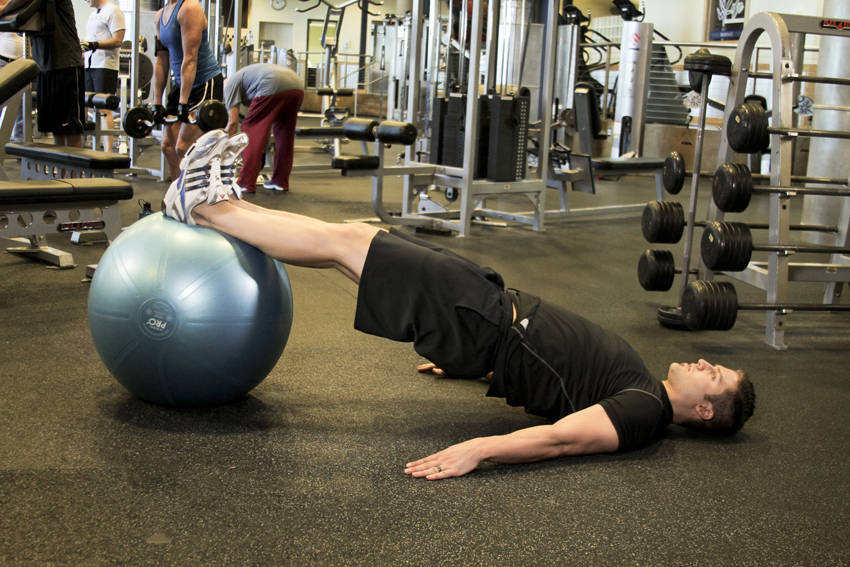
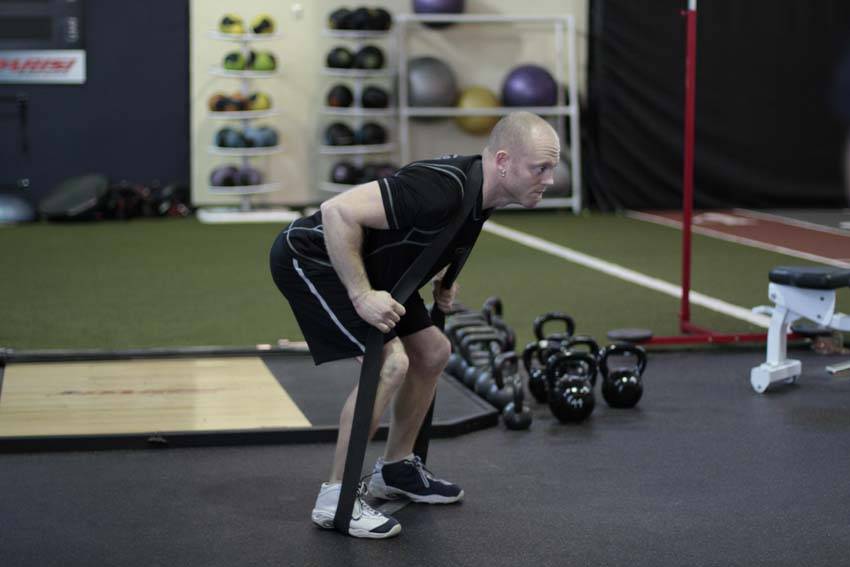
Jijibisha’s Ball Leg Curl provides a strength-focused option using an exercise ball. The Band Good Morning trains the hamstrings and glutes through a hip-hinge pattern.
Hamstring mobility can be useful, but flexibility is only one part of physical preparation.
Training load, sprint exposure, strength, fatigue, recovery, technique, previous injury, and sport demands also matter.
Do not rely on stretching alone as a complete hamstring injury-prevention plan.
Some people with back discomfort also report tight hamstrings, but the relationship is not always simple.
Stretching may feel helpful for one person and irritating for another. Persistent back pain requires a broader assessment rather than assuming the hamstrings are the only cause.
A single session may create a temporary change in range or how the leg feels.
Longer-lasting improvement usually requires repeated practice over time.
The dynamic version uses repeated knee extensions.
Perform it like this:
This version is suitable for warm-ups and mobility practice.
The static version holds the knee near the end of the comfortable range.
Perform it like this:
Static stretching may be more appropriate after training or during a separate flexibility session.
Use the dynamic version when you want to prepare for movement.
Use the static version when your main goal is dedicated flexibility work and you do not need to perform explosive activity immediately afterward.
You can also combine them. Perform several dynamic repetitions first, then finish with a comfortable static hold.
The right amount depends on when and why you are performing the exercise.
| Goal | Sets | Repetitions or hold | Rest |
|---|---|---|---|
| General warm-up | 1 to 2 | 8 to 12 reps per side | Little or no rest |
| Running or sport preparation | 1 to 3 | 10 to 15 reps per side | 15 to 30 seconds |
| Mobility practice | 2 to 3 | 10 to 20 reps per side | 30 to 60 seconds |
| Static flexibility | 2 to 4 | 20 to 30 seconds per side | 15 to 30 seconds |
| Movement break | 1 to 2 | 8 to 10 reps per side | As needed |
Move slowly enough that the thigh and pelvis remain stable.
More repetitions are not useful if the movement becomes rushed or the range changes dramatically.
Many people can perform a gentle version several times per week.
You may also use it daily if:
A harder mobility session with long holds or strong end-range effort may require more recovery than a light warm-up.
Frequency matters less than consistency and sensible intensity. A small amount performed regularly is often more manageable than one aggressive session each week.
Use the dynamic version before exercises such as:
First raise your body temperature with walking, cycling, or another light activity. Then perform controlled mobility exercises that match the workout.
The movement can help prepare the hamstrings for repeated leg extension.
Include it as one part of a complete running warm-up that also contains general movement, ankle preparation, hip mobility, leg swings, and gradual running drills.
Sports involving sprinting, kicking, acceleration, or rapid direction changes place high demands on the hamstrings.
Use controlled repetitions before progressing to faster drills.
A static variation can be used after training if it feels comfortable.
Avoid treating stretching as a requirement for recovery. It is an optional tool for flexibility and relaxation.
The exercise can be combined with hip, ankle, and trunk mobility drills.
This is useful when your goal is to improve movement rather than prepare immediately for intense activity.
Gentle repetitions may provide a useful movement break after sitting for a long period.
Stand and walk briefly first if your body feels especially stiff.
Place the foot of the non-working leg flat on the floor.
This can reduce lower-back arching and make it easier to keep the pelvis stable.
Do not try to straighten as far.
Work within a range where you feel mild tension and can move smoothly.
Allow the working thigh to move a little farther away from the torso.
This reduces the stretch, although the thigh should still remain controlled throughout the repetition.
Support the thigh with your hands closer to the pelvis rather than near the knee.
This may feel more comfortable for your arms and reduce pressure behind the thigh.
Begin with five to eight repetitions per side.
Add more only when the movement feels natural.
Return as soon as you reach a comfortable stretch.
You can add a longer pause later.
Bring the thigh a little closer to your chest while keeping the pelvis down.
This begins the movement with the hamstrings in a more lengthened position.
Make only a small adjustment. Do not pull the thigh as far as possible.
Pause for two to five seconds at the end of each repetition.
Keep the intensity moderate and continue breathing.
Gently dorsiflex the ankle as the knee straightens.
This may increase tension through the calf and back of the leg. Stop if you experience tingling or electrical sensations.
Keeping the non-working leg long may increase the stability demand and make pelvic control more difficult.
Use this only if you can prevent excessive lower-back arching.
After completing the dynamic repetitions, straighten the knee to a comfortable point and hold for 20 to 30 seconds.
At the top, contract the quadriceps and try to straighten the knee slightly farther without using your hands.
The movement may be very small. Do not force it.
Progress based on control rather than chasing a perfectly straight leg.
You do not need to complete every stage. Use the version that supports your current goal.
Straighten the knee to a comfortable position and hold rather than repeating.
This is useful for focused flexibility work.
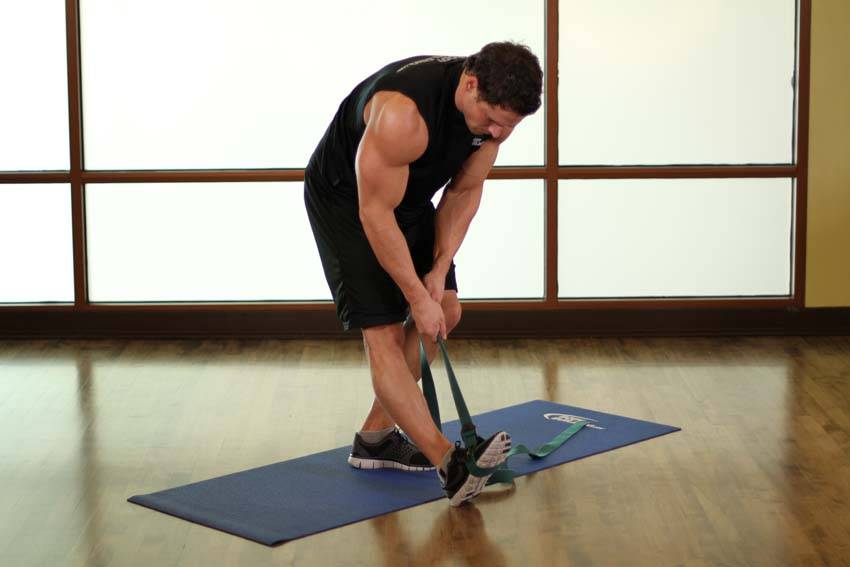
Loop a stretching strap or towel around the foot.
Support the thigh in the same position and use the strap gently to assist knee extension.
Do not pull the leg into pain. The strap should provide light assistance rather than maximum force.
Position the raised thigh near a wall or door frame for support.
This can reduce the effort required from your arms.
Make sure the setup allows you to exit the position easily.
A partner supports the thigh and gradually helps straighten the knee.
Clear communication is essential. The person stretching should control the intensity and be able to stop the movement immediately.
Hold the knee at a comfortable level of extension and slowly point and flex the foot.
This changes tension through the calf and back of the leg.
Use a small range and stop if the movement causes tingling, numbness, or radiating discomfort.
Move into a comfortable stretch, then gently attempt to bend the knee against your hands or a partner’s resistance for several seconds.
Relax and carefully explore a slightly greater range.
This is a more advanced technique. It should remain controlled and should not involve maximal effort.
Both exercises are performed lying on the back and target the hamstrings.
Choose the 90/90 version when you want active mobility. Choose the strap version when you want more support or a longer static hold.
A straight leg raise keeps the knee extended while the entire leg lifts through hip flexion.
The 90/90 hamstring fixes the hip position and creates movement mainly through knee extension.
The 90/90 version may be easier for people who struggle to keep the knee straight while raising the whole leg. It also makes it easier to notice whether the limitation appears during knee extension.
A standing hamstring stretch usually places one heel on the floor or an elevated surface while you hinge forward.
Neither is universally better. Use the position that allows you to feel a controlled hamstring stretch without pain.
The seated toe touch often combines hamstring length with spinal flexion.
People may reach farther by rounding the back rather than changing the hamstrings.
The 90/90 hamstring keeps the torso supported and makes the knee movement easier to observe. It may be a better choice when your goal is to practise hamstring mobility without making forward reaching the main objective.
Leg swings are dynamic warm-up movements performed while standing.
They involve faster hip movement and require balance.
The 90/90 exercise is slower, more supported, and easier to control. It works well early in a warm-up before progressing to larger and faster leg swings.
Mobility and strength exercises serve different purposes.
The 90/90 hamstring helps you explore and improve available range. It does not provide enough resistance to replace strength training.
A balanced hamstring program may include:
Use the Jijibisha routine builder to place mobility and strength exercises in a clear training order.
There are several possible reasons.
Your hamstrings may currently resist further lengthening.
Regular controlled practice may gradually improve your range.
A greater hip angle increases the stretch.
Move the thigh slightly away and try again.
Pulling the toes toward the shin can increase tension through the calf and back of the leg.
Relax the foot and reassess.
If the pelvis tilts or lifts, your body may be compensating for the requested range.
Use a smaller movement and bend the bottom knee.
Moving too quickly or forcing the position can cause the body to resist.
Slow down, breathe, and use less intensity.
The sensation may not come only from muscle.
Tingling, burning, numbness, or an electrical feeling may suggest that sensitive nerve tissue is being placed under tension. Reduce the range and avoid repeatedly forcing through the sensation.
A knee that does not fully straighten during this exercise is not automatically a problem. Your range should be judged in context rather than compared with an ideal image.
A broad pulling sensation near the lower hamstrings can be normal.
The hamstring tendons approach the area behind the knee, and the gastrocnemius also crosses the knee joint.
Reduce the range if the sensation becomes sharp or highly concentrated.
Avoid pressing your hands directly into the crease behind the knee. Support the thigh above the joint.
The calf can contribute to the stretch because the gastrocnemius crosses the knee.
You are more likely to feel the calf when:
Relax your ankle if you want to place more emphasis on the hamstrings.
The lower back may arch when:
Bend the bottom knee and place the foot flat. Gently brace your abdomen and use a smaller range.
Do not force the entire lower back into the floor. Aim for a comfortable, stable position.
Shaking can occur when the quadriceps work near the edge of your active range.
It may also happen because the position is unfamiliar or your muscles are fatigued.
Reduce the range, shorten the hold, and complete fewer repetitions.
Mild shaking is not necessarily dangerous, but the movement should remain controlled. Stop if shaking is accompanied by pain, cramping, weakness, or unusual symptoms.
It can be a useful option for people who want to improve hamstring range of motion.
Its supported position and adjustable range make it accessible for many beginners.
However, the feeling of tightness does not always mean the hamstrings simply need more stretching. Fatigue, weakness, prolonged positioning, training load, nerve sensitivity, and other factors can produce similar sensations.
If stretching provides only brief relief or consistently makes the problem worse, consider a broader approach that includes strength training and professional assessment where appropriate.
The dynamic version can be included in a running warm-up.
Use controlled repetitions rather than long, intense holds. Follow it with movements that gradually become more similar to running, such as:
A single mobility exercise is not a complete running warm-up.
The 90/90 hamstring can help you assess and prepare hamstring range before deadlifts or Romanian deadlifts.
Perform a small number of dynamic repetitions after general movement.
Do not stretch so intensely that the legs feel weak or unusually loose before heavy lifting. Your warm-up should also include hip hinges and progressive practice sets of the lift itself.
The exercise is generally accessible because it is performed on the floor and requires no external load.
Safety still depends on using an appropriate range and responding to your body.
Use extra caution if you have:
People who are pregnant or recently postpartum should seek individualized advice before using unfamiliar stretching positions.
Stop the exercise if you feel sharp pain, tearing, sudden weakness, numbness, tingling, or discomfort that travels down the leg.
The exercise should not be treated as a general cure for sciatica.
Some leg positions used for hamstring stretching can also place tension on the sciatic nerve. This means the movement may feel helpful for one person and aggravating for another.
Do not repeatedly stretch through:
Seek guidance from an appropriate healthcare professional if you have persistent or recurring nerve-related symptoms.
Complete the following after three to five minutes of easy walking, cycling, or jogging.
The 90/90 hamstring appears early because it is controlled and supported. The later movements become progressively more active and specific to training.
Keep the entire session comfortable. Mobility training should not feel like a test of pain tolerance.
The dynamic stretch prepares the range, the strength exercises load the hamstrings, and the final hold provides optional flexibility work.
It primarily stretches the hamstrings at the back of the thigh.
The calf may also be stretched, especially when the knee is straight and the toes are pulled toward the shin. The quadriceps actively straighten the knee.
The raised hip and knee begin at approximately 90-degree angles.
The thigh points generally upward while the shin begins roughly parallel to the floor.
No.
The hamstring version is performed lying on your back and involves straightening the knee. The hip version is performed seated and focuses on hip rotation.
Yes.
Beginners can keep the knee more bent, use fewer repetitions, and bend the bottom leg for additional pelvic support.
No.
Straighten only until you feel a comfortable hamstring stretch while keeping the thigh and pelvis stable.
Begin with the ankle relaxed or neutral.
Pulling the toes toward the shin can increase tension in the calf and back of the leg. Pointing the toes may reduce that tension slightly.
Your lower back should remain comfortable and relatively stable.
You do not need to press it forcefully into the floor. Avoid a large increase in arching as the knee straightens.
Hold the back of the thigh above the knee.
Do not press directly into the knee joint or pull on the lower leg.
A practical starting point is 8 to 15 controlled repetitions per side.
Use one or two sets during a warm-up and two or three sets during a dedicated mobility session.
The standard dynamic version uses only a brief pause.
For a static variation, hold a comfortable position for approximately 20 to 30 seconds.
A gentle version can be performed daily if it does not cause pain or lingering irritation.
Use less intensity on days when the hamstrings are sore or heavily fatigued.
The dynamic version fits well before a workout.
A longer static hold may fit better after training or during a separate mobility session.
Not substantially.
The hamstrings are primarily being stretched. Add loaded knee-flexion and hip-extension exercises when strength is the goal.
It may contribute to a complete preparation program, but it cannot guarantee injury prevention.
Strength, appropriate training load, gradual sprint exposure, recovery, and sport-specific preparation also matter.
Tingling may indicate that the position is placing tension on sensitive nerve tissue rather than only stretching muscle.
Reduce the range, relax the ankle, and stop forcing the movement. Seek professional advice if the symptom persists.
Differences can result from activity, previous injury, training habits, anatomy, or normal side-to-side variation.
Use a controlled range for each side. Do not force the tighter side to match immediately.
Alternatives include:
Choose the variation that allows you to maintain a comfortable position without pain.
The 90/90 hamstring is a simple, controlled way to train hamstring mobility without equipment.
Lie on your back, support one thigh above the hip, and begin with the knee bent. Straighten the knee gradually until you feel comfortable tension along the back of the thigh, pause briefly, then return.
Remember the most important technique points:
Explore more movements in the Jijibisha exercise library, organize mobility and strength work with the routine builder, and track your sessions using the Jijibisha app.
Swap it
Different equipment, same muscle
These movements also target the hamstrings using something else.
Related
Related movements
Get the app
Add it to a routine, record every completed set, and keep the workout saved on your phone even when the gym has no reception.