
Training rhythm
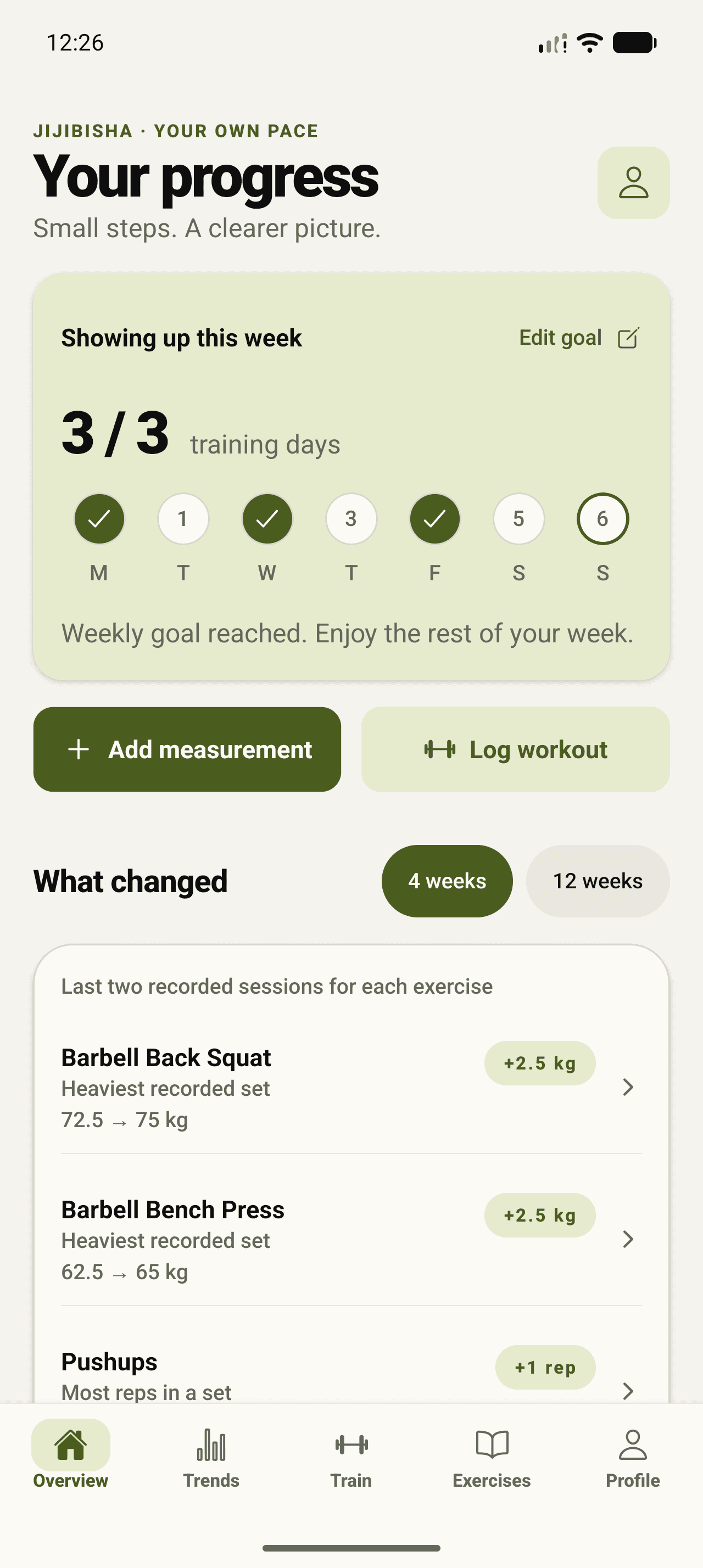
See your training days against your weekly goal. Rest days fit naturally, and two sessions on one day still count as one day of showing up.
Getting your next view ready…
Fitness progress tracker
Your weekly consistency, recent exercise changes, dated measurements and private photos. Start with one entry and build a record you can look back on.
Signals
Five ways to see progress
A personal best matters. So does showing up, completing more quality work, or repeating a load with better control.
See your training days against your weekly goal. Rest days fit naturally, and two sessions on one day still count as one day of showing up.
Weight × reps from your completed working sets, with the calculation kept visible so the number never becomes a mystery.
A labelled front-and-back view built from completed sets, with a clear low-to-high key. It shows history; it does not prescribe.
Compare completed sets, rep performance and estimated strength for a single movement over time.
Save weight, waist, chest, arms and more with dates. Review entries in consistent units and add progress photos when you choose.
Muscle map
Muscle groups trained
The front-and-back map labels the main and supporting muscles used in your completed sets. It reports your history — it does not judge balance or tell you what to train.
| Muscle group | Completed sets | Level |
|---|---|---|
| Quadriceps | 14 | High |
| Chest | 9 | Medium |
| Abdominals | 3 | Low |
Illustrative example. Your dashboard uses only your own completed sets.
Honesty
Know what the numbers mean
Estimated one-rep max and total weight lifted come from the sets you entered. Technique, equipment, fatigue, range of motion and entry accuracy all affect them — so Jijibisha shows the formula rather than a verdict.
Get the app
Add a measurement or record a workout. Your next entry has something real to compare with.