Breathing
Breathe slowly and evenly. Exhale as you ease into a comfortable range, and never use the breath to force a deeper position.
Getting your next view ready…
The Adductor/Groin primarily works the adductors. It is a stretching movement that needs no equipment.
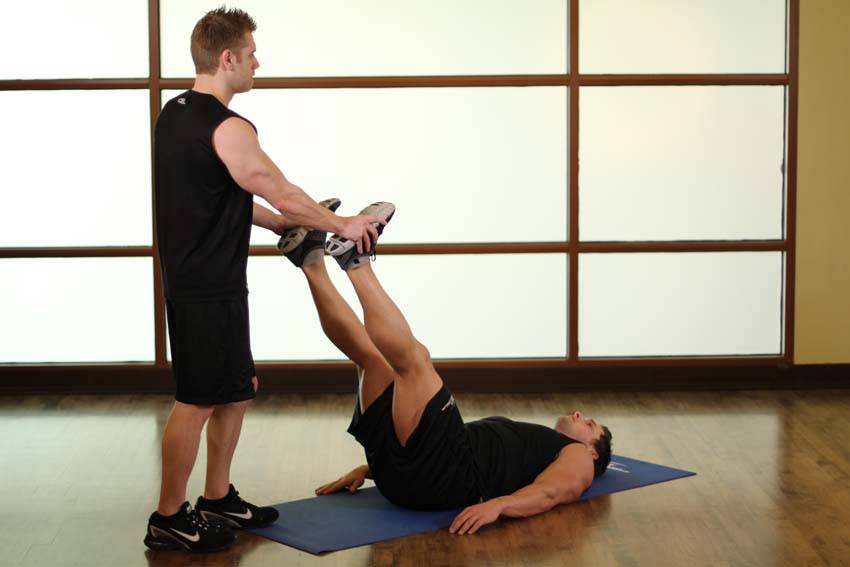
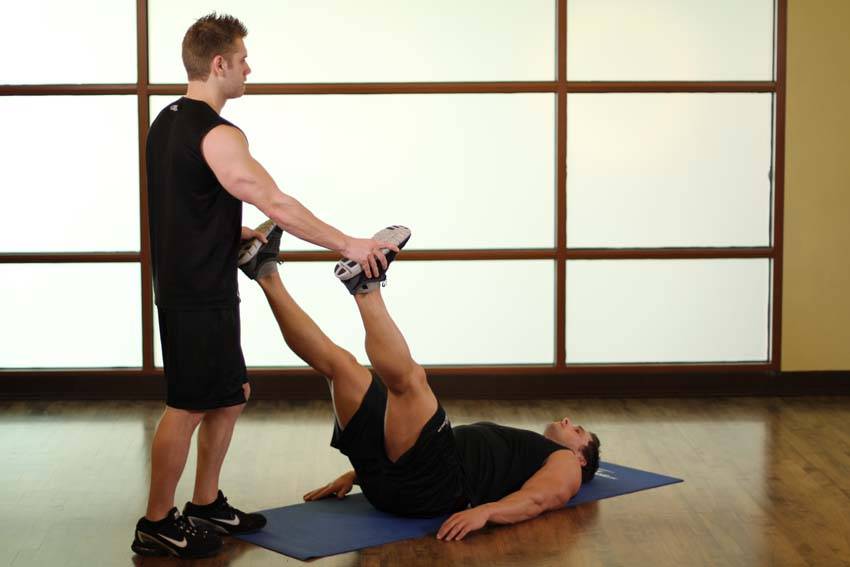 1 / 2
1 / 2How to
Movement instructions
Lie on your back with your feet raised towards the ceiling.
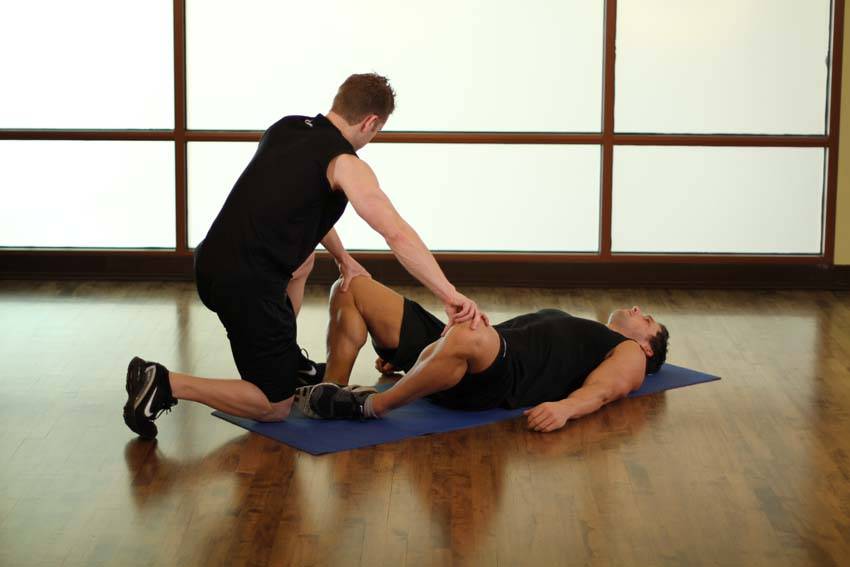
Have your partner hold your feet or ankles. Abduct your legs as far as you can. This will be your starting position.
Attempt to squeeze your legs together for 10 or more seconds, while your partner prevents you from doing so.
Now, relax the muscles in your legs as your partner pushes your feet apart, stretching as far as is comfortable for you. Be sure to let your partner know when the stretch is adequate to prevent overstretching or injury.
Technique guidance
Breathe slowly and evenly. Exhale as you ease into a comfortable range, and never use the breath to force a deeper position.
General guidance based on the exercise and equipment. It is not personal coaching or medical advice.
Your progress
Keep the same exercise variation, range of motion and recording method when comparing Adductor/Groin sessions.
Duration and completed sets.
Example: a 30-second set, followed by a 25-second set. Record the time you completed, not the target.
Review duration alongside your notes about the variation and control. Longer is a recorded result, not an instruction to extend every set.
Read the tracking guideThe examples show how to keep a record. They are not workout targets or a personalised training plan.
See how Jijibisha tracks your progressMuscles
Muscle guide
Adductors is the primary muscle group. The lighter highlights show the supporting muscles involved in the movement.
In depth
The adductor groin stretch is a partner-assisted flexibility exercise that targets the muscles along the inside of the thighs. It combines a controlled inraction, making it different from a standard passive groin stretch.
During the exercise, you lie on your back with your legs raised while a partner supports your ankles or feet. After opening the legs to a comfortable position, you attempt to squeeze them together while your partner prevents movement. You then relax, allowing your partner to guide the legs slightly farther apart.
This contract-relax method is commonly associated with proprioceptive neuromuscular facilitation, usually shortened to PNF stretching. It can be useful for people who want to improve hip abduction range, reduce the feeling of inner-thigh stiffness, or develop greater control near the end of their available range.
Because another person controls part of the movement, communication is essential. The stretch should build gradually and remain within a comfortable range. It should never involve sudden force, bouncing, or pressure that causes sharp groin or hip pain.
The adductor groin stretch is a partner-assisted stretch performed while lying on your back with both legs raised.
Your partner holds your feet or ankles and slowly opens your legs apart. Once you reach a comfortable stretch, you try to bring the legs back together without allowing them to move. Your partner provides enough resistance to create an isometric contraction in the adductors.
After holding the contraction, you relax the inner thighs. Your partner then gently increases the distance between your legs until you reach a new comfortable stretching position.
This sequence can be summarized as:
The exercise may also be called:
These names may describe minor variations, but they usually involve the same basic combination of passive stretching and resisted contraction.
| Detail | Information |
|---|---|
| Primary muscles | Hip adductors |
| Exercise type | Partner-assisted flexibility exercise |
| Technique | Contract-relax or PNF-style stretching |
| Equipment | No equipment, but a partner is required |
| Difficulty | Intermediate |
| Body position | Lying on the back |
| Contraction type | Isometric |
| Main joint action | Hip abduction during the stretch |
| Suggested contraction | 5 to 10 seconds |
| Suggested final stretch | 15 to 30 seconds |
| Suggested rounds | 2 to 4 |
| Best used | After training or during dedicated mobility work |
PNF stretching is a flexibility method that combines stretching with muscular contractions.
Instead of simply holding a muscle in a lengthened position, you contract the target muscles against resistance before relaxing into another stretch. The resistance may come from a partner, strap, wall, or another stable object.
The adductor groin exercise uses a contract-relax pattern:
Regular stretching can improve joint range of motion, and research comparing stretching methods has found that PNF, static stretching, and other structured techniques can all contribute to flexibility gains. The precise reason PNF allows a person to move farther may involve changes in stretch tolerance, muscle activity, and the nervous system's response to the position. stretching is not automatically superior for every person or every goal. Its main advantage is that it provides a structured way to combine muscle activation with passive stretching.
The main targets are the hip adductors, a group of muscles located along the inside of the thigh.
The medial thigh muscles contribute to hip adduction, normal walking mechanics, lower-body control, and stability around the hip and knee. Adductor Longus
The adductor longus is one of the most prominent muscles in the upper inner thigh.
It helps bring the thigh toward the body's centerline and assists with controlling the leg during walking, running, squatting, and changing direction.
Many people feel this stretch strongly through the adductor longus, especially near the upper and middle inner thigh.
The adductor brevis lies underneath the adductor longus.
It assists with hip adduction and contributes to control of the thigh. Because it is a deeper muscle, it cannot be isolated precisely during stretching, but it is lengthened along with the surrounding adductors as the legs open.
The adductor magnus is the largest muscle in the adductor group.
It covers a substantial portion of the inner and back thigh. Different sections of the muscle contribute to hip adduction, hip flexion, and hip extension.
The adductor magnus can work hard during:
A wide-legged stretch can place considerable tension through this muscle, so the position should be increased gradually.
The gracilis is a long muscle that runs from the pelvis to the inside of the lower leg.
Unlike most of the other adductors, it crosses both the hip and knee. It assists with hip adduction and also contributes to knee flexion and rotation.
Keeping the knees straight during the partner-assisted adductor stretch may increase the sensation along the gracilis and the longer inner-thigh tissues.
The pectineus is a smaller muscle located near the upper inner thigh.
It assists with hip adduction and flexion. Pressure or stretching near this region can feel intense, particularly when the legs are opened too quickly.
The goal is to feel a broad stretch along the inner thighs, not a sharp pull directly inside the groin crease.
The adductors are often described simply as the muscles that bring the legs together, but their role is more extensive.
They contribute to:
The adductors are active during everyday movement as well as athletic activities. They are especially important when the body must control side-to-side force.
The most direct purpose of this exercise is to improve flexibility through the inner thighs.
The partner-assisted position allows the legs to open gradually while the upper body remains supported by the floor. This may make it easier to relax than a standing stretch that also requires balance.
Long-term stretch training can produce meaningful improvements in joint range of motion when performed consistently. Uses Active Muscle Contraction
A normal static stretch involves moving into a position and remaining there.
The adductor groin stretch adds an active contraction. When you try to squeeze your legs together, the adductors produce force even though the partner prevents visible movement.
This gives you an opportunity to activate the muscles before relaxing into the next stretch.
A single stretching session can temporarily increase the amount of movement available at a joint.
This may make wide-stance movements or lateral exercises feel more comfortable during the same session. The effect is usually temporary, so the new range should be followed by controlled movement if you want to use it during exercise.
Useful follow-up movements include:
Research indicates that several forms of stretching can create short-term improvements in range of motion. Allows Precise Control of the Stretch
A reliable partner can adjust the position in very small increments.
This can be useful when you find it difficult to relax during unsupported groin stretches. Your partner supports the weight of the legs while you focus on breathing and communicating.
This benefit depends entirely on the partner using patience and control.
Although both legs move at the same time, one inner thigh may feel tighter than the other.
The exercise can help you notice:
Small differences are common. Do not ask your partner to force the more restricted side until it matches the other.
The adductors may feel heavily worked after exercises such as squats, lunges, deadlifts, and lateral movements.
A controlled stretch during the cool-down can help you transition from training into a lower-intensity state. It may also reduce the immediate sensation of stiffness.
Stretching should support recovery rather than replace sleep, nutrition, hydration, and appropriate management of training volume.
Perform the exercise with someone who understands that the stretch must be gradual.
Your partner should be able to:
Do not perform the exercise with someone who treats stretching as a test of pain tolerance.
Lie flat on a mat or comfortable floor.
Keep your head, shoulders, back, and pelvis supported. You may place a thin cushion underneath your head if needed, but avoid a position that pushes the chin excessively toward the chest.
Let your arms rest beside your body or slightly away from it.
Raise both legs toward the ceiling.
Your knees may remain straight or slightly bent. A small bend can make the stretch easier if you have limited hamstring flexibility or difficulty controlling the legs.
Try to keep your pelvis level and your lower back comfortable.
Your partner should stand or kneel near your feet.
They can hold:
Holding closer to the ankles often provides more control than pulling directly from the toes.
Your partner should support the legs without twisting the knees or forcing the feet into an uncomfortable angle.
Allow your partner to guide your legs apart.
Move into hip abduction until you feel a gentle to moderate stretch along the inner thighs.
Stop before you experience:
This is your initial stretching position.
Try to squeeze your legs together while your partner provides resistance.
The legs should not move significantly. You are creating an isometric contraction, which means the muscles produce force without a noticeable change in position.
Use approximately 20 to 50 percent of your maximum effort when learning the exercise.
Hold the contraction for 5 to 10 seconds.
Do not suddenly contract as hard as possible. Build the pressure smoothly over the first second or two.
Stop squeezing and allow the inner thighs to relax.
Take a slow breath. Your partner should maintain the current position without immediately pushing farther.
Pause for approximately 2 to 5 seconds.
Once you have relaxed, your partner can gradually move your legs a little farther apart.
The new position should feel like a controlled increase in tension, not a sudden jump in range.
Hold the stretch for approximately 15 to 30 seconds while breathing normally.
You may repeat the contraction and relaxation cycle two to four times.
Each new position should be only slightly deeper than the previous one.
You do not have to increase the range during every round. If the stretch already feels sufficient, remain at the same angle.
Your partner should bring your legs back together slowly.
Do not let the legs fall inward without support, especially after a long stretch.
Bend the knees and lower the feet to the floor before standing up.
The partner has an important responsibility during this exercise.
Hold both ankles or lower legs with a secure but comfortable grip.
Avoid pulling from only one side or allowing one leg to drop faster than the other.
The person being stretched decides when the position is deep enough.
Ask simple questions such as:
Do not assume silence means the person is comfortable.
During the contraction, provide enough resistance to prevent the legs from closing.
Do not suddenly push the legs farther apart while the adductors are contracting.
Your role during this phase is to hold the position, not overpower the person.
After the contraction ends, pause briefly.
Only increase the stretch after the person has released the muscular effort and confirmed that they are ready.
A few additional degrees of movement may be enough.
The exercise is not a competition to see how close the legs can move toward the floor.
Support the legs as you bring them back toward the center.
The adductors may feel temporarily relaxed after the stretch, so a sudden return can be uncomfortable.
Use these cues throughout the movement:
A maximal contraction is rarely necessary.
For general flexibility work, begin with approximately 20 to 30 percent of your strongest possible squeeze. You can gradually work toward 40 to 60 percent if you have experience with contract-relax stretching and the position remains comfortable.
Using more force does not guarantee a better stretch.
Excessive contraction may cause:
The contraction should feel strong enough to activate the inner thighs but controlled enough that you can stop instantly.
Use a discomfort scale from 0 to 10.
A suitable stretching intensity is often around 3 to 5 out of 10.
At this level:
A stretch intensity of 8 or 9 out of 10 is excessive for most flexibility work.
The goal is not to prove how much discomfort you can tolerate. The goal is to spend controlled time near the edge of your available range.
Breathe slowly throughout the exercise.
During the contraction:
During the final stretch:
Relaxed breathing can help reduce unnecessary tension, but it should not be used to push beyond a safe range.
A practical starting structure is:
Beginners may perform only one or two contraction cycles.
A complete session does not need to last more than a few minutes. The quality of the positioning matters more than accumulating a long stretching duration.
For general flexibility:
For a more experienced flexibility routine:
Avoid repeating the sequence until the inner thighs feel weak or irritated.
The exercise fits best in:
Because the exercise can create a strong stretch and includes a contraction near the end of the available range, it is not always the best first movement of a warm-up.
Begin with light general activity before attempting it.
Suitable preparation may include:
Warm muscles are generally easier to stretch comfortably than muscles exposed immediately to a deep range.
Use caution when performing a long or intense PNF stretch immediately before heavy strength, sprinting, jumping, or explosive sport.
Longer static and PNF stretching performed immediately before activity can temporarily reduce force or power in some situations, particularly when substantial stretching time is accumulated for the same muscle group. Dynamic activity after stretching may reduce this concern. n using the stretch before training:
A pre-workout sequence could be:
After training, you can use a slower and slightly longer version.
The body is already warm, and you do not need to produce maximum force immediately afterward.
A post-workout sequence might include:
A separate mobility session gives you more time to focus on control.
Combine the stretch with:
Stretching can increase the available range. Strength exercises help you control that range.
This is the most serious mistake.
A partner may be able to push the legs farther than you can comfortably control. That does not make the position useful.
The person being stretched must decide the depth.
Squeezing as hard as possible can cause cramping or strain.
Use a moderate, gradually applied contraction. You should remain in complete control.
Rapid movement gives the body little time to adjust.
The partner should open the legs slowly and pause as soon as the person feels sufficient tension.
Bouncing introduces uncontrolled force.
The stretch should remain smooth and stable. Each adjustment should be small and deliberate.
Breath-holding often creates tension through the abdomen, pelvis, shoulders, and neck.
Continue breathing throughout both the contraction and stretching phases.
The lower back should remain comfortable.
If the pelvis rolls or the lower back arches excessively, bend the knees slightly or reduce the leg angle.
The legs should remain in a natural position.
Do not allow the partner to rotate the feet aggressively or place uneven pressure through the knees.
You do not need to move farther during every round.
Sometimes maintaining the same position while reducing the feeling of tension is enough.
A normal stretch may feel different from one side to the other.
Sharp pain on one side, especially near the groin crease, should not be treated as ordinary tightness.
A strong partner-assisted stretch is not suitable for a newly strained adductor.
Muscle strains may cause sudden pain, tenderness, swelling, weakness, bruising, or a popping sensation. A suspected strain should be allowed to heal and may require professional assessment. Beginner Modification
The full partner-assisted version may feel intense for someone with limited inner-thigh flexibility.
Use these modifications:
Beginners can also start with an unassisted exercise such as the groin and back stretch.
Progress by improving control, not by chasing an extreme split position.
Suitable progressions include:
Do not increase contraction intensity, range, duration, and number of rounds at the same time.
Change one variable and observe how the muscles respond.
Yes. Similar positions can be created with straps or a wall, although the exact exercise changes.
Lie on your back with your legs resting against a wall.
Allow the legs to open gradually under their own weight. Use your hands to help bring them back together when the stretch is complete.
This version is passive and does not automatically include the contract-relax phase.
Place a strap around each foot and hold the ends with your hands.
Control the opening of the legs using the straps. You may attempt a light inward squeeze against the resistance before relaxing.
Make sure the straps are secure and do not pull forcefully on the ankles.
Lie on your back, bend the knees, bring the soles of the feet together, and allow the knees to move outward.
This is usually gentler because the knees remain bent.
Sit with the legs apart and hinge forward from the hips.
Keep the spine long and stop before the lower back rounds excessively.
Stretching and strengthening serve different purposes.
The partner-assisted stretch develops tolerance and range in a wide-legged position. Strength exercises teach the adductors to produce and control force.
Useful adductor strengthening exercises include:
A balanced routine may include both.
For example:
Greater flexibility without strength does not guarantee control. Strong adductors without adequate mobility may also limit certain positions.
The adductors contribute to control during deep and wide-stance squats.
The stretch may be useful when the inner thighs feel restrictive, but it should not be used to force a squat stance that does not suit your body.
After stretching:
If squat depth remains limited, other factors may include ankle mobility, hip structure, technique, balance, and strength.
The adductors help control the leg and pelvis during running.
They may experience increased demands during:
The assisted stretch can be included after running or during a mobility session.
It should not be used as the only preparation for running. Before a run, prioritize dynamic movements such as walking lunges, leg swings, light jogging, and gradual accelerations.
Football, rugby, hockey, basketball, and similar sports involve rapid lateral movement and direction changes.
The adductors help decelerate and reposition the legs during these actions.
A suitable mobility and strength routine might include:
Stretching alone does not guarantee protection against groin injuries. Training load, strength, fatigue, previous injury, movement demands, and recovery also matter.
Martial arts often require large ranges of hip abduction for kicking and stance positions.
The assisted adductor stretch may help develop comfort in wider positions, but flexibility should progress gradually.
After stretching, practice active control through:
Passive range should not advance much faster than the ability to control the leg.
Avoid the partner-assisted adductor groin stretch when you have:
Stop immediately if you feel:
Groin pain can have several possible causes and is not always a simple flexibility problem.
It primarily stretches the muscles along the inner thigh, including the adductor longus, adductor brevis, adductor magnus, gracilis, and pectineus.
The exercise uses a contract-relax pattern commonly associated with PNF stretching. You contract the adductors against your partner's resistance, relax, and then move into a slightly deeper stretch.
Start with a 5-second contraction. More experienced users may hold the contraction for 8 to 10 seconds.
Use moderate effort rather than maximum strength. Approximately 20 to 50 percent effort is suitable for most general flexibility sessions.
Hold the final position for approximately 15 to 30 seconds while breathing normally.
Two or three rounds are usually enough. Beginners can start with one round.
You should feel mild to moderate tension along the inner thighs. Sharp, burning, tearing, electrical, or joint-specific pain is not normal.
Gentle stretching may be performed regularly when the muscles respond well. The stronger contract-relax version may not be necessary every day. Reduce the frequency if you experience persistent soreness or irritation.
You can use a brief, moderate version before squats, but follow it with dynamic movements and progressive warm-up sets. Longer or more intense stretching is usually better placed after training or in a separate mobility session.
It may contribute to the hip abduction range required for a side split. Side splits also require gradual training of other tissues, active strength, pelvic control, and consistent practice.
Stretching may improve flexibility, but it does not guarantee injury prevention. Adductor strength, appropriate training progression, recovery, fatigue management, and sport-specific preparation are also important.
Do not assume groin pain is caused by tight muscles. If the pain is persistent, sharp, worsening, or associated with weakness, swelling, bruising, or difficulty walking, seek professional assessment.
Differences in flexibility, previous activity, strength, hip position, and muscle sensitivity can make one side feel tighter. Reduce the range to match the more restricted side instead of forcing it.
The contraction may be too strong, the position may be too deep, or the muscles may already be fatigued. Reduce the stretch, use less effort, and shorten the contraction.
No. A butterfly stretch is usually performed with bent knees and the soles of the feet together. The partner-assisted adductor stretch is performed with the legs raised and opened while the knees are relatively straight.
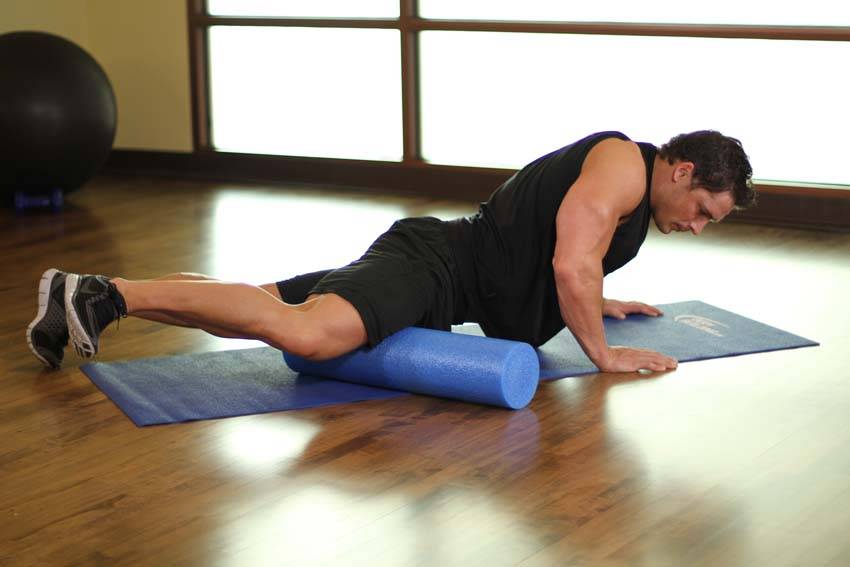
No. The adductor foam roll applies external pressure to the inner thigh. The partner-assisted groin stretch moves the legs apart to lengthen the adductor muscles.
The partner-assisted adductor groin stretch is a controlled flexibility exercise for the muscles along the inner thighs.
Its contract-relax structure makes it more active than a normal passive stretch. You first move into a comfortable range, contract the adductors against resistance, relax, and then allow the partner to increase the stretch slightly.
The method can improve flexibility when practised consistently, but it depends on trust and communication between both people. Your partner should never force the legs apart or treat discomfort as a challenge to overcome.
Use moderate contraction strength, breathe normally, and progress through small increases in range. Combine the stretch with dynamic movement and exercises that strengthen the adductors so that you can control the mobility you develop.
Explore more movements in the Jijibisha exercise library to build a balanced routine for hip mobility, lower-body strength, and long-term training progress.
Swap it
Different equipment, same muscle
These movements also target the adductors using something else.
Related
Related movements
Get the app
Add it to a routine, record every completed set, and keep the workout saved on your phone even when the gym has no reception.