
Strength training
Progressive Overload: How to Keep Getting Stronger
Learn how progressive overload works and how to build strength by adding weight, reps, sets, or better technique without rushing your progress.
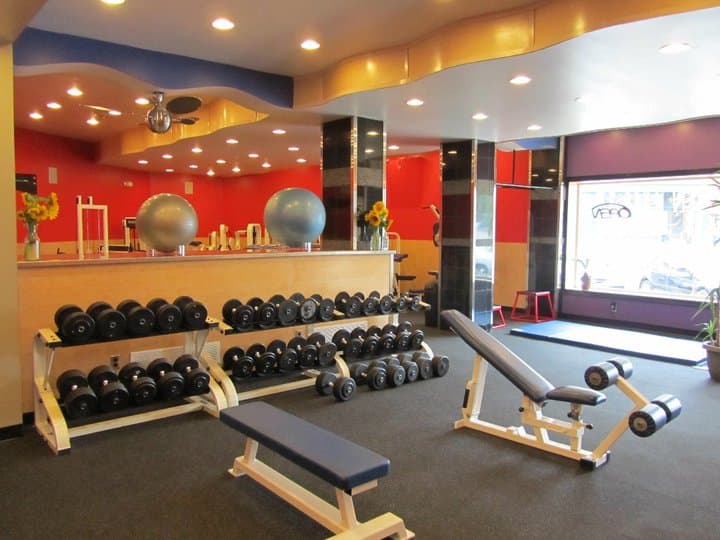
Photo: Bruce Tanner / Wikimedia Commons · Public domain
Most people make quick progress when they first start lifting.
The weights go up. Exercises feel easier. You add repetitions almost every week.
Then progress slows.
You may keep doing the same exercises with the same weight and the same number of repetitions. The workout still feels tiring, but your strength stops improving.
This is where progressive overload matters.
Progressive overload means gradually increasing the challenge placed on your body. You do a little more over time, recover from it, and give your body a reason to adapt.
That does not mean adding weight every time you enter the gym. It also does not mean pushing every set until you cannot move.
Progress can come from lifting more weight, completing more repetitions, improving your technique, increasing your range of motion, or doing more useful work.
The important part is that your training moves forward.
What is progressive overload?
Progressive overload is the gradual increase of training demands over time.
Suppose you can squat 40 kilograms for three sets of eight repetitions. After a few weeks, that same workout may no longer challenge you as much as it did before.
You could make it harder by:
- Squatting 42.5 kilograms
- Doing nine repetitions instead of eight
- Adding another set
- Using a deeper and more controlled squat
- Improving your technique with the same weight
Each option increases the demand in a different way.
Research has found that increasing either the load or the number of repetitions can support strength and muscle growth during the early stages of resistance training. This matters because it shows that adding weight is not the only valid way to progress. c idea is simple:
Train. Recover. Adapt. Then increase the challenge when you are ready.
Why progressive overload works
Your body adapts to the demands you place on it.
A workout that feels difficult today may feel normal after you have repeated it for several weeks. Your muscles, nervous system, movement skills, and work capacity become better prepared for that task.
That adaptation is good. It is the reason you become stronger.
But once your body can comfortably handle a certain level of work, repeating the exact same workout may no longer provide enough reason for further improvement.
Progressive overload keeps the training challenge slightly ahead of your current ability.
The increase does not need to be large. In fact, small increases are often easier to sustain.
You are not trying to overwhelm your body. You are giving it a manageable problem, allowing it to solve that problem, and then making the problem a little harder.
Progressive overload does not always mean lifting heavier
Adding weight is the most obvious form of progressive overload. It is also the one most people focus on.
But it is only one method.
There will be times when you cannot add another plate or move to the next dumbbell. The jump may be too large. You may also need more time to improve your technique before using a heavier weight.
You can still make progress.
1. Add weight
This is the clearest method.
If you can perform all your planned sets and repetitions with good form, add the smallest practical amount of weight.
For example:
- Bench press: 50 kg to 52.5 kg
- Squat: 70 kg to 72.5 kg
- Dumbbell curl: 10 kg to 12 kg, when that is the next available dumbbell
The increase should be small enough that your technique remains stable.
A heavier lift is not real progress when your range of motion becomes shorter, your body position changes, or someone has to help you finish every repetition.
2. Add repetitions
You can perform more repetitions with the same weight.
Suppose you bench press 50 kilograms for three sets of eight repetitions. During the next few weeks, you might progress like this:
- 8, 8, 8
- 9, 8, 8
- 9, 9, 8
- 10, 9, 9
- 10, 10, 10
The weight stayed the same, but your performance improved.
This is progressive overload.
Adding repetitions is especially useful when the next available weight increase feels too large.
3. Add a set
You can increase the amount of work by adding another set.
For example:
- Three sets of squats become four sets.
- Two sets of rows become three sets.
But more is not always better.
Every extra set creates more fatigue and requires more recovery. Add sets when they serve a clear purpose, not because you think every workout must contain more work than the last one.
4. Improve your range of motion
A repetition completed through a fuller, controlled range of motion may be more demanding than a shorter repetition with the same weight.
For example, a shallow squat may allow you to lift more weight. But a deeper squat performed with control may place a greater demand on the working muscles.
The same principle applies to presses, rows, lunges, pull-ups, and many other exercises.
Do not reduce your range of motion just to claim a heavier number.
5. Improve your technique
Better technique can also represent progress.
You may use the same weight and complete the same number of repetitions, but with:
- Better balance
- Less unwanted movement
- More control
- A steadier bar path
- More consistent repetitions
- Better use of the intended muscles
At first, cleaner technique may make an exercise feel harder. That does not mean you became weaker. It may mean you stopped using shortcuts.
6. Use a harder exercise variation
Bodyweight exercises are a good example.
Once regular push-ups become easy, you could move to:
- Feet-elevated push-ups
- Deficit push-ups
- Ring push-ups
- Weighted push-ups
- A slower, more controlled variation
You can progress squats by moving from supported squats to bodyweight squats, split squats, Bulgarian split squats, and eventually weighted versions.
The exact order depends on your current ability and available equipment.
7. Do the same work with less effort
Progress is not always visible as more weight or more repetitions.
A workout may produce less fatigue than before. Your breathing may recover faster. Your technique may stay consistent across every set.
This often shows that your body has adapted.
It may be time to increase the challenge, provided the exercise still feels stable and pain-free.
A simple way to use progressive overload
One of the easiest systems is called double progression.
You choose:
- A fixed number of sets
- A repetition range
- A weight you can control
For example:
Exercise: Dumbbell bench press Sets: 3 Repetition range: 8–12
You keep using the same weight until you can complete all three sets near the top of the range with good form.
Your training log might look like this:
| Week | Set 1 | Set 2 | Set 3 |
|---|---|---|---|
| 1 | 10 | 9 | 8 |
| 2 | 10 | 10 | 9 |
| 3 | 11 | 10 | 10 |
| 4 | 12 | 11 | 10 |
| 5 | 12 | 12 | 12 |
Once you reach 12 repetitions on every set, increase the weight by the smallest available amount.
Your repetitions may drop back to eight or nine. That is normal.
You then repeat the process with the new weight.
This system works well because it removes much of the guessing. You do not add weight because you feel impatient. You add it after your performance shows that you are ready.
How quickly should you increase the weight?
There is no fixed schedule that works for everyone.
A beginner may improve almost every week. An experienced lifter may need several weeks or months to add weight to an exercise.
Progress also varies between exercises.
You may add weight to a squat faster than you add weight to a lateral raise. Large compound movements usually allow larger increases than small isolation exercises.
Use the smallest practical increase when:
- You complete the planned sets and repetitions
- Your form remains consistent
- You are not relying on momentum
- You still control the lowering part of the repetition
- The exercise feels challenging but manageable
Do not increase the weight just because a new week has started.
Your body does not follow your calendar.
How hard should your sets feel?
A useful way to judge effort is to estimate how many good repetitions you had left at the end of a set.
This is called repetitions in reserve, or RIR.
- 3 RIR: You could probably perform three more good repetitions.
- 2 RIR: You could probably perform two more.
- 1 RIR: You could probably perform one more.
- 0 RIR: You could not complete another good repetition.
You do not need to reach complete muscular failure on every set.
Research comparing failure and non-failure training suggests that reaching failure is not required for strength or muscle growth when training is managed well. Training closer to failure may matter more for muscle growth than for strength, but the exact relationship is not perfectly clear. For many main sets, finishing with roughly one to three good repetitions left is a practical target.
Beginners should be careful with these estimates. It takes time to learn what true failure feels like. At first, focus more on stable technique and consistent effort than on judging RIR perfectly.
Progressive overload for strength
If your main goal is strength, you need regular practice with relatively heavy loads.
You still need good technique and enough training volume, but the ability to lift heavy weight improves partly by practising heavy lifting.
Research comparing different weight ranges has found that heavier training tends to improve one-repetition maximum strength more. Muscle growth, however, can occur across a wider range of weights when sets require enough effort. The American College of Sports Medicine's 2026 resistance-training guidance recommends adjusting weight and the amount of training to match the goal. It also stresses that regular training matters more for most people than an overly complicated program.
For strength-focused exercises, progress may look like:
- Adding a small amount of weight
- Performing another repetition with the same weight
- Completing the same weight with better speed or control
- Improving technique under a heavy load
- Completing more high-quality sets
Progressive overload for muscle growth
Building muscle does not require you to test your maximum strength every week.
Muscles can grow through training with different repetition ranges. The sets still need to be challenging, and your total training must gradually move forward.
For muscle growth, progressive overload may come from:
- More repetitions
- More weight
- More productive sets
- Better range of motion
- Better control
- A harder exercise variation
- More consistent training
Do not confuse a harder-feeling workout with a more effective workout.
Drop sets, short rest periods, forced repetitions, and complicated exercise combinations can create a strong burning feeling. But the burn itself does not prove that the workout will produce better results.
Your progress should be measurable.
Progressive overload for beginners
Beginners do not need an advanced system.
Start with a small number of exercises. Learn how to perform them. Record what you do. Then improve one part of your performance at a time.
A beginner could use this process:
- Choose a weight you can control for the planned repetition range.
- Keep the exercise the same for several weeks.
- Try to add one repetition while maintaining good form.
- Once you reach the top of the range on every set, add a small amount of weight.
- Continue from the lower end of the range.
For example:
Goblet squat: 3 sets of 8–12 repetitions
- Workout 1: 10 kg for 8, 8, 8
- Workout 2: 10 kg for 9, 8, 8
- Workout 3: 10 kg for 9, 9, 8
- Workout 4: 10 kg for 10, 9, 9
The progress may look slow when written down.
But those small improvements add up.
Progressive overload with bodyweight exercises
You can use progressive overload without a gym.
Suppose you can perform five push-ups. Your first goal may be to reach six, then seven, and eventually ten.
After regular push-ups become too easy, you can make them harder by:
- Elevating your feet
- Wearing a weighted backpack
- Pausing at the bottom
- Using a larger range of motion
- Moving to a harder variation
- Adding another controlled set
The same approach works for:
- Squats
- Lunges
- Pull-ups
- Dips
- Glute bridges
- Planks
- Calf raises
Bodyweight training becomes difficult to track when you change several things at once. Keep the movement, range of motion, and technique as consistent as possible.
That way, you can tell whether you are actually improving.
Why you should track your workouts
Progressive overload depends on knowing what you did before.
It is difficult to remember the exact weight, repetitions, sets, exercise order, and effort level from every workout.
Without a record, you may spend months repeating similar sessions without a clear direction.
At minimum, record:
- Exercise
- Weight
- Sets
- Repetitions
- Effort or repetitions in reserve
- Any useful notes
Your next workout should then have a simple target.
You might aim to:
- Add one repetition
- Improve one set
- Use a slightly heavier weight
- Perform cleaner repetitions
- Match your previous result with less effort
A workout tracker such as Jijibisha can keep this history in one place. But the tool matters less than the habit. A notebook, spreadsheet, or app can all work.
For a quick check, the training volume calculator compares sets, reps, and load, while the one-rep max calculator turns one technically consistent set into a strength estimate. Neither number replaces your notes about technique, range, and effort.
The important thing is to stop guessing.
What to do when you stop progressing
Progress does not move in a straight line.
You may perform well one week and struggle the next. Sleep, stress, nutrition, illness, exercise order, and normal daily variation can all affect performance.
One poor workout does not mean your program has failed.
But if the same exercise has not improved for several weeks, review the situation.
Check your technique
You may have started with a shorter range of motion or less control. As your technique improved, the same weight became harder.
That is not necessarily a problem.
Compare repetitions honestly. A clean repetition and a rushed repetition are not equal.
Check your recovery
Training creates the need for adaptation. Recovery gives that adaptation a chance to happen.
Ask yourself:
- Am I sleeping enough?
- Am I eating enough to support my goal?
- Am I training the same muscles hard every day?
- Has my stress increased?
- Am I doing more work than I can recover from?
Adding more weight is not always the answer.
Sometimes you need to recover better.
Hold the weight steady
You do not have to increase something every workout.
You may need to repeat the same performance while improving control, confidence, or consistency.
Maintaining your strength during a stressful period can also be a useful result.
Reduce fatigue
If your performance keeps falling, consider reducing the number of sets or using lighter weights for a short period.
This is often called a deload.
A deload is not a punishment. It is a planned reduction in training stress that may help you recover before returning to harder work.
Change the exercise when needed
You should not change exercises every week. That makes progress difficult to measure.
But you also do not need to keep an exercise forever.
Consider replacing it when:
- It consistently causes pain
- Your body structure makes it difficult to perform safely
- Progress has stopped despite reasonable adjustments
- You no longer have access to the equipment
- Another exercise fits your goal better
Keep enough consistency to measure progress, but do not become loyal to an exercise that no longer serves you.
Common progressive overload mistakes
Adding too much weight
Large jumps often cause technique to break down.
Use the smallest increase available. Slower progress is better than pretending to progress with poor repetitions.
Trying to progress every exercise every week
You will not always improve every movement at the same speed.
Some lifts may progress while others stay the same. That is normal.
Changing too many things at once
If you add weight, repetitions, sets, and a new exercise variation at the same time, you will not know what caused the result.
Change one main variable at a time.
Training to failure on every set
Failure can be useful in some situations, but it also creates fatigue.
You do not need to turn every set into a test of willpower.
Save complete failure for exercises and situations where it is appropriate and safe.
Sacrificing technique for numbers
If you add weight but reduce the range of motion, use more momentum, or need help completing every set, the progression may exist only in your training log.
Keep the movement standard consistent.
Doing more work without recovering
More sets and more exercises may create more fatigue without producing more progress.
Your training must fit your ability to recover.
Comparing your progress with someone else
Two people can follow the same program and progress at different speeds.
Training age, body size, exercise technique, sleep, nutrition, stress, and genetics all affect the rate of improvement.
Compare your current performance with your previous performance.
That is the comparison that matters.
Is soreness required for progressive overload?
No.
Muscle soreness can happen after a hard workout, a new exercise, or an unfamiliar movement. But soreness does not measure the quality of a workout.
You can make progress without becoming sore after every session.
And you can become very sore without making useful progress.
Track performance instead.
Are you lifting more? Doing more controlled repetitions? Using a better range of motion? Recovering well enough to repeat the process?
Those questions tell you more than soreness does.
Does every workout need to be better than the last?
No.
Progress should be judged over time, not from one session to the next.
You may repeat the same result for several workouts before improving. You may also have an unusually strong session followed by a normal one.
Look for a trend across several weeks.
A good program creates enough stability for that trend to become visible.
How long does progressive overload take?
You begin applying progressive overload from the start, but visible results take time.
Beginners often progress quickly because almost every part of training is new. As you become stronger, improvements usually become smaller and less frequent.
That does not mean progressive overload has stopped working.
It means you are no longer a beginner.
At that stage, progress may involve:
- One extra repetition
- A small increase in weight
- Better control
- More consistent performance
- A personal best after several weeks of preparation
Small progress is still progress.
Frequently asked questions
What is progressive overload in simple terms?
Progressive overload means gradually making your training more challenging as your body becomes stronger. You can add weight, repetitions, sets, range of motion, control, or exercise difficulty.
Do I need to add weight every week?
No. Add weight when you can complete your target sets and repetitions with stable technique. You can also progress by adding repetitions or improving the quality of the movement.
How much weight should I add?
Use the smallest practical increase that allows you to maintain good form. The right increase depends on the exercise, your strength level, and the equipment available.
Should I train to failure?
Not on every set. Many people can build strength and muscle while ending most working sets with one to three good repetitions left. Failure can be used selectively, especially on safer exercises.
Can beginners use progressive overload?
Yes. Beginners can start by adding repetitions within a fixed range. Once they reach the top of that range with good form, they can increase the weight slightly.
Can I use progressive overload at home?
Yes. You can add repetitions, sets, range of motion, pauses, resistance bands, weighted backpacks, or harder bodyweight variations.
Is doing more repetitions always progressive overload?
Only when the repetitions remain consistent. Extra repetitions performed with a shorter range of motion or worse technique may not represent real progress.
What should I do if I cannot add more weight?
Keep the same weight and add repetitions, improve your technique, increase your range of motion, or use a smaller weight increase if possible.
How do I know whether progressive overload is working?
Track your workouts and review your performance across several weeks. Look for improvements in weight, repetitions, technique, range of motion, work capacity, or effort.
The main point
Progressive overload does not need to be complicated.
Do a little more when you are ready. Keep your technique honest. Record your training. Recover before asking your body to do more again.
You will not improve in every workout. You will have strong days, weak days, and periods when progress feels slow.
That is normal.
What matters is the direction of your training over time.
Train with a clear target. Track what happened. Then use that information to plan the next session.
Train. Track. Become.