Breathing
Exhale as the target muscle shortens against resistance and inhale during the controlled return. Keep breathing steadily throughout the set.
Getting your next view ready…
The Alternate Hammer Curl primarily works the biceps, with the forearms supporting the movement. It is a strength movement performed with dumbbell.
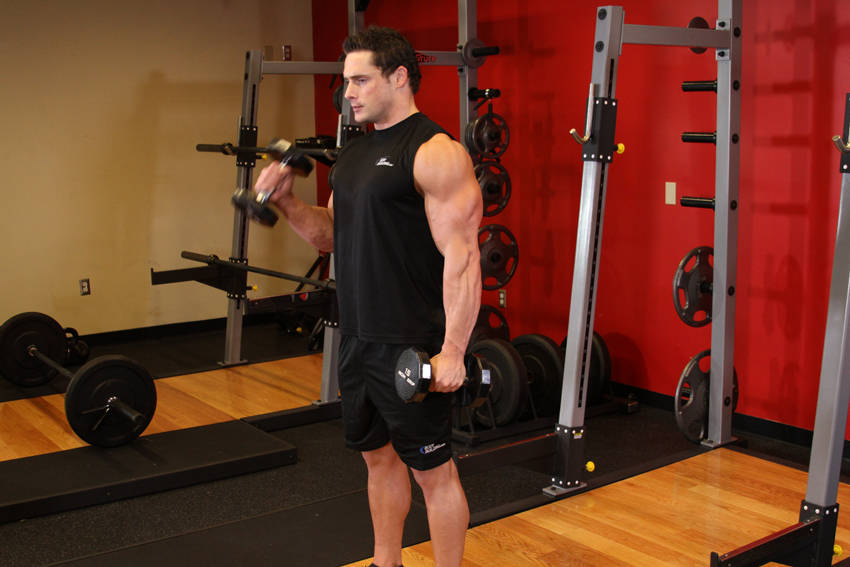
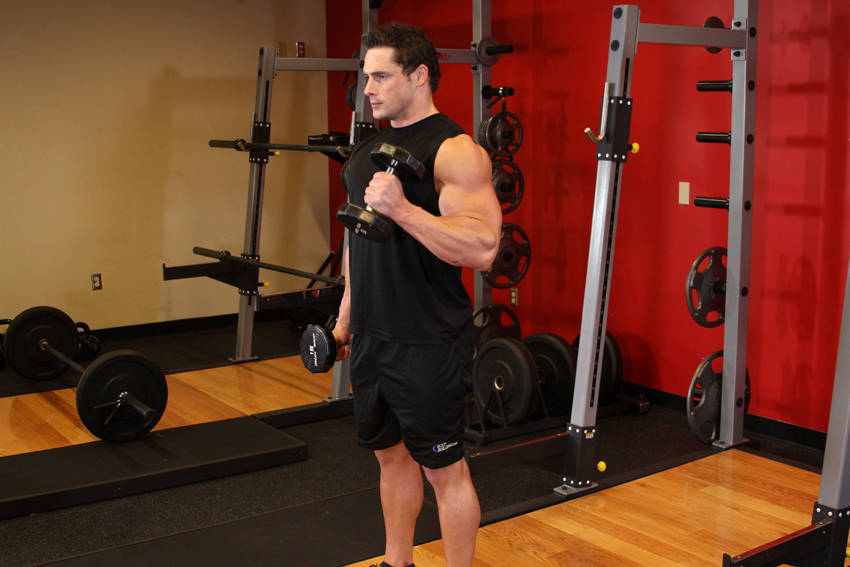 1 / 2
1 / 2How to
Movement instructions
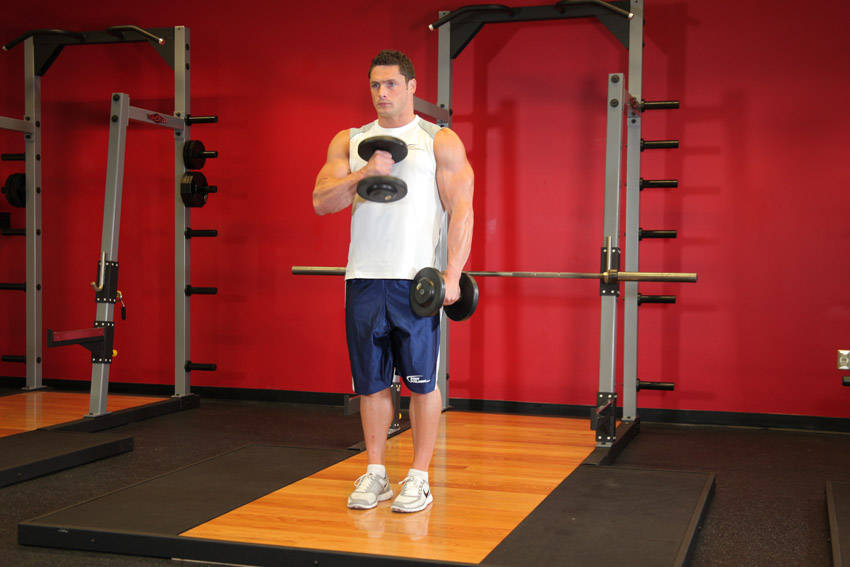
Stand up with your torso upright and a dumbbell in each hand being held at arms length. The elbows should be close to the torso.
The palms of the hands should be facing your torso. This will be your starting position.
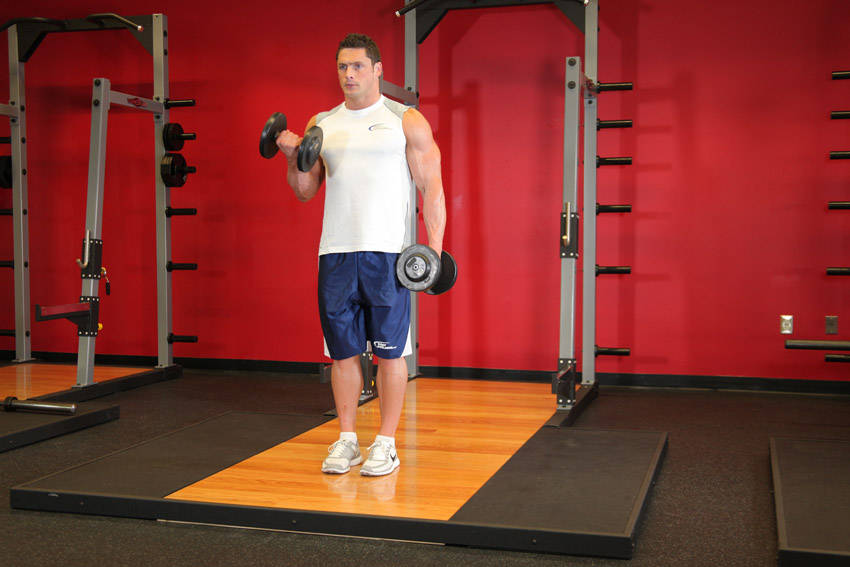
While holding the upper arm stationary, curl the right weight forward while contracting the biceps as you breathe out. Continue the movement until your biceps is fully contracted and the dumbbells are at shoulder level. Hold the contracted position for a second as you squeeze the biceps. Tip: Only the forearms should move.
Slowly begin to bring the dumbbells back to starting position as your breathe in.
Repeat the movement with the left hand. This equals one repetition.
Continue alternating in this manner for the recommended amount of repetitions.
Technique guidance
Exhale as the target muscle shortens against resistance and inhale during the controlled return. Keep breathing steadily throughout the set.
General guidance based on the exercise and equipment. It is not personal coaching or medical advice.
Your progress
Keep the same dumbbell setup, range of motion and recording method when comparing Alternate Hammer Curl sessions.
Weight, repetitions and completed sets.
Example: 3 sets of 8 reps at 30 kg. Next time, record the actual result, even if it is the same.
Look for more repetitions at the same weight, or a heavier weight for comparable repetitions. Total weight lifted also changes when you add sets, so it is not a strength score.
Read the tracking guideThe examples show how to keep a record. They are not workout targets or a personalised training plan.
See how Jijibisha tracks your progressMuscles
Muscle guide
Biceps is the primary muscle group. The lighter highlights show the supporting muscles involved in the movement.
In depth
The alternate hammer curl is a dumbbell exercise for building the upper arms and forearms. It is performed by curling one dumbbell at a time while keeping the palms facing inward, similar to the way you would hold a hammer.
This neutral hand position distinguishes the movement from a traditional dumbbell curl, where the palms usually turn upward. Keeping the forearms neutral changes how the elbow flexors share the work and places considerable demand on the brachialis and brachioradialis alongside the biceps brachii.
Alternating sides also allows you to concentrate on one arm at a time. You can monitor your elbow position, wrist alignment, range of motion, and control more easily than when both dumbbells move together.
The exercise is simple enough for beginners, but it remains useful for experienced lifters. It can be added to an arm workout, pull day, upper-body session, or full-body program. The main requirement is a pair of dumbbells and enough discipline to avoid swinging weights that are too heavy.
The alternate hammer curl, also called the alternating hammer curl or alternating dumbbell hammer curl, is a single-joint resistance exercise based on elbow flexion.
You stand or sit with a dumbbell in each hand and your palms facing your thighs. Without rotating the wrist, you bend one elbow and raise the dumbbell toward the same-side shoulder. You then lower it under control and repeat the movement with the opposite arm.
The exercise gets its name from the hand position. Your thumb remains above your fingers as though you were holding the handle of a hammer.
The main movement occurs at the elbow. Your upper arm should remain close to your torso while the forearm moves through the repetition. The shoulders, hips, and lower back should remain relatively still.
One complete right-and-left cycle is sometimes counted as one repetition. Other workout programs count each individual curl as one repetition. Either approach can work, but you should use the same counting method every time you record the exercise.
| Category | Details |
|---|---|
| Primary movement | Elbow flexion |
| Main muscles involved | Biceps brachii, brachialis and brachioradialis |
| Supporting muscles | Forearm flexors, grip muscles and core stabilizers |
| Equipment | Two dumbbells |
| Difficulty | Beginner |
| Exercise type | Isolation exercise |
| Grip | Neutral grip with palms facing inward |
| Repetition style | One arm at a time |
| Typical rep range | 8 to 15 repetitions per arm |
| Best used for | Arm size, elbow-flexor strength and forearm development |
| Main technique priority | Keep the torso and upper arms controlled |
The alternate hammer curl trains several muscles that bend the elbow. The amount each muscle contributes can change depending on your grip, elbow angle, load, lifting speed, and individual anatomy.
The biceps brachii is the prominent two-headed muscle on the front of the upper arm.
Its main functions include bending the elbow and rotating the forearm so the palm faces upward. Because the forearm remains neutral during a hammer curl, the biceps does not perform the same amount of active forearm rotation that it performs during a fully supinated curl.
The biceps still contributes strongly to elbow flexion. It does not switch off simply because your palms face inward.
Both the long head and short head participate in the exercise. The exact sensation may vary depending on your shoulder position and whether your elbow remains beside your torso or moves forward.
The brachialis is located underneath the biceps brachii.
It attaches to the upper-arm bone and forearm and acts as a powerful elbow flexor. Unlike the biceps brachii, its ability to bend the elbow is not dependent on rotating the forearm into a palms-up position.
The neutral grip used during hammer curls makes the brachialis an important contributor to the movement.
Developing the brachialis can add thickness to the upper arm, particularly when viewed from the side. However, no exercise can completely isolate it from the other elbow flexors.
The brachioradialis is a large forearm muscle that runs from the upper arm toward the thumb side of the forearm.
It assists with elbow flexion and is strongly involved when the forearm is held in a neutral or partially pronated position.
Many people feel hammer curls through the upper outer forearm because of the brachioradialis. Its involvement is one reason the exercise is often used to train both the upper arms and forearms.
The muscles that control your fingers and wrist must maintain a secure hold on the dumbbell.
They work isometrically throughout the set, meaning they create tension without producing the main curling motion.
Your forearms may fatigue before your upper arms when your grip strength is limited or when you use thick-handled dumbbells.
The wrist flexors and extensors work together to keep your wrist aligned with your forearm.
A stable wrist allows force to transfer efficiently between your hand and elbow. Letting the wrist bend backward or forward can reduce control and create unnecessary discomfort.
The front portion of the shoulder may assist slightly, particularly if the elbow moves forward near the top of the repetition.
Some forward elbow movement can occur naturally, but excessive shoulder flexion turns the exercise into a partial front raise.
Your abdominal muscles, spinal erectors, glutes, and upper-back muscles stabilize your torso during standing hammer curls.
They should prevent you from leaning backward, twisting, or swinging the dumbbells. These muscles support the exercise, but they should not create the main movement.
Alternate hammer curls train the biceps brachii and brachialis, both of which contribute to upper-arm size.
The movement complements palms-up curl variations by training elbow flexion from a different forearm position.
A balanced arm program can include both neutral-grip curls and supinated curls rather than relying on only one variation.
The brachialis is often overlooked because it lies beneath the biceps.
Hammer curls provide a practical way to train this muscle through loaded elbow flexion without requiring complicated equipment or technique.
Increasing brachialis size can contribute to greater overall arm thickness.
The neutral grip places substantial demand on the brachioradialis.
This can improve the muscular development of the upper forearm and strengthen elbow flexion in a neutral hand position.
The exercise can be useful for lifters whose upper arms are developing faster than their forearms.
Holding a dumbbell securely during every repetition challenges the hands and forearms.
Grip strength is not the main purpose of the exercise, but it receives useful secondary work.
Stronger gripping muscles can support rows, pull-ups, deadlifts, loaded carries, and other pulling exercises.
Alternating repetitions make it easier to focus on the working arm.
You can watch whether the elbow moves, feel the target muscles contract, and correct wrist position before switching sides.
This can be helpful when one arm is less coordinated than the other.
Because each arm performs independently, the stronger side cannot directly lift the dumbbell for the weaker side.
You may notice differences in repetition speed, control, range of motion, or fatigue.
Use the same weight on both sides and allow the weaker arm to determine the number of clean repetitions.
Some people find the neutral grip more comfortable than holding a straight bar or maintaining a fully palms-up position.
The wrist remains in a natural alignment with the forearm, which may feel easier during curling.
Comfort varies between individuals. A neutral grip is not guaranteed to be pain-free, especially when the weight is too heavy or an existing wrist or elbow problem is present.
You only need two dumbbells.
Alternate hammer curls can be performed in a commercial gym, home gym, hotel gym, or any training space with suitable weights.
Adjustable dumbbells are sufficient when you do not have access to a complete rack.
The exercise can fit into:
It is usually performed after larger compound pulling exercises, although it can also be used earlier when arm strength is the main training priority.
Choose two dumbbells that you can control for your full planned repetition range.
The correct weight should allow you to curl without leaning backward, swinging your hips, shrugging your shoulders, or bending your wrists.
Start lighter than you think you need when learning the movement.
Stand with your feet approximately hip-width to shoulder-width apart.
Keep your weight distributed evenly through both feet. Your knees can remain straight without being forcefully locked.
Tighten your glutes and abdominal muscles lightly to create a stable base.
Hold one dumbbell in each hand with your arms extended beside your torso.
Your palms should face inward toward your thighs. Keep your thumbs pointing forward and your wrists aligned with your forearms.
Allow your shoulders to settle into a comfortable position rather than aggressively pulling them backward.
Keep your elbows near your ribs.
They do not need to be squeezed painfully against your sides. Leave enough space for your arms to move naturally without allowing the elbows to flare outward.
Your upper arms should remain mostly vertical.
Keep your chest comfortably lifted and your ribs controlled.
Avoid exaggerating the arch in your lower back. Look forward and keep your neck in a neutral position.
Your body should remain tall and steady throughout the repetition.
Bend your right elbow and raise the dumbbell toward your right shoulder.
Keep the palm facing inward throughout the movement. Do not rotate into a palms-up curl unless you are intentionally performing a different variation.
Move the dumbbell in a smooth path rather than throwing it upward.
As the dumbbell rises, keep your right upper arm close to your torso.
A small amount of forward elbow movement near the top may occur, but it should not become the main action.
Stop before your shoulder rolls forward or your elbow travels far in front of your body.
Curl until your forearm approaches your upper arm or until further movement would require your elbow to move excessively.
The dumbbell does not need to touch your shoulder.
Pause briefly and contract the muscles on the front of your upper arm. Keep your wrist straight during the pause.
Extend your elbow and lower the dumbbell back toward your side.
Take approximately two to three seconds to control the lowering phase.
Do not let the weight drop freely. Maintain muscular tension until the arm reaches the bottom position.
Finish with your arm almost or fully straight, depending on what feels comfortable for your elbow.
Avoid forcefully snapping the joint into lockout.
Allow the working arm to settle without relaxing your entire posture.
Curl the left dumbbell using the same technique.
Keep the right arm still while the left arm works. Do not use the resting arm to create momentum.
Continue alternating sides until you complete the planned repetitions.
After the final repetition, hold both dumbbells securely at your sides.
Place them on the floor or rack by bending your hips and knees rather than dropping them.
Use this checklist during your working sets:
Try one or two of these cues during the exercise:
The best cue is the one that corrects your main mistake. Trying to remember every cue during one set can make a simple exercise unnecessarily confusing.
Exhale as you curl the dumbbell upward.
Inhale as you lower it back to the starting position.
A simple pattern is:
You do not need to forcefully empty your lungs on every repetition. The goal is steady breathing while maintaining enough abdominal tension to keep your torso stable.
Avoid holding your breath through a long set. Breath-holding can increase unnecessary tension and may make you feel lightheaded.
There are two common counting methods.
One curl with the right arm counts as one repetition for the right side. One curl with the left arm counts as one repetition for the left side.
A prescription of 10 repetitions per arm therefore includes 20 individual curls.
This is the clearest method for workout tracking.
Curling the right arm and then the left arm counts as one complete repetition.
A set of 10 repetitions includes 10 curls per arm.
This method is common in some exercise databases and workout plans.
Neither method is wrong. Problems occur only when you change counting methods and mistakenly double or halve your training volume.
When logging the exercise, write the target as “10 per arm” to remove uncertainty.
Swinging often begins when the dumbbells are too heavy or when you continue the set beyond technical failure.
The hips move forward, the shoulders lean backward, and momentum launches the dumbbell through the hardest part of the curl.
Reduce the weight and tighten your glutes and abdominal muscles. You can also perform the exercise with your back against a wall to learn stricter form.
Leaning backward shortens the effective range of the curl and places unnecessary demand on the lower back.
Stay tall and keep your rib cage stacked over your pelvis.
If every repetition requires a backward lean, the weight is too heavy.
Some elbow movement is not automatically dangerous, but allowing the elbow to travel far forward turns the final part of the curl into shoulder flexion.
Keep the upper arm controlled and stop the repetition when the forearm reaches a strong top position.
Do not force the dumbbell all the way to your shoulder.
When the elbows move away from the torso, the movement becomes less stable and the dumbbells may travel unpredictably.
Keep the elbows pointed generally toward the floor and close to your ribs.
Use a weight that does not pull your arms outward.
Turning the palm upward changes the exercise toward a traditional dumbbell curl.
This is not necessarily harmful, but it removes the consistent neutral grip that defines the hammer curl.
Keep your thumbs above your fingers and your palms facing inward from bottom to top.
Allowing the wrist to bend backward can create discomfort and reduce force transfer.
Keep your knuckles, wrist, and forearm in a straight line.
Do not try to lift the dumbbell higher by curling the hand toward the shoulder.
A weak grip allows the dumbbell to shift in your hand and makes wrist control more difficult.
Hold the handle securely without squeezing so hard that your forearms fatigue immediately.
The opposite problem is gripping with maximum effort throughout every repetition.
This may cause your forearms to fail before the elbow flexors receive enough work.
Use a firm, controlled grip rather than attempting to crush the dumbbell.
The shoulders may rise toward the ears when the weight becomes difficult.
Keep your neck long and your shoulders stable.
Do not turn the curl into a shrug.
Some people begin alternating but gradually move both dumbbells at once as fatigue increases.
Decide whether you are performing alternating or simultaneous hammer curls before the set.
Keep the resting arm still until the working arm finishes.
Allowing the dumbbell to press against the thigh between repetitions reduces muscular tension and can create momentum for the next curl.
Keep the weight controlled at your side without deliberately bouncing it off your leg.
Partial repetitions can be used intentionally, but repeatedly avoiding the lower position reduces the available range of motion.
Lower the dumbbell until the elbow reaches a comfortable near-straight position.
Do not shorten every repetition simply to use more weight.
Reaching a long position is useful, but snapping the elbow into lockout is unnecessary.
Finish the lowering phase smoothly and maintain control around the joint.
The lowering phase is part of the exercise.
Allowing gravity to pull the dumbbell down removes muscular work and can strain your control at the bottom.
Lower each dumbbell deliberately.
Your dominant arm may use a larger range or faster speed.
Watch both arms and allow the weaker side to set the standard.
Do not give the stronger arm extra repetitions unless your program has a specific reason for doing so.
Rushing from side to side can raise your heart rate, but it often reduces control.
Alternate hammer curls are primarily a strength and muscle-building exercise. Use a steady pace that allows each arm to complete a full repetition.
Use a dumbbell weight that allows you to complete the planned repetitions without swinging, leaning, twisting, or bending your wrists.
The final repetitions should feel difficult, but they should still resemble the first repetitions.
A suitable weight allows you to:
Beginners should prioritize technique over load.
Experienced lifters can use heavier dumbbells, but the weight should not transform the exercise into a full-body movement.
There is no universal starting weight. Strength, body size, training history, dumbbell design, and repetition target all affect what is appropriate.
Alternate hammer curls work well across a range of repetition targets.
| Goal | Sets | Repetitions | Rest |
|---|---|---|---|
| Learning technique | 2 to 3 | 8 to 12 per arm | 60 to 90 seconds |
| Muscle growth | 3 to 4 | 8 to 15 per arm | 60 to 120 seconds |
| Heavier arm training | 3 to 5 | 6 to 10 per arm | 90 to 150 seconds |
| Muscular endurance | 2 to 4 | 15 to 20 per arm | 45 to 90 seconds |
| Arm finisher | 2 to 3 | 12 to 20 per arm | 30 to 60 seconds |
These ranges are practical starting points rather than rigid rules.
Muscle growth can occur across different repetition ranges when the weight is challenging, technique remains controlled, and the total program allows recovery.
For most lifters, sets of 8 to 15 repetitions per arm provide a useful balance between load, control, and training volume.
You do not need to reach complete failure during every set.
A practical approach is to end most sets when you believe you could complete one to three additional clean repetitions.
This leaves approximately one to three repetitions in reserve.
Stopping before uncontrolled failure can help you:
Occasionally training closer to failure can be appropriate, particularly during the final set of an isolation exercise.
The set should still end when you can no longer perform another repetition without changing your body position.
A controlled tempo makes alternate hammer curls more effective and easier to evaluate.
Try the following:
The exact timing is less important than maintaining control.
Avoid using an extremely slow tempo if it forces you to use a weight too light to provide a meaningful challenge. Avoid moving so quickly that momentum performs most of the repetition.
There are several ways to alternate the dumbbells.
Curl and lower the right dumbbell completely. Then begin the left repetition.
This style provides a brief rest for each arm and makes it easy to concentrate on technique.
It is the most straightforward option for beginners.
Start curling the left dumbbell while the right dumbbell is descending.
This creates a continuous alternating rhythm and reduces total set duration.
It also requires more coordination and constant torso control.
Curl one dumbbell and keep it near the top while the other arm completes repetitions.
This creates an isometric challenge for the holding arm.
It is considerably harder and should be treated as a separate advanced variation.
Keep one elbow bent at approximately 90 degrees while the opposite arm curls.
Switch roles after the planned repetitions.
This increases time under tension but usually requires lighter dumbbells.
The standing variation allows a natural arm path and is easy to set up.
It requires your core, glutes, and legs to stabilize your body. It also creates more opportunity to swing or lean backward.
Choose the standing version when you can maintain a strict torso position.
The seated version reduces the contribution of the legs and can make body swinging more obvious.
Sitting on a bench with back support may help people who struggle to control their lower back.
However, you can still lean, shrug, or move the elbows excessively while seated.
Neither variation guarantees perfect form. Choose the position in which you can control the dumbbells comfortably.
The exercises use the same neutral grip and elbow-flexion movement.
The main difference is repetition timing.
| Alternate hammer curl | Simultaneous hammer curl |
|---|---|
| One arm works at a time | Both arms work together |
| Easier to focus on each side | More time-efficient |
| Each arm receives a brief rest | Both arms fatigue together |
| Helps reveal side differences | Requires greater total-body stability |
| Sets usually take longer | Sets usually finish faster |
| May allow slightly heavier dumbbells | May create greater cardiovascular demand |
Both variations can build the upper arms and forearms.
Use alternating curls when individual control is the priority. Use simultaneous curls when you want both arms working together or need to complete the set more quickly.
The main difference is the forearm position.
During a hammer curl, your palms face each other. During a traditional dumbbell curl, your palms face upward or rotate upward as the weight rises.
| Alternate hammer curl | Dumbbell bicep curl |
|---|---|
| Neutral grip | Supinated grip |
| Strong brachialis and brachioradialis contribution | Greater emphasis on the biceps’ supination role |
| Often feels natural at the wrist | Requires comfortable palms-up rotation |
| Builds upper-arm and forearm thickness | Commonly used for direct biceps training |
| Thumb points upward | Palm faces upward |
A complete arm program can include both.
For example, you might perform a palms-up curl earlier in the session and alternate hammer curls afterward.
A reverse curl uses a pronated grip with the palms facing downward.
This position generally reduces the amount of weight most people can lift and places a strong demand on the forearms and brachioradialis.
The hammer curl uses a neutral grip and is usually more comfortable and stronger.
| Alternate hammer curl | Reverse curl |
|---|---|
| Palms face inward | Palms face downward |
| Neutral wrist position | Pronated forearm position |
| Usually allows more weight | Usually requires less weight |
| Trains biceps, brachialis and brachioradialis | Strong forearm and brachioradialis demand |
| Commonly performed with dumbbells | Often performed with an EZ bar or barbell |
Both can be useful, but they do not need to appear in every workout.
The standard alternate hammer curl moves the dumbbell upward toward the same-side shoulder.
The cross-body version moves the dumbbell diagonally toward the opposite side of the chest or shoulder.
The cross-body path changes the arm position and may make the brachioradialis feel more noticeable.
Use the standard version when you want a simple vertical curl path. Use the cross-body variation when you want variety or find the diagonal path more comfortable.
Do not let the torso rotate to meet the dumbbell during cross-body curls.
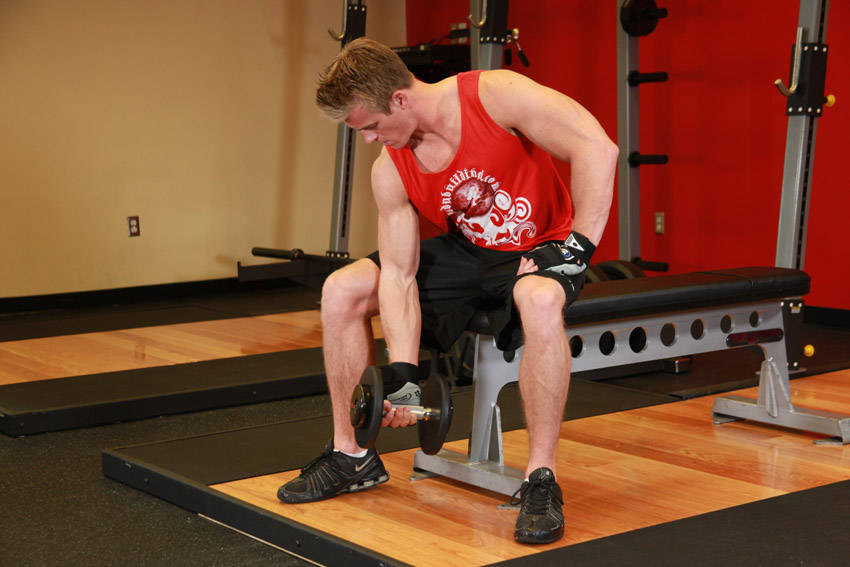
The concentration curl is usually performed seated with the working elbow supported against the inner thigh.
It uses a palms-up grip and minimizes body movement.
The alternate hammer curl is performed with both dumbbells and uses a neutral grip.
| Alternate hammer curl | Concentration curl |
|---|---|
| Neutral grip | Supinated grip |
| Alternates between both arms | Usually completes one arm at a time |
| Brachialis and forearm involvement | Direct focus on the biceps |
| Standing or seated | Usually seated |
| No elbow support | Elbow braced against the thigh |
| Faster to train both arms | Allows strong one-arm concentration |
Neither exercise is inherently superior. They simply provide different positions and loading options.
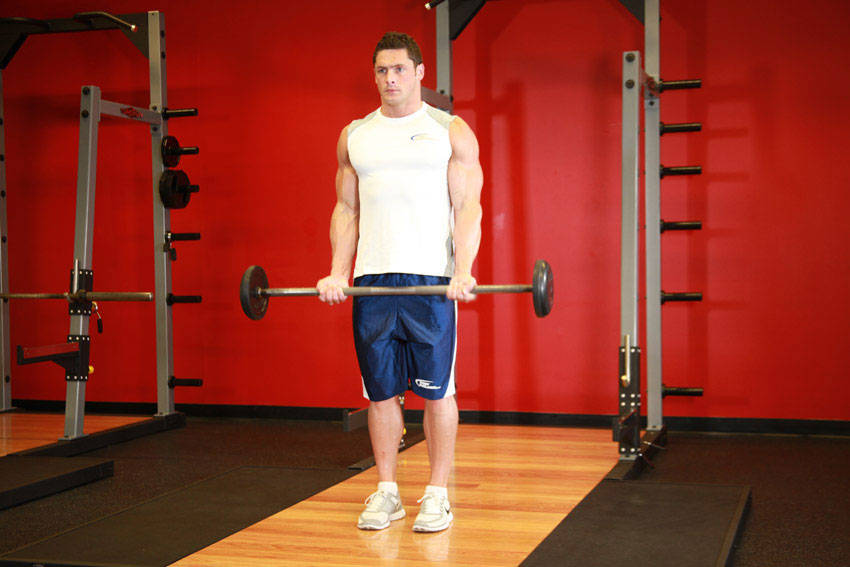
The barbell curl trains both arms with a fixed bar.
It usually allows more total load, but both hands must use the same grip width and forearm position.
Alternate hammer curls allow each arm to move independently and maintain a neutral grip.
The Barbell Curl may be useful as a heavier bilateral movement, while alternate hammer curls can provide additional unilateral work afterward.
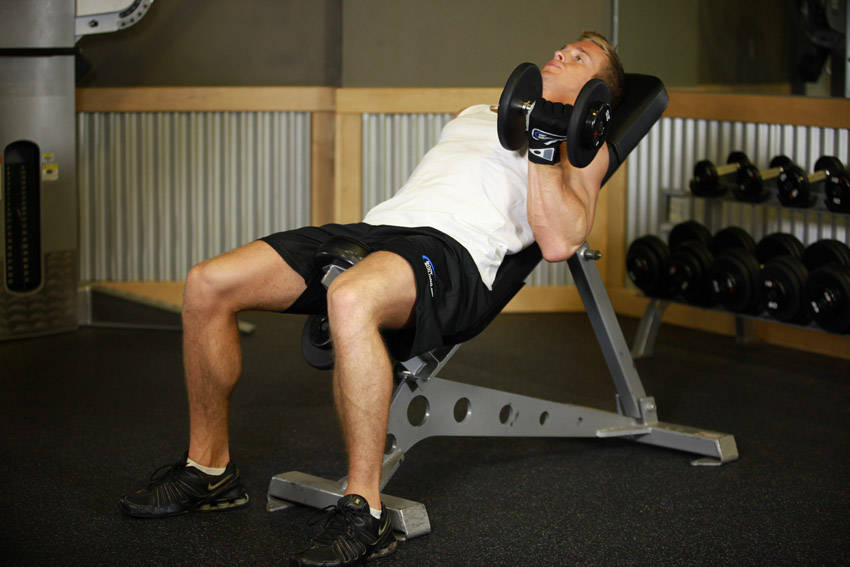
The incline dumbbell curl is performed while lying back on an inclined bench with the arms hanging behind the torso.
This position places the shoulder in extension and can create a strong stretch through the biceps.
Alternate hammer curls keep the arms closer to the sides and use a neutral grip.
The Alternate Incline Dumbbell Curl can complement hammer curls when you want to train the elbow flexors from a different shoulder position.
Sit on a bench and perform the same alternating movement.
This reduces the opportunity to generate momentum through the legs.
Sit against an upright bench.
Keep your head, upper back, and hips in contact with the pad while curling.
This can help reduce backward leaning.
Curl each dumbbell toward the opposite side of your upper chest.
Keep your torso facing forward.
Lie back on an incline bench with your arms hanging beside and slightly behind your torso.
Use lighter weights because the bottom position can be demanding.
Perform neutral-grip curls with the upper arm supported on a preacher bench.
Dumbbells, a rope attachment, or a suitable machine may be used.
Avoid forcefully locking the elbows at the bottom.
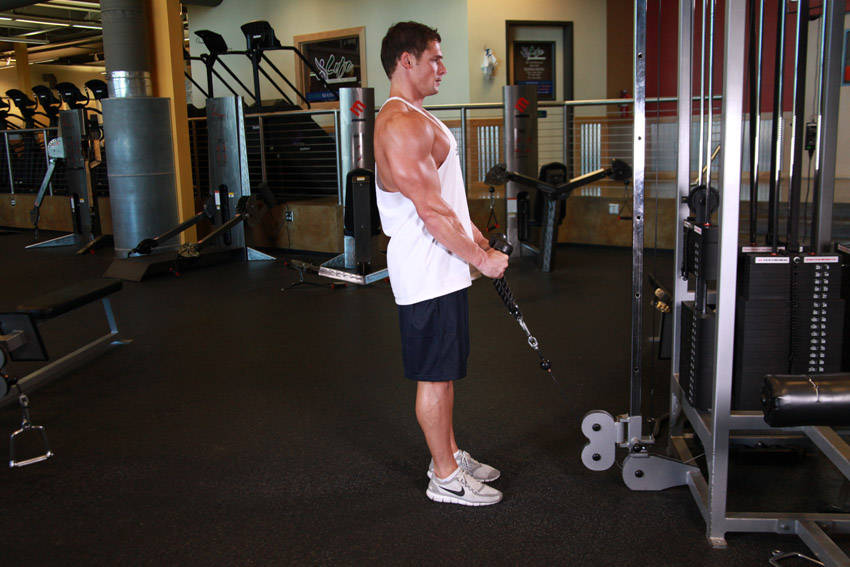
Attach a rope to a low cable pulley.
Hold one end in each hand and curl while keeping the palms facing each other.
Cable resistance provides continuous tension throughout the movement.
Use a single rope end or neutral-grip handle.
Complete one arm at a time with the cable providing a consistent resistance path.
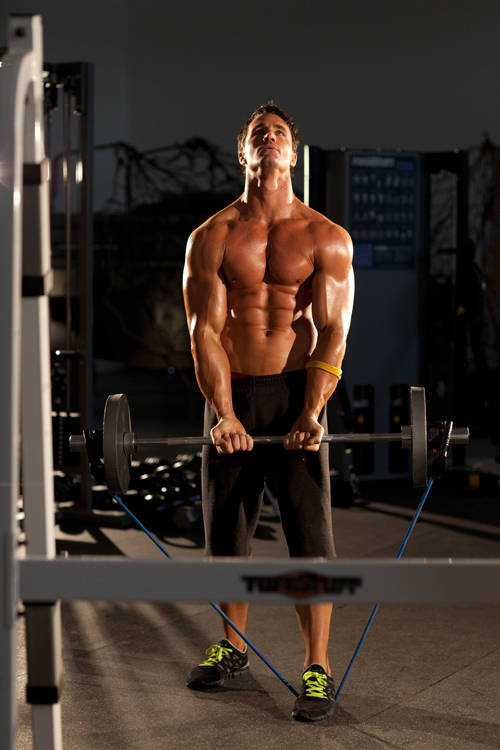
Stand on a resistance band and hold the ends with a neutral grip.
The resistance increases as the band stretches.
This is useful for home workouts and travel.
Hold the dumbbell with your elbow bent at approximately 90 degrees.
Maintain the position for a set amount of time.
This variation can develop positional endurance but should not replace full-range repetitions entirely.
Curl normally and take three to five seconds to lower each dumbbell.
Use less weight than usual and maintain wrist alignment.
Use a palms-up grip to emphasize the biceps’ role in elbow flexion and forearm supination.
Use a barbell when you want a bilateral curl that can be loaded progressively.
The angled handle may feel more comfortable than a straight bar for some wrists.
A cable provides resistance throughout the range and allows different handle options.
The rope permits a neutral hand position similar to a hammer curl.
A palms-down grip increases the challenge to the forearms and brachioradialis.
The chin-up is a compound pulling exercise that trains the back and elbow flexors together.
It is not a direct replacement for isolation work, but it can build substantial arm strength.
A neutral-grip pull-up uses a hand position similar to the hammer curl while requiring you to lift your body weight.
This is a controlled one-arm biceps exercise with the upper arm supported against the thigh.
A curl machine provides a fixed movement path and may be useful when free-weight stability is limiting.
Before increasing weight, make every repetition consistent.
Your torso, elbow position, wrist alignment, range, and tempo should remain stable.
Begin with a target range such as 8 to 12 repetitions per arm.
When you can complete 12 controlled repetitions on every set, consider increasing the dumbbell weight.
Move to the next available dumbbell increment.
Your repetitions may initially fall toward the lower end of the range. Build them back up before increasing again.
Take three seconds to lower each repetition.
This increases muscular effort without requiring a heavier dumbbell.
Hold the top position for one or two seconds.
Do not let the elbow move forward simply to create a more comfortable resting position.
Add another set when your current volume is no longer challenging and your recovery remains good.
Do not add sets automatically every week. More volume is useful only when you can recover from it.
Work toward a controlled long position at the bottom and a strong contraction at the top.
Do not sacrifice joint comfort to create an artificial range.
Shortening rest can increase the endurance challenge.
Do this only when your primary goal is muscular endurance or efficient workout density. Longer rest may be more appropriate for heavier sets.
Double progression is a simple way to progress hammer curls.
Suppose your target is three sets of 8 to 12 repetitions per arm.
Once you reach the top of the range on all sets with clean form, increase the dumbbell weight and return to approximately eight repetitions per arm.
This approach provides a clear reason to increase load instead of choosing heavier dumbbells based on mood.
One to three sessions per week is enough for most people.
The ideal frequency depends on:
Your biceps and other elbow flexors also work during rows, pull-ups, pulldowns, and similar pulling exercises.
Count this indirect work when planning direct arm training.
A beginner may need only two or three hammer curl sets once or twice per week. An experienced lifter specializing in arm development may use more weekly volume spread across multiple sessions.
A common approach is to perform rows, pull-ups, or pulldowns before curls.
This prioritizes larger back exercises while saving direct arm work for later.
Example:
Perform a traditional biceps curl first and hammer curls second.
This trains elbow flexion with two different forearm positions.
Example:
Place hammer curls first when brachialis, forearm development, or neutral-grip strength is the priority.
The exercise you perform first usually receives your highest energy and concentration.
Add two or three sets near the end of the session.
Direct arm exercises should not interfere with the larger movements that matter most to your program.
Pair alternate hammer curls with a triceps exercise.
For example:
This allows one muscle group to recover while the opposing group works.
Complete three rounds:
Use loads that allow controlled repetitions throughout every round.
You do not need a long curl-specific warm-up, especially when you have already completed back exercises.
A practical preparation sequence is:
Do not fatigue your arms during the warm-up.
The goal is to practise the movement and confirm that the elbows, wrists, and shoulders feel comfortable.
This is the simplest and most effective correction.
Place your upper back and hips near a wall.
Avoid using the wall to bounce yourself forward.
A seated position reduces help from the legs.
Allow the dumbbell to become still before beginning the next repetition.
Take one to two seconds to lift and two to three seconds to lower.
Gently tighten your glutes and abdominal muscles before the dumbbell moves.
The final repetitions are not useful when they require a completely different technique.
Begin each set with the weaker or less coordinated arm.
Match the stronger side to the number of clean repetitions completed by the weaker side.
For example, if your left arm completes 10 good repetitions and fails on the eleventh, perform only 10 with the right arm.
Do not automatically add extra repetitions to the weaker arm. Additional unilateral work may be helpful in some programs, but large differences should not be addressed through random extra volume.
Track:
Small differences between arms are common. Seek professional assessment when the imbalance is sudden, severe, painful, or related to a previous injury.
Yes, alternate hammer curls can contribute to biceps growth because the biceps brachii assists with elbow flexion.
However, the exercise also trains the brachialis and brachioradialis.
For complete upper-arm development, combine hammer curls with at least one curl variation that uses a comfortable palms-up grip.
Muscle growth also depends on:
No single curl variation guarantees a specific arm shape.
Developing the brachialis and brachioradialis can contribute to a thicker appearance through the upper arm and upper forearm.
The visual result varies according to muscle insertions, bone structure, body-fat level, and total muscle development.
Hammer curls can support arm thickness, but they cannot change your skeletal structure.
Yes. The brachioradialis and gripping muscles of the forearm contribute throughout the exercise.
However, hammer curls do not train every forearm function.
A complete forearm program may also include:
Many people receive enough forearm work from hammer curls, rows, deadlifts, pull-ups, and carries without needing a large number of additional exercises.
Neither exercise is universally better.
Traditional curls place the forearm in a palms-up position and strongly involve the biceps brachii.
Hammer curls use a neutral grip and provide a useful combination of biceps, brachialis, brachioradialis, and grip work.
Use both when your goal is complete arm development and both positions feel comfortable.
Choose one when time is limited or when one grip is better suited to your joints and equipment.
Yes. The movement has a simple setup and does not require advanced coordination.
Beginners should still learn to:
Start with two or three sets of 8 to 12 repetitions per arm.
Use a lighter load, a different variation, or professional guidance if you have:
A seated or back-supported variation may help when standing aggravates the lower back.
A cable rope attachment may feel more comfortable when fixed dumbbell handles do not suit your wrists.
Stop immediately if you experience sharp pain, sudden weakness, loss of grip, or unusual symptoms.
An alternate hammer curl is a dumbbell exercise in which you curl one arm at a time while keeping your palms facing inward.
The neutral grip resembles holding a hammer.
The main muscles involved are the biceps brachii, brachialis, and brachioradialis.
The forearm gripping muscles, wrist stabilizers, shoulders, and core also contribute.
They train both.
The biceps brachii and brachialis contribute to upper-arm development, while the brachioradialis and gripping muscles contribute to forearm development.
A hammer curl describes the neutral-grip curling movement.
An alternate hammer curl specifies that one arm works at a time. Standard hammer curls may also be performed with both arms simultaneously.
Yes, in the standard alternate hammer curl.
Complete one repetition with one arm, lower it under control, and then curl the opposite arm.
Not during the standard version.
Curl the dumbbell toward the same-side shoulder. Moving toward the opposite shoulder creates a cross-body hammer curl.
No.
Curl until you achieve a strong elbow bend without allowing the shoulder or wrist to take over.
Keep them mostly stationary beside your torso.
A small amount of natural movement can occur, but excessive forward travel changes the exercise and often indicates that the weight is too heavy.
Lower the dumbbell to a comfortable long position.
Avoid stopping every repetition with the elbow significantly bent, but do not forcefully snap the joint into lockout.
The brachioradialis and gripping muscles work strongly during the neutral-grip curl.
Forearm fatigue is normal, but sharp pain or tingling is not.
Your wrists may be bending, the dumbbells may be too heavy, or the handle position may not suit you.
Keep your wrists aligned with your forearms, reduce the load, and try a cable rope variation if discomfort continues.
Possible causes include excessive weight, abrupt lockout, too much weekly curl volume, a grip that irritates the joint, or an existing condition.
Reduce the load and range, stop painful repetitions, and obtain qualified guidance when symptoms persist.
The elbow may be drifting forward as your anterior deltoid helps lift the weight.
Use a lighter dumbbell and focus on keeping the upper arm near your torso.
Minor natural movement may occur during difficult repetitions, but deliberate leaning should not drive the exercise.
If every repetition requires momentum, reduce the weight.
A useful starting point is two to four sets of 8 to 15 repetitions per arm.
Adjust the volume based on your experience, other pulling exercises, and recovery.
Use a weight that allows your planned repetitions with a stable torso, straight wrists, controlled elbows, and a slow lowering phase.
The correct number on the dumbbell differs between individuals.
Daily hard sets are unnecessary for most people.
One to three sessions per week usually provide enough direct training when combined with rows, pulldowns, and other pulling exercises.
Either order can work.
Perform hammer curls first when brachialis and forearm development is your priority. Perform palms-up biceps curls first when direct biceps work is your priority.
They can serve as your main curl variation, especially when the neutral grip feels better.
However, including a comfortable palms-up curl can provide more complete training across different forearm positions.
No. They are generally classified as an isolation exercise because the main visible movement occurs at the elbow.
Other muscles stabilize the body, but the exercise does not involve several large joints moving through substantial ranges.
The long head contributes to elbow flexion during hammer curls.
The exercise does not isolate it completely from the short head, brachialis, or brachioradialis.
They can contribute to total upper-arm development, but muscle shape is strongly influenced by genetics and anatomical structure.
The brachialis may add thickness beneath the biceps, but no curl can completely redesign your natural muscle insertions.
Each arm receives a brief rest while the other arm works, which may make alternating sets feel easier locally.
However, the set takes longer and requires you to maintain posture for more time.
Yes.
Complete all repetitions with one arm, switch the dumbbell, and repeat on the other side.
This becomes a single-arm hammer curl rather than a continuously alternating set.
Stop the stronger arm at the number of clean repetitions achieved by the weaker arm.
Use the weaker side to determine the set.
The alternate hammer curl is a straightforward dumbbell exercise for developing the biceps, brachialis, brachioradialis, and gripping muscles of the forearm.
Its defining feature is the neutral grip. Keep your palms facing inward, your thumbs pointing upward, and your wrists aligned with your forearms throughout each repetition.
Curl one dumbbell at a time while keeping your torso stable and your upper arm close to your side. Pause briefly near the top, then lower the weight slowly before switching arms.
Do not judge the exercise by how heavy the dumbbells are. A useful set is one in which the target muscles control the weight without help from your hips, shoulders, or lower back.
Begin with two or three controlled sets, use the same weight and repetitions on both sides, and progress gradually. Add repetitions before increasing the load, and allow the weaker arm to determine when the set should end.
Record the dumbbell weight, sets, repetitions per arm, and technique notes so that progression is based on consistent information. You can use Jijibisha routines to organize alternate hammer curls within an arm, pull, upper-body, or full-body training plan.
Swap it
Different equipment, same muscle
These movements also target the biceps using something else.
Related
Get the app
Add it to a routine, record every completed set, and keep the workout saved on your phone even when the gym has no reception.