Breathing
Exhale as the target muscle shortens against resistance and inhale during the controlled return. Keep breathing steadily throughout the set.
Getting your next view ready…
The Alternate Incline Dumbbell Curl primarily works the biceps, with the forearms supporting the movement. It is a strength movement performed with dumbbell.
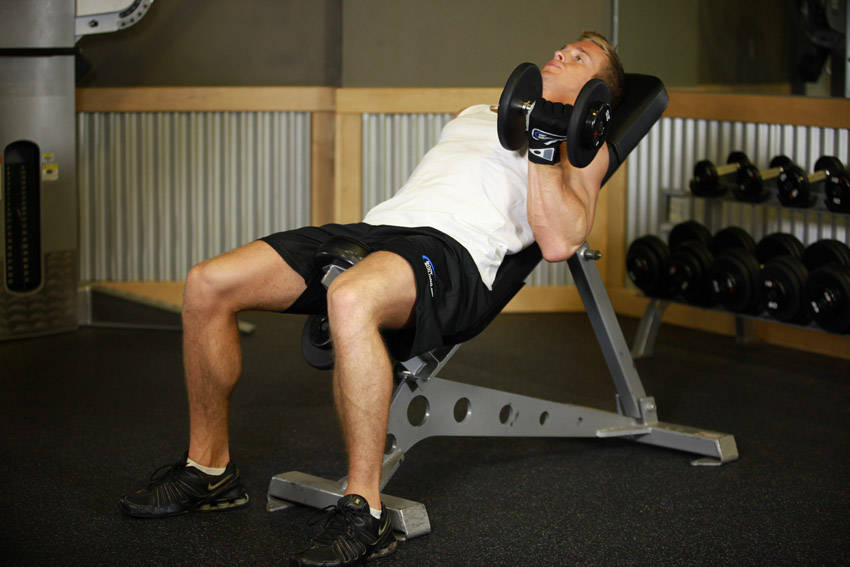
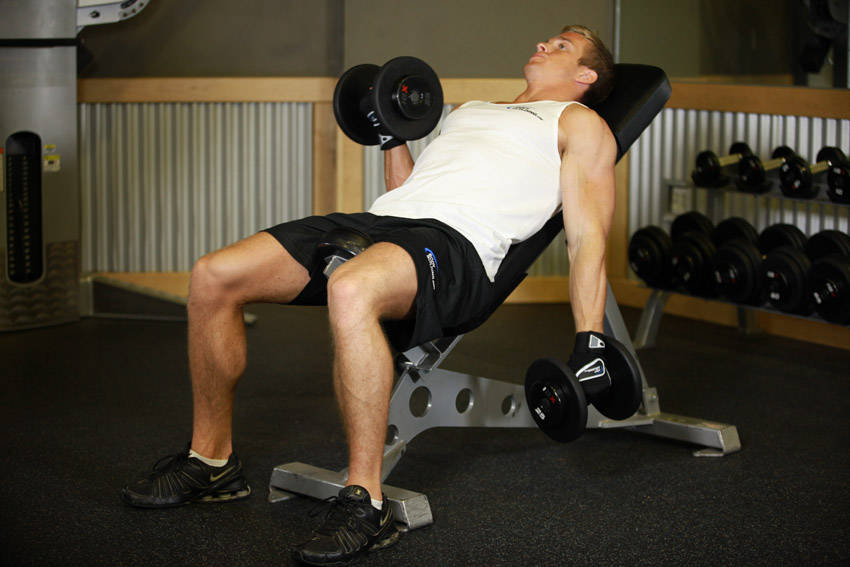 1 / 2
1 / 2How to
Movement instructions
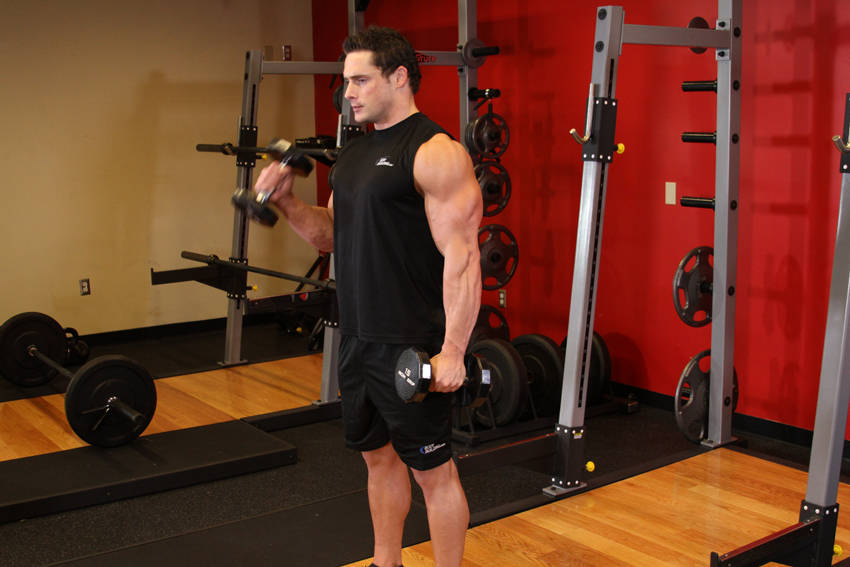
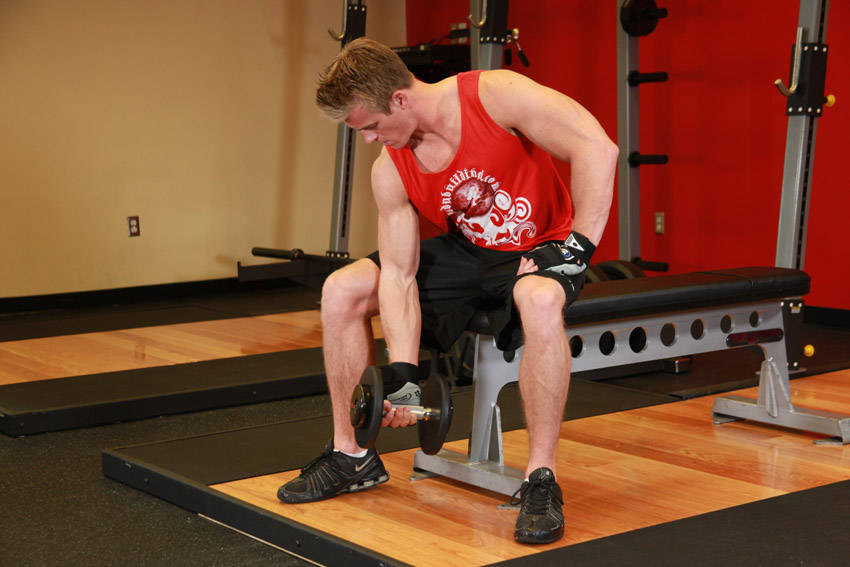
Sit down on an incline bench with a dumbbell in each hand being held at arms length. Tip: Keep the elbows close to the torso.This will be your starting position.
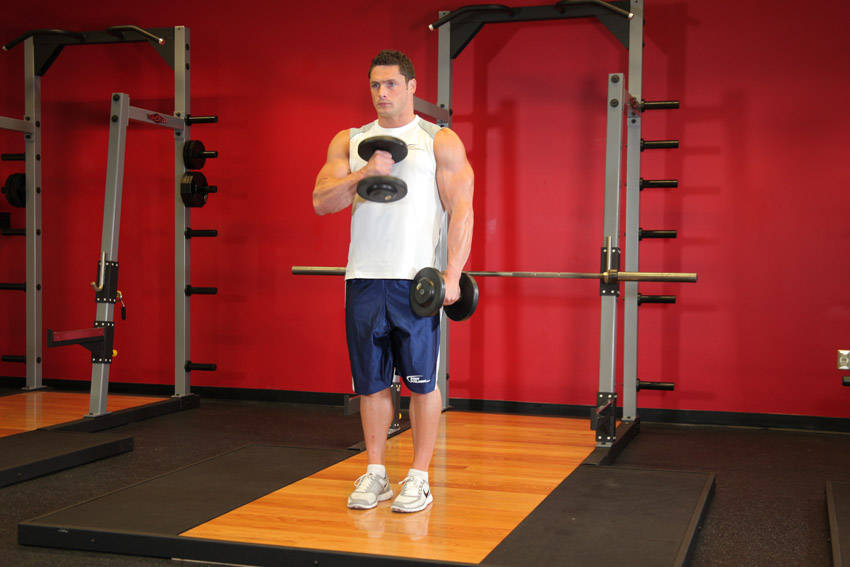
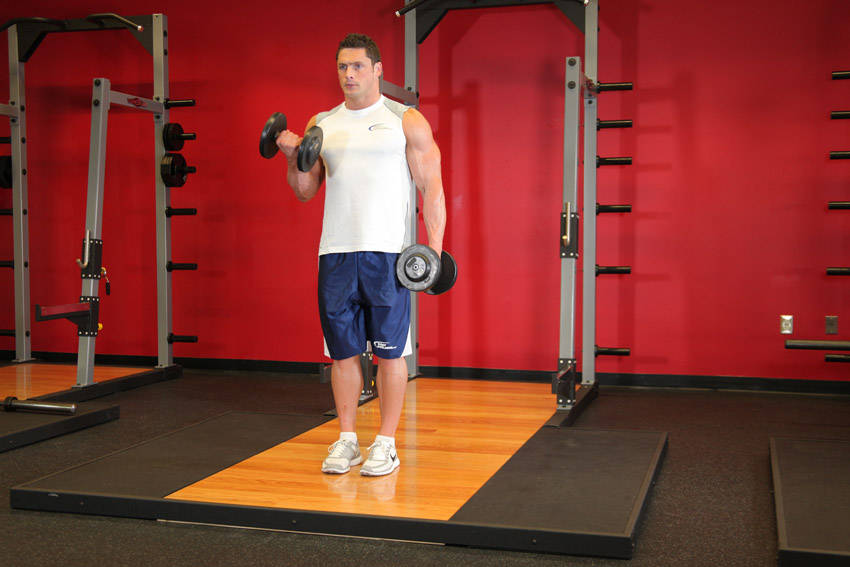
While holding the upper arm stationary, curl the right weight forward while contracting the biceps as you breathe out. As you do so, rotate the hand so that the palm is facing up. Continue the movement until your biceps is fully contracted and the dumbbells are at shoulder level. Hold the contracted position for a second as you squeeze the biceps. Tip: Only the forearms should move.
Slowly begin to bring the dumbbell back to starting position as your breathe in.
Repeat the movement with the left hand. This equals one repetition.
Continue alternating in this manner for the recommended amount of repetitions.
Technique guidance
Exhale as the target muscle shortens against resistance and inhale during the controlled return. Keep breathing steadily throughout the set.
General guidance based on the exercise and equipment. It is not personal coaching or medical advice.
Your progress
Keep the same dumbbell setup, range of motion and recording method when comparing Alternate Incline Dumbbell Curl sessions.
Weight, repetitions and completed sets.
Example: 3 sets of 8 reps at 30 kg. Next time, record the actual result, even if it is the same.
Look for more repetitions at the same weight, or a heavier weight for comparable repetitions. Total weight lifted also changes when you add sets, so it is not a strength score.
Read the tracking guideThe examples show how to keep a record. They are not workout targets or a personalised training plan.
See how Jijibisha tracks your progressMuscles
Muscle guide
Biceps is the primary muscle group. The lighter highlights show the supporting muscles involved in the movement.
In depth
The alternate incline dumbbeceps exercise performed while sitting against an inclined bench and curling one dumbbell at a time. The supported position limits torso movement, while the arms begin slightly behind the body. That setup gives the biceps a long, stretched starting position and makes clean technique more important than the amount of weight in your hands.
This exercise is useful for lifters who want stronger, more muscular arms without relying on swinging or shoulder movement. Alternating sides also gives you time to concentrate on each repetition, match the range of motion between arms, and notice whether one side is weaker or less coordinated.
The movement looks simple, but small details make a noticeable difference. Bench angle, shoulder position, elbow control, grip, and lowering speed all affect where you feel the exercise. Done well, the alternate incline dumbbell curl provides a controlled biceps stimulus from the bottom stretch to the top contraction. Done poorly, it often turns into a partial curl assisted by the shoulders.
The alternate incline dumbbell curl is a single-joint pulling exercise for the front of the upper arm. You sit back on an adjustable bench with a dumbbell in each hand, allow your arms to hang toward the floor, then curl one weight toward the shoulder while the other arm remains down. After lowering the first dumbbell, you repeat the movement with the opposite arm.
It is closely related to the regular incline dumbbell curl. The main difference is that the regular version may be performed with both arms moving together, while the alternate version uses one arm at a time.
The incline position matters because it places the upper arm behind the torso at the bottom. This lengthens the biceps, particularly the long head, before the elbow begins to bend. Research comparing dumbbell curl variations has found that changing shoulder position changes where in the range of motion the biceps produces its highest activity. The incline curl and standing dumbbell curl both produced substantial biceps activity, but their activation patterns were not identical. Alternate Incline Dumbbell Curl at a Glance
The biceps brachii is the main muscle trained during the alternate incline dumbbell curl. It has two heads, commonly called the long head and short head. Both contribute to bending the elbow and turning the forearm so the palm faces upward.
Because the arm starts behind the torso, the long head begins in a more lengthened position than it does during a standard standing curl. This is one reason the incline curl is commonly used in bodybuilding and hypertrophy programs. It should not be treated as an exercise that completely isolates one head of the biceps, however. Both heads still work, and individual anatomy, grip, elbow path, and range of motion influence how the exercise feels.
The brachialis sits underneath the biceps and assists with elbow flexion. It works during nearly every curl variation, including the alternate incline dumbbell curl. Building the brachialis can contribute to overall upper-arm thickness, even though the muscle is not as visually prominent as the biceps.
The brachioradialis assists with bending the elbow, while the forearm muscles help you hold and stabilize the dumbbell. Forearm involvement is normal, especially as the weight becomes challenging. If your grip fails long before your biceps become tired, reduce the load or include separate grip and forearm work elsewhere in your program.
The existing Jijibisha exercise entry classifies the biceps as the primary muscle and the forearms as supporting muscles, which matches the basic mechanics of the movement.
Adjust an incline bench to roughly 45 to 60 degrees. A lower setting creates a more reclined position and usually a stronger stretch at the bottom. A higher setting feels closer to a seated curl and may be more comfortable for some shoulders.
There is no single perfect angle for every lifter. Start near 45 degrees, then raise the bench slightly if you cannot keep your shoulders comfortable and stable.
Sit on the bench with a dumbbell in each hand. Place both feet firmly on the floor. Keep your hips, upper back, and head supported by the bench without forcing your neck into an uncomfortable position.
Brace your abdomen gently. You do not need an extreme powerlifting brace, but your torso should remain steady throughout the set.
Allow the arms to hang toward the floor. Keep the shoulders gently pulled back and down so they do not roll forward. Your elbows should remain near your sides, but they do not need to be squeezed tightly against your ribs.
Begin with a neutral or partially neutral grip if that feels natural, then rotate the palm upward as you curl. You may also begin with the palms already facing forward. Both options can work as long as the wrist remains stable and the motion is controlled.
Bend one elbow and curl the dumbbell toward the same-side shoulder. As the weight rises, turn the palm upward if it was not already supinated.
Think about moving the forearm while keeping the upper arm quiet. The elbow may shift slightly because no human movement is perfectly fixed, but it should not travel far forward.
Near the top, contract the biceps and pause briefly. Stop when further movement would require the elbow to swing forward or the shoulder to roll inward.
The dumbbell does not need to touch your shoulder. The useful end point is where the biceps is strongly shortened and you can still maintain the same upper-arm position.
Slowly return the weight toward the floor. Keep resisting the dumbbell instead of letting it drop. Finish with the arm comfortably extended and the shoulder still stable.
Do not force the elbow into an aggressive lockout. Reach a natural bottom position where the biceps is lengthened and you remain in control.
Perform the same movement with the opposite arm. Continue alternating sides until you complete the planned repetitions.
The Jijibisha movement instructions also treat one right-arm curl followed by one left-arm curl as one complete repetition. When logging your workout, choose one counting method and use it consistently so your records remain comparable.
Use one or two cues at a time rather than trying to remember everything during the set.
A useful self-check is to watch your shoulders. If one shoulder repeatedly rolls forward, shrugs, or leaves the bench, the weight is probably too heavy or the set has gone past the point of productive technique.
A standing curl allows the upper arm to rest beside the torso. During an incline curl, the upper arm begins behind the torso because the bench supports the body in a reclined position.
This changes the starting length of the biceps and the mechanical demand across the repetition. The biceps long head crosses the shoulder joint, so shoulder position affects its length. An incline dumbbell curl begins with that portion of the muscle in a longer position than a standard standing curl. bench also reduces your ability to lean backward and create momentum. It does not make cheating impossible, but it makes excessive torso movement easier to notice.
The bottom of the incline curl places the biceps in a stretched position while the dumbbell still creates resistance. This gives the exercise a different feel and strength curve from curls performed with the elbows in front of the body.
The exercise should still be viewed as one tool within a complete biceps program, not as a magical movement that replaces every other curl. Different curl variations load the elbow flexors differently across the range of motion, which is a good reason to use more than one pattern over time. Less Opportunity to Swing
Your torso is supported by the bench, making it harder to use hip drive or lean backward. This encourages a lighter load and a cleaner repetition.
That does not mean every repetition must look perfectly motionless. Minor natural movement is normal. The goal is to prevent momentum from becoming the main reason the dumbbell rises.
Alternating arms lets you concentrate on the working side. You can pay attention to elbow position, wrist alignment, range of motion, and the quality of the contraction without trying to coordinate both dumbbells simultaneously.
Because each arm works separately, it becomes easier to notice strength or control differences. Start with the weaker side when practical, then match its repetitions with the stronger side.
Do not give the stronger arm extra repetitions simply because it can perform them. Matching the weaker side helps prevent the gap from growing.
Dumbbells allow each hand to rotate independently. This can feel more natural than a fixed straight bar, especially for lifters who find fully supinated barbell curls uncomfortable.
The wrist should still remain neutral rather than bending backward or curling forward around the dumbbell.
The alternate incline dumbbell curl does not require extremely heavy weights to challenge the biceps. Strict positioning and a full range of motion often make a moderate dumbbell feel much heavier than it would during a standing curl.
This is the most common problem. A weight that is manageable during standing curls may be too heavy on an incline bench.
Signs that the load is excessive include:
Reduce the weight until you can control the entire repetition.
Some elbow movement is natural, but a large forward swing changes the exercise. It reduces the strictness of the curl and brings more shoulder flexion into the movement.
Think about keeping the elbow pointed toward the floor while the forearm rotates upward.
Lifting the shoulder toward the ear often appears when the lifter is fatigued or trying to curl too much weight. Keep the shoulder blade gently set against the bench.
Many lifters stop the dumbbell several inches before the arm is extended. This removes much of the lengthened portion that makes the exercise distinct.
Lower until the arm is comfortably straight, but do not force a painful stretch or slam into elbow lockout.
The lowering phase should be deliberate. If gravity pulls the dumbbell down without resistance, you lose control and make the bottom transition harder on the elbow and shoulder.
A lowering phase of about two to three seconds is a practical starting point. It does not need to be timed perfectly.
Bending the wrist toward the forearm may help the dumbbell move, but it often creates unnecessary wrist fatigue. Keep the knuckles, wrist, and forearm in a strong line.
If the elbow moves far forward and upward, the front shoulder begins doing more of the work. Finish the curl by shortening the biceps, not by lifting the whole upper arm.
The alternate format is not a race. Complete one controlled repetition, settle the arm at the bottom, then curl the other side.
The arm that is not curling should remain relaxed but controlled near the bottom. Do not hold it halfway up for the entire set unless you intentionally want an isometric challenge. That variation creates extra fatigue and may reduce the quality of later repetitions.
A bench angle between 45 and 60 degrees works well for most people.
A 45-degree angle places the torso farther back and the arms farther behind the body. This often produces a stronger biceps stretch, but it may also feel more demanding on the front of the shoulder.
A 60-degree angle is more upright. It may reduce the stretch slightly while making the position easier to control.
A steeper bench begins to resemble a seated dumbbell curl. It can still be useful, especially if lower angles bother your shoulders, but the arm may not begin as far behind the torso.
Choose the lowest angle that lets you keep the shoulders stable and pain-free. More stretch is not automatically better if you cannot control the position.
Both approaches are common.
With a palms-up starting position, the forearm is already supinated before the curl begins. This keeps the movement simple and places a consistent demand on the biceps.
With a neutral starting position, the palms face inward at the bottom and rotate upward during the curl. This combines elbow flexion with active forearm supination, another action of the biceps.
Use the version that feels natural at your wrists and elbows. Avoid exaggerated twisting. The rotation should be smooth and should not cause the dumbbell to wobble.
The ideal prescription depends on your goal, training experience, and the rest of your program.
Perform 3 to 4 sets of 8 to 15 repetitions per arm. Stop most sets when you feel you could complete about one to three additional clean repetitions.
You can occasionally train closer to failure, but the set should end when you can no longer maintain the bench position and controlled elbow movement.
Perform 2 to 3 sets of 10 to 15 repetitions per arm with a light dumbbell. Focus on learning the bottom stretch, smooth rotation, and stable shoulder position.
Perform 3 to 4 sets of 6 to 10 repetitions per arm. Even in a lower rep range, do not turn the exercise into a heavy cheat curl. The incline curl is best used as a controlled accessory exercise rather than a maximal-strength test.
Perform 2 to 3 sets of 12 to 20 repetitions per arm after your main pulling and arm exercises. Use a lighter weight and keep the lowering phase controlled.
Current resistance-training guidance emphasizes that many loading styles can build muscle when training is performed consistently with sufficient effort and volume. Higher weekly volume tends to support hypertrophy, while heavier loading is more specific to maximal strength. How Long Should You Rest?
Rest for 60 to 90 seconds between sets for typical hypertrophy training. Take up to two minutes if your biceps or grip are not ready to repeat the same quality of work.
Remember that alternating arms already gives each side a brief rest while the other arm curls. This can make a set last longer than a simultaneous incline curl set.
The alternate incline dumbbell curl usually fits best after your main back or pulling exercises.
Placing the incline curl after compound pulling movements lets you train the biceps directly without reducing your performance on rows, pulldowns, and chin-ups.
If biceps development is a high priority, you can place it earlier in the workout, but consider how that fatigue will affect later pulling exercises.
Most lifters can perform the alternate incline dumbbell curl one or two times per week. The right frequency depends on your total biceps work from curls, rows, pulldowns, and chin-ups.
You do not need to use the same exercise in every session. One weekly workout might include incline curls, while another uses hammer curls, preacher curls, or cable curls.
Give the elbows and biceps enough time to recover. Persistent joint discomfort, falling performance, or soreness that interferes with later workouts can indicate that you need less volume, a different exercise, or more recovery.
Progress does not require adding weight every workout. Use a progression method that protects technique.
Choose a range such as 8 to 12 repetitions per arm.
This works well because dumbbell jumps can be large relative to the weight used for curls.
Adding one clean repetition is progress, especially when the previous workout was already challenging.
A repetition with a controlled bottom stretch and stable top position is more valuable than a heavier partial repetition.
Using a two to three second descent can make the current weight more challenging without requiring a heavier dumbbell.
When progress has stalled and recovery is good, adding one weekly set may help. Do not add sets automatically. First check whether your current sets are hard enough and performed consistently.
Matching the weaker arm's range, tempo, and repetitions is another form of progress. Record each side separately if the difference is meaningful.
The standing dumbbell curl starts with the arms beside the torso and usually allows more weight. The incline version begins with the arms behind the body and offers more external support for the torso.
Use the standing curl for general biceps training and heavier loading. Use the incline curl when you want stricter form and a different challenge in the lengthened position.
The alternating version improves one-side-at-a-time focus and gives each arm a brief rest. The simultaneous version is faster and creates a stronger whole-set demand because both arms work together.
Neither is universally better. Choose based on your goal and preference.
The incline curl positions the upper arm behind the torso. The preacher curl positions it in front of the torso and supports the upper arm against a pad.
These exercises challenge the biceps differently across the range of motion. Research comparing incline and preacher curls suggests that exercise selection can produce different regional growth and strength adaptations, so they can complement each other rather than compete for a single “best curl” label. Alternate Incline Dumbbell Curl vs. Hammer Curl
The incline curl normally uses a supinated, palms-up grip that gives the biceps a strong role. A hammer curl uses a neutral grip and places relatively more emphasis on the brachialis and brachioradialis.
Using both can support more complete upper-arm and forearm development. You can pair this movement with the alternate hammer curl in separate sessions or within the same arm workout.
Both exercises encourage strict technique. The incline curl creates a long starting position with the arm behind the torso, while the concentration curl braces the arm against the inner thigh and is usually hardest through a different part of the movement.
Keep the palms facing forward from the bottom to the top. This removes most of the turning motion and lets you focus on elbow flexion.
Begin with the palms facing inward and gradually rotate them upward as you curl. This is the standard choice for many lifters.
Curl both dumbbells at the same time. This reduces the duration of the set and demands more total-body stability.
Use one dumbbell and complete all repetitions on one side before switching. The free hand can hold the bench for stability.
Keep the palms facing each other throughout the repetition. This changes the emphasis toward the brachialis and brachioradialis while retaining the incline setup.
Lower each repetition for three to five seconds. Use less weight than normal and stop before the descent becomes uncontrolled.
The alternate incline dumbbell curl is a good option for:
It may not be the best choice for someone who has pain when the arm moves behind the torso. Shoulder, elbow, or wrist discomfort should not be ignored. Raise the bench, reduce the range, lower the weight, or choose another curl that feels comfortable.
Stop the exercise if you feel sharp pain, sudden weakness, numbness, or an unusual pulling sensation. General training information cannot replace assessment by a qualified healthcare professional.
Yes. It directly trains elbow flexion and forearm supination while supporting the torso against a bench. Its stretched starting position and strict setup make it a useful biceps hypertrophy exercise when you use an appropriate load and progress it over time.
The incline position lengthens the long head of the biceps because the upper arm begins behind the torso. This can make the exercise useful when you want a curl variation that trains the biceps from a lengthened shoulder position. It does not completely isolate the long head, and both heads of the biceps contribute.
Start between 45 and 60 degrees. Use a more upright angle if the lower position causes shoulder discomfort or makes it difficult to maintain control.
Usually, yes. Curl one dumbbell, lower it to the starting position, then repeat with the opposite arm. This keeps the alternating rhythm clear and lets each arm work through a full repetition.
Both counting methods are used. Some people count each arm curl as one repetition, while others count a right and left curl together as one repetition. The page's existing movement instructions use one curl on each side as one complete repetition. Whichever method you choose, use it consistently in your workout log.
They can face up from the start, or they can begin facing inward and rotate upward during the curl. Choose the version that feels comfortable and allows smooth control.
The forearms grip and stabilize the dumbbells, while the brachioradialis assists elbow flexion. Some forearm fatigue is normal. Excessive forearm strain may come from gripping too hard, bending the wrists, using too much weight, or performing more volume than your grip can tolerate.
Your shoulders may be rolling forward, the bench may be too low, or the weight may be too heavy. Raise the bench slightly, keep your shoulder blades supported, and reduce the load. Stop if the position causes pain.
Reach a comfortable, nearly straight arm position without forcefully snapping into lockout. The goal is a controlled biceps stretch, not joint impact.
Use a dumbbell that allows the same range of motion and tempo from the first repetition to the last. Most people need less weight than they use for standing dumbbell curls.
Yes. You need a stable adjustable bench and enough space for both arms to hang freely. Fixed dumbbells or adjustable dumbbells both work.
Yes. Beginners should use light weights, a moderate bench angle, and controlled repetitions. Learning to keep the upper arm stable is more important than lifting heavy.
You do not need to reach failure on every set. Most sets can end with one to three clean repetitions left. Taking the final set closer to failure can be useful if your technique remains stable, but stop when the shoulders or torso begin taking over.
It is different, not automatically better. Barbell curls allow both arms to work together and often support heavier loading. Alternate incline dumbbell curls provide unilateral focus, independent wrist movement, and a lengthened starting position. A complete program can use both.
Before starting your set, confirm that:
The alternate incline dumbbell curl works best when it is treated as a controlled training movement rather than a chance to move the heaviest dumbbell possible. Set the bench to a comfortable incline, keep the upper arm quiet, use a full pain-free range, and make the lowering phase part of the exercise.
Track the weight, repetitions, sets, and any difference between arms. Over time, aim to add a clean repetition, improve control, or move to a slightly heavier dumbbell without losing the bottom stretch. Small improvements repeated consistently are what turn a good biceps exercise into measurable progress.
Swap it
Different equipment, same muscle
These movements also target the biceps using something else.
Related
Related movements
Get the app
Add it to a routine, record every completed set, and keep the workout saved on your phone even when the gym has no reception.