Breathing
Exhale as the target muscle shortens against resistance and inhale during the controlled return. Keep breathing steadily throughout the set.
Getting your next view ready…
The Alternate Heel Touchers primarily works the abdominals. It is a strength movement that needs no equipment.
 1 / 2
1 / 2How to
Movement instructions
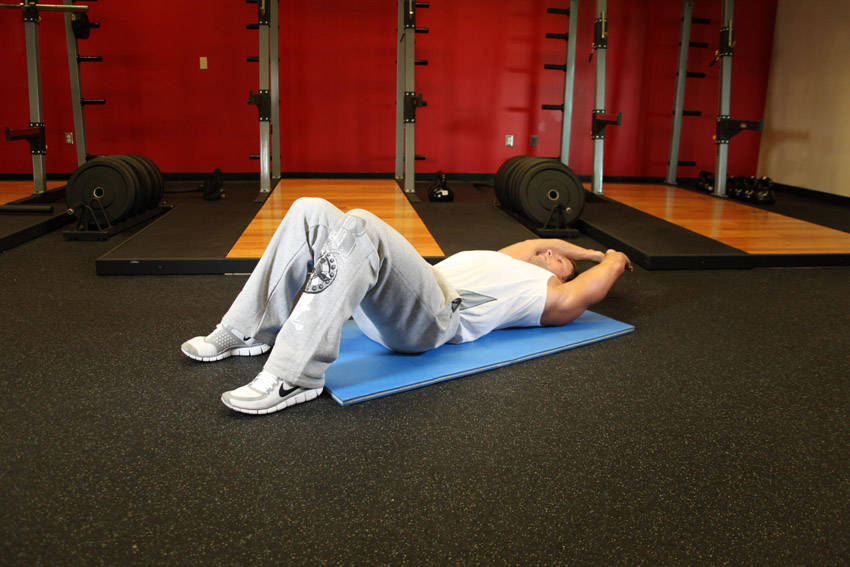
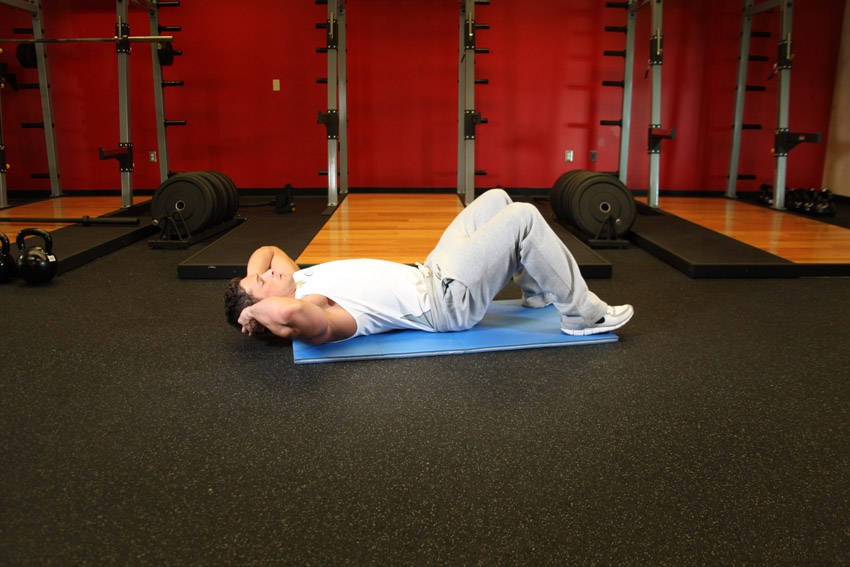
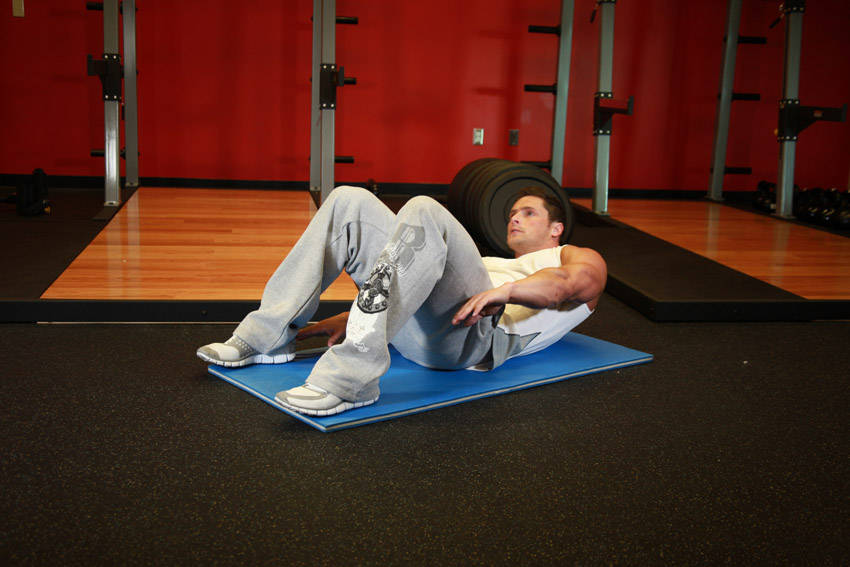
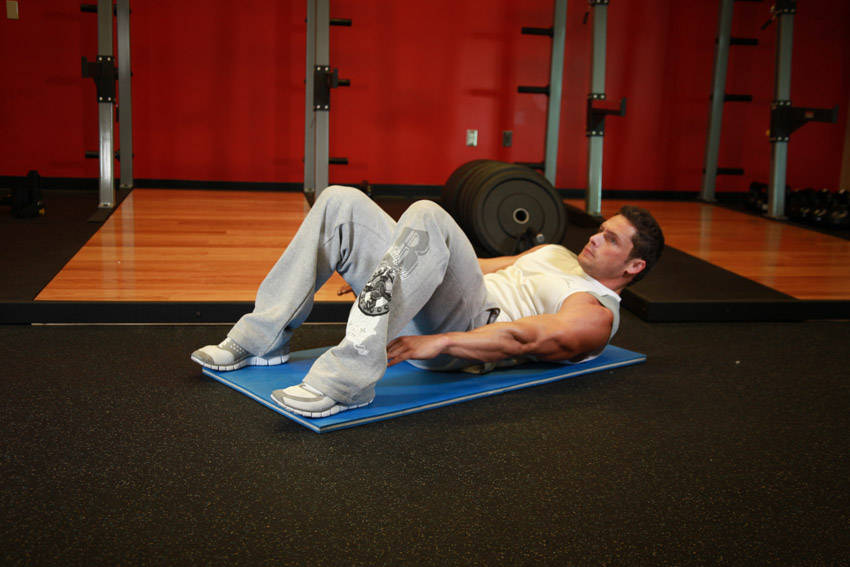
Lie on the floor with the knees bent and the feet on the floor around 18-24 inches apart. Your arms should be extended by your side. This will be your starting position.
Crunch over your torso forward and up about 3-4 inches to the right side and touch your right heel as you hold the contraction for a second. Exhale while performing this movement.
Now go back slowly to the starting position as you inhale.
Now crunch over your torso forward and up around 3-4 inches to the left side and touch your left heel as you hold the contraction for a second. Exhale while performing this movement and then go back to the starting position as you inhale. Now that both heels have been touched, that is considered 1 repetition.
Continue alternating sides in this manner until all prescribed repetitions are done.
Technique guidance
Exhale as the target muscle shortens against resistance and inhale during the controlled return. Keep breathing steadily throughout the set.
General guidance based on the exercise and equipment. It is not personal coaching or medical advice.
Your progress
Keep the same exercise variation, range of motion and recording method when comparing Alternate Heel Touchers sessions.
Repetitions and completed sets.
Example: 10, 9 and 8 completed reps. Keep each set separate instead of recording only the total.
Compare repetitions using the same variation and range. A different variation needs its own history; extra reps are not directly comparable if the movement changes.
Read the tracking guideThe examples show how to keep a record. They are not workout targets or a personalised training plan.
See how Jijibisha tracks your progressMuscles
Muscle guide
Abdominals is the primary muscle group. The lighter highlights show the supporting muscles involved in the movement.
In depth
Alternate heel touchers are a simple bodyweight core exercise performed by reaching from side to side toward your heels while holding a raised crunch position. The movement primarily challenges the muscles along the sides of your abdomen, especially the internal and external obliques.
You may also see this exercise called heel touches, alternating heel taps, ankle taps, side heel touches, oblique heel touches, or heel touch crunches. These names generally describe the same basic movement.
Although alternate heel touchers look easy, small changes in technique can completely change how the exercise feels. Simply waving your arms toward your feet does very little. The useful part of the movement comes from shortening one side of your torso, bringing your ribs closer to the same-side hip, and maintaining abdominal tension as you alternate.
The exercise requires no equipment and very little space. It can be performed at home, in a gym, while traveling, or as part of a short bodyweight workout. It is suitable for beginners, but slower tempos, longer reaches, pauses, and added resistance can make it challenging for more experienced trainees.
Alternate heel touchers are a floor-based abdominal exercise that combines a held crunch with alternating lateral trunk flexion.
You begin by lying on your back with your knees bent and feet planted on the floor. After lifting your head and shoulder blades slightly, you bend your torso toward the right and reach your right hand toward your right heel. You return toward the center and repeat the movement on the left side.
The legs remain relatively still. Your upper body moves from side to side while your abdominal muscles keep your shoulders raised.
The movement is small. You do not need to sit up, rotate forcefully, or touch the outside of the opposite foot. Your right hand reaches toward your right heel, and your left hand reaches toward your left heel.
The heel is primarily a target that gives you a consistent reaching distance. Touching it is not the only measure of a successful repetition. You can train the obliques effectively even when your fingertips stop slightly short, provided that your torso is genuinely bending to the side.
| Category | Details |
|---|---|
| Also known as | Heel touches, alternating heel taps, ankle taps and oblique heel touches |
| Primary muscles | Internal and external obliques |
| Secondary muscles | Rectus abdominis and transverse abdominis |
| Supporting muscles | Deep neck flexors, hip stabilizers and lower-back stabilizers |
| Equipment | None |
| Optional equipment | Exercise mat and light dumbbells |
| Difficulty | Beginner |
| Exercise type | Bodyweight isolation exercise |
| Movement pattern | Alternating lateral trunk flexion |
| Typical repetition range | 10 to 25 touches per side |
| Typical set duration | 20 to 45 seconds |
| Best used for | Oblique training, abdominal endurance and bodyweight core workouts |
| Main form priority | Move the ribs toward the hip instead of only moving the arm |
The main action during alternate heel touchers is lateral flexion of the torso.
Lateral flexion means bending sideways. When you reach your right hand toward your right heel, the right side of your torso shortens slightly. When you reach toward the left heel, the left side shortens.
Your shoulder blades remain raised from the floor throughout the set. This held crunch position keeps the rectus abdominis working while the obliques produce the side-to-side movement.
The pelvis and legs should remain fairly stable. If your hips roll, your knees sway, or your feet slide across the floor, you reduce the amount of controlled movement coming from your abdominal muscles.
Alternate heel touchers use a shorter range than a sit-up or Russian twist. The exercise becomes effective through repeated tension and controlled movement rather than a large visible range.
Alternate heel touchers train several muscles around the trunk. The obliques create much of the side-to-side action, while other abdominal muscles help maintain the raised position.
The external obliques are broad abdominal muscles located along the sides of your torso.
They assist with trunk rotation, lateral flexion, abdominal compression, and control of the rib cage. During a heel touch, the obliques help shorten the distance between the ribs and hip on the side toward which you are reaching.
For example, reaching your right hand toward your right heel involves lateral flexion toward the right side.
The external obliques also help prevent uncontrolled movement as you return toward the middle and switch directions.
The internal obliques lie beneath the external obliques.
They contribute to side bending, rotation, abdominal compression, and stabilization of the trunk. They work with the external obliques to create and control the alternating movement.
You may feel the exercise through the lower and side portions of your abdomen. The exact location varies according to your anatomy, torso angle, foot position, and range of motion.
The rectus abdominis runs vertically down the front of the abdomen and is often called the six-pack muscle.
It helps lift your head and shoulder blades from the floor. During alternate heel touchers, it works continuously to maintain the crunch position as your torso moves from side to side.
If your shoulder blades repeatedly drop to the floor between touches, the rectus abdominis receives less continuous tension.
The muscle is not the main producer of the side bend, but it plays an important role in keeping your upper body elevated.
The transverse abdominis is a deeper abdominal muscle that wraps around the torso.
It helps control the abdominal wall, pelvis, and lower spine. During heel touches, it contributes to trunk stability while you move laterally.
You may not feel this muscle as clearly as the superficial abdominal muscles, but it supports the overall position.
Your neck muscles help support the weight of your head while your shoulders remain elevated.
They should work gently rather than becoming the main source of effort. Excessive neck fatigue often means that you are pushing your chin too far forward, raising your head without lifting your torso, or continuing after your abdominal muscles are fatigued.
The hip flexors are not intended to create the main movement, but they can help stabilize the pelvis and maintain the bent-leg position.
Because your feet stay on the floor, heel touchers generally place less demand on the hip flexors than bicycle crunches or leg raises.
Your glutes and hamstrings help keep your feet planted and pelvis steady.
They should not be contracting as hard as they would during a bridge, but light lower-body tension can prevent your legs from shifting as you reach.
The muscles around the lower spine help maintain a controlled position.
The exercise should not feel like repeated lower-back bending. Your movement should remain concentrated through the abdominal region while your pelvis stays stable.
Many basic abdominal exercises focus primarily on forward trunk flexion.
Alternate heel touchers introduce repeated side bending, making them a practical exercise for directly training the obliques.
A balanced core program should not rely on heel touches alone, but they can fill a useful role alongside planks, reverse crunches, carries, and anti-rotation exercises.
Your shoulders remain elevated while you alternate from side to side.
This creates continuous tension through the front and sides of the abdomen. Even though each individual reach is small, the set can become difficult when you avoid resting between repetitions.
Alternate heel touchers can be performed with only your body weight.
A mat may improve comfort, but you do not need a gym membership, machine, bench, cable station, or free weights.
This makes the exercise useful for home workouts, travel routines, warm-ups, and quick core sessions.
The basic movement is straightforward:
Beginners can learn the exercise without mastering complicated equipment or balance demands.
Proper technique still matters, especially when controlling the neck and creating movement through the torso instead of the arms.
You can adjust the difficulty by changing:
This allows you to keep the same basic exercise while gradually increasing the challenge.
The alternating pattern makes it easy to train the right and left obliques within a single set.
You can also compare the distance, control, and sensation on both sides. One side may initially feel stronger or more coordinated.
Use the weaker side as a guide rather than forcing it through a larger range.
Alternate heel touchers require almost no setup.
They can be added to the end of a strength workout, included in a circuit, or performed during a brief bodyweight session.
A few controlled sets may take less than five minutes.
Maintaining a raised shoulder position while repeatedly bending side to side challenges the endurance of the abdominal muscles.
This can help you become more comfortable sustaining core tension for longer periods.
Your feet remain on the floor and you do not need to jump, run, or support your body in a plank position.
This may make heel touches more accessible than mountain climbers, hanging leg raises, or advanced rollout variations.
Low impact does not mean suitable for every person. Stop if the exercise causes neck, back, hip, or abdominal pain.
Lie on an exercise mat or another firm, padded surface.
A very soft mattress makes it difficult to stabilize your body. A hard floor may be uncomfortable for your spine and head.
Make sure you have enough space to reach along both sides of your body.
Position your head, upper back, lower back, and hips on the floor.
Look upward and allow your neck to settle into a comfortable position.
Keep your arms extended beside your body with your palms facing inward or downward.
Bend both knees and place your feet flat on the floor.
Position your feet approximately hip-width apart. Your knees should point generally upward rather than collapsing inward or spreading excessively.
Begin with your heels close enough that you can almost reach them when your shoulders are lifted.
Your feet should remain stable throughout the set.
Placing your heels closer to your hips usually makes them easier to reach. Moving them farther away increases the reaching distance and may make the exercise harder.
Do not position your feet so far away that your lower back becomes uncomfortable or your hamstrings cramp.
Extend both arms alongside your body.
Your fingertips should point toward your heels. Keep your hands slightly above the floor rather than pressing them down for assistance.
Relax your shoulders away from your ears.
Gently tighten your abdominal muscles.
Think about drawing your ribs toward your pelvis without forcefully flattening your entire spine.
The goal is to prepare the torso before lifting rather than suddenly throwing your head forward.
Raise your head, shoulders, and upper back a few inches from the floor.
Your lower back and hips should remain supported.
Keep a small, comfortable space between your chin and chest. Imagine holding a small orange beneath your chin.
Do not lift only your head. Your upper torso should rise as one controlled unit.
Bend your torso slightly toward the right.
Slide your right hand toward your right heel or ankle. Think about bringing your right ribs closer to your right hip.
Your right shoulder may move slightly closer to the floor as your torso bends, but your shoulder blades should remain generally elevated.
Hold the right-side position for approximately one second.
Contract the muscles along the right side of your abdomen.
Touching the heel is optional. Stop at the farthest point you can reach without losing the raised crunch position.
Move slowly back toward a centered crunch position.
Do not lower your head and shoulders completely unless you are using an easier variation.
Maintain abdominal tension during the transition.
Bend your torso toward the left and slide your left hand toward your left heel.
Bring the left side of your ribs closer to the left hip.
Use the same range and tempo that you used on the right.
Move from side to side in a smooth, controlled rhythm.
Avoid bouncing through the middle or throwing your arms toward your feet.
Complete the planned repetitions or continue for the prescribed time.
Return to the center before lowering your shoulders and head.
Place your upper back on the floor slowly rather than suddenly relaxing.
Bring your knees together or extend your legs if that feels comfortable.
Use this checklist during your set:
Different cues work for different people. Try these:
Choose one or two cues rather than trying to remember everything at once.
The most important cue is usually: shorten the side of your torso instead of simply reaching farther with your arm.
Exhale as you reach toward one heel.
Inhale as you return toward the center.
Then exhale as you reach toward the opposite heel.
A simple pattern looks like this:
Do not hold your breath for the entire set.
Steady breathing can help you maintain abdominal tension without creating unnecessary pressure through your neck and face.
If alternating breaths becomes difficult during a fast set, slow down. Your breathing should support your technique rather than force you to rush.
You should feel muscular effort through the front and sides of your abdomen.
The sensation may be strongest:
A mild amount of neck effort can occur because your head remains elevated. However, your neck should not become the main area of fatigue.
You should not feel:
Stop the set if the movement produces sharp pain or unusual symptoms.
This is the most common mistake.
People often keep their torso still and stretch one arm toward the heel. The hand moves, but the obliques perform little meaningful side bending.
Instead, think about shortening the side of your torso. Your shoulder and ribs should move toward the same-side hip.
The arm follows the torso rather than creating the movement by itself.
Fast swinging uses momentum and makes it difficult to control the abdominal muscles.
Slow down and pause briefly near each heel.
You should be able to stop at any point during the repetition.
Allowing your upper back to rest after every reach reduces continuous abdominal tension.
Keep your shoulder blades raised while moving from one side to the other.
Beginners may intentionally rest between repetitions, but this should be a planned regression rather than an uncontrolled collapse.
Raising the head without lifting the shoulders can create neck strain.
Initiate the movement by tightening your abdomen and lifting the upper torso. Your head should follow the movement rather than being pulled forward separately.
Pressing your chin into your chest increases neck tension.
Maintain a small gap between your chin and upper chest. Keep your gaze directed diagonally upward instead of staring at your knees.
Turning your head toward each hand can make the neck move excessively.
Keep your eyes directed upward or slightly forward. Allow the torso to bend without repeatedly rotating your head.
Placing the heels directly beneath the glutes makes them easy to touch, but it may reduce the reaching distance so much that the exercise becomes ineffective.
Move your feet far enough away that you need a genuine side bend to approach them.
The correct distance depends on your arm length and torso proportions.
Moving the heels excessively far from your hips can cause you to strain, lose the crunch position, or slide your feet.
Choose a distance that allows a controlled reach without forcing the movement.
Your feet should remain planted.
If they repeatedly move, place them on a surface with better traction or reduce your reaching speed.
Do not use your legs to pull your torso toward each side.
The knees should remain relatively stable and point upward.
If they move from side to side, your pelvis may be rotating rather than your torso bending laterally.
Reduce the range and focus on keeping your lower body quiet.
Your hips should remain in contact with the floor.
Rocking the pelvis makes the movement larger but reduces the isolation of the abdominal muscles.
Keep both sides of your pelvis heavy and stable.
Standard alternate heel touchers use a same-side reach.
The right hand moves toward the right heel, and the left hand moves toward the left heel.
Reaching across the body creates a different rotational exercise.
Heel contact is not mandatory.
Forcing the touch may cause your shoulder to drop, your neck to strain, or your pelvis to shift.
Use the heel as a direction rather than a test you must pass.
Completing a large number of rapid touches may look impressive but often reduces muscular control.
Ten slow touches per side can be harder than thirty rushed touches.
Breath-holding increases unnecessary tension and may cause lightheadedness.
Exhale during the reach and inhale as you move through the center.
The set should end when you can no longer hold your upper torso with your abdominal muscles.
Rest, reduce the number of repetitions, or use an easier variation.
Do not keep pushing your head forward to complete an arbitrary target.
Heel touchers naturally use a modest range, but the torso should still move.
Your ribs and shoulder should travel visibly toward the hip.
If only your fingertips move, reset your position and slow down.
Your hands may hover close to the floor, but they should not push down to help lift your torso.
Keep the arms relaxed and use your abdominal muscles to maintain the crunch.
The ideal distance depends on your arm length, leg length, torso size, flexibility, and current abdominal strength.
A useful starting point is to position the heels approximately 45 to 60 centimetres from your hips.
This is only a general reference. Adjust the position until you can nearly touch each heel with a controlled side bend.
Move the feet closer when:
Move the feet farther away when:
Change the distance in small amounts.
Lift your shoulder blades a few inches from the floor.
You do not need to perform a full sit-up. The bottom edges of your shoulder blades should become light or leave the mat while your lower back and hips remain supported.
Lifting higher can increase abdominal effort, but excessive height may turn the exercise into a forward crunch and make side bending more difficult.
Lifting too little may cause you to reach only with your arms.
Use the lowest raised position that allows you to feel continuous abdominal tension and move your torso from side to side.
No.
The purpose of the exercise is to train the abdominal muscles through controlled lateral flexion. Touching the heel simply provides a visible target.
Some people can touch easily because they have long arms or place their feet close to their hips. Others may have to create a much larger side bend.
Measure quality by:
Reaching to within a few centimetres of the heel can be completely acceptable.
There are two common methods.
Touching the right heel counts as one repetition.
Touching the left heel counts as the next repetition.
A set of 20 total repetitions therefore includes 10 touches per side.
Touch the right heel and then the left heel. The complete pair counts as one repetition.
A set of 15 repetitions includes 15 touches per side and 30 individual touches.
The Jijibisha exercise instructions use this second method, counting both heel touches as one full repetition.
Either method is acceptable when clearly recorded.
For easier workout tracking, write the target as “15 per side” or “30 total touches.”
Alternate heel touchers usually work well with moderate to high repetition ranges.
| Goal | Sets | Repetitions or time | Rest |
|---|---|---|---|
| Learning technique | 2 to 3 | 6 to 10 per side | 45 to 75 seconds |
| General core strength | 3 to 4 | 10 to 20 per side | 45 to 75 seconds |
| Abdominal endurance | 3 to 4 | 20 to 30 per side | 30 to 60 seconds |
| Timed circuit | 2 to 5 | 20 to 45 seconds | 15 to 60 seconds |
| Core finisher | 2 to 3 | 15 to 25 per side | 30 to 45 seconds |
These ranges are starting points rather than fixed rules.
Stop the set when:
Technique should determine the end of the set.
A controlled tempo increases the amount of useful tension.
Try this rhythm:
For a harder variation, take two seconds to reach each side.
The movement should feel steady rather than frantic.
The last few repetitions should be challenging, but you should still be able to control your torso and breathing.
A useful set may end with one to three technically clean repetitions remaining.
Training until complete failure is not necessary every time. Neck fatigue often becomes the limiting factor before the abdominal muscles reach true failure.
Stop before compensation becomes severe.
You can increase difficulty through better control, a longer reach, slower movement, pauses, or light resistance rather than performing hundreds of repetitions.
Lie on your back with your knees bent and feet on the floor.
Gently tighten your abdomen while breathing normally.
Practise keeping your pelvis and lower back comfortable.
Lift your head and shoulder blades slightly.
Keep your hands on your thighs and slide them toward your knees.
Lower slowly.
This helps you learn to raise the torso without pulling the neck.
Raise your shoulders and hold for 10 to 20 seconds.
Keep breathing and maintain space beneath your chin.
From the crunch position, move a few centimetres to the right and then to the left.
Do not try to reach the heels yet.
Bring your heels close enough that your fingertips can approach them with a small side bend.
Perform short alternating sets.
Move the feet gradually farther away as your control improves.
Keep your shoulders raised throughout the complete set instead of resting between touches.
Once the standard version feels comfortable, pause at each heel or slow the side-to-side movement.
Keep the heels close to your hips and use a smaller side bend.
Focus on maintaining the raised position.
Lower your shoulders to the floor after reaching each side.
Reset your abdomen before the next repetition.
This reduces continuous tension and gives the neck a brief rest.
Keep your shoulders only slightly raised and slide each hand along the floor without trying to reach the heel.
Gradually increase the distance.
Place a small folded towel beneath your head.
Keep the head lightly supported while lifting the shoulders as much as you comfortably can.
Do not use a large pillow that forces the neck forward.
Complete a short set on one side, rest, and then train the other side.
This allows you to concentrate on one movement direction at a time.
Bring the heels closer to the hips.
This shortens the reaching distance and makes heel contact easier.
Move your feet several centimetres farther from your hips.
This increases the distance your torso must travel.
Do not move them so far that your heels lift or lower back becomes uncomfortable.
Take two to three seconds to reach each heel.
Avoid relaxing as you pass through the center.
Hold the shortened position for two seconds at each side.
Maintain the raised crunch throughout the pause.
Hold a light dumbbell or small weight in each hand.
Keep the weights close to the floor and use the same controlled movement.
Begin with a very light load. Adding too much weight can strain the neck or encourage arm swinging.
Complete all planned repetitions toward the right heel before switching to the left.
This produces more continuous fatigue on one side.
Use equal repetitions and similar technique on both sides.
Place your feet on a low, stable step or bench.
The change in body position can alter the reaching angle and increase the stability demand.
Make sure the platform cannot move.
Raise your legs into a tabletop position and reach laterally toward the outside of each thigh or ankle.
Because the feet are no longer planted, your core must work harder to stabilize the pelvis.
This is a different and more advanced variation.
Hold the raised starting position for 20 to 40 seconds while alternating very slowly.
This increases abdominal endurance.
Anchor a light resistance band so that it adds tension to the lateral reach.
This setup is more complicated and should only be used when the anchor is secure.
The side plank trains the obliques isometrically.
Instead of repeatedly bending the torso, you hold your body in a straight position while resisting sideways collapse.
It provides a useful complement to heel touchers.
The bicycle crunch combines trunk rotation with alternating leg movement.
It generally requires more coordination and hip-flexor control than heel touches.
See the Air Bike exercise guide for complete bicycle crunch instructions.
The Russian twist trains rotational movement from a seated position.
It can be performed with body weight or resistance, but requires careful control of the lower back.
Heel touchers use side bending, while Russian twists emphasize rotation.
A side crunch trains one side of the abdomen at a time.
It may be performed lying on the side or with the knees turned to one side.
The dead bug trains the core while the arms and legs move.
It emphasizes keeping the trunk stable rather than bending repeatedly.
This can be a good alternative for people who want less neck involvement.
The bird dog is performed on hands and knees.
It challenges trunk stability as the opposite arm and leg extend.
The Pallof press uses a cable or resistance band to train resistance against rotation.
It complements dynamic exercises such as heel touches.
The suitcase carry involves walking while holding a weight in one hand.
Your obliques work to prevent the torso from leaning toward the weight.
A regular crunch focuses more on forward trunk flexion than side bending.
It may be easier for beginners who struggle to coordinate alternating movement.
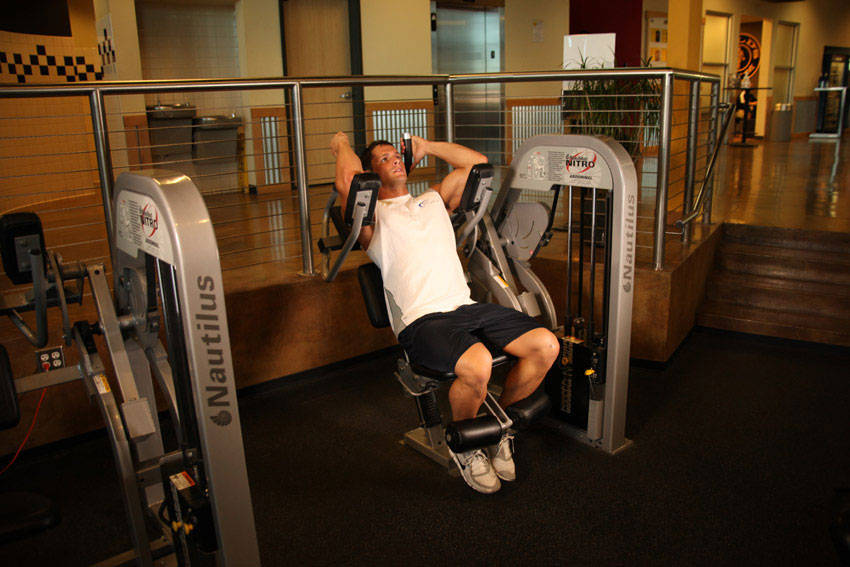
The Ab Crunch Machine allows you to train trunk flexion with adjustable resistance.
It does not reproduce the same lateral movement as heel touchers.
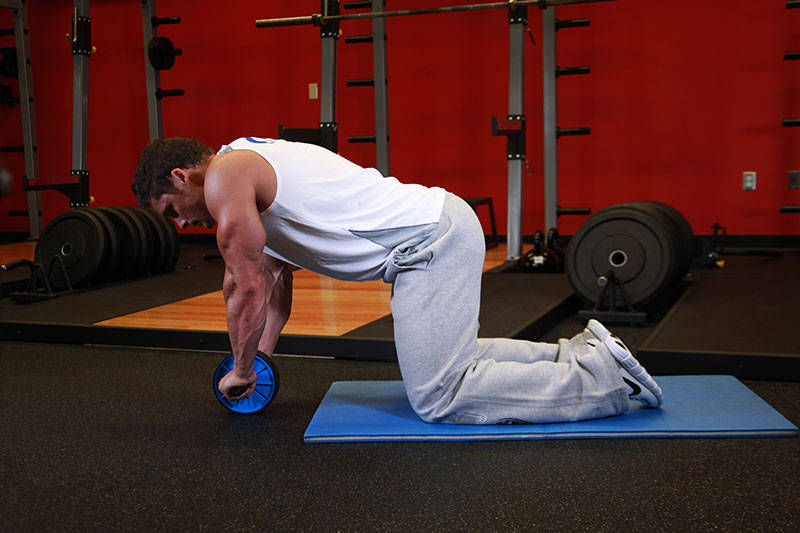
The Ab Roller trains the core primarily by resisting excessive spinal extension.
It is substantially more difficult and should not be treated as a direct beginner replacement.
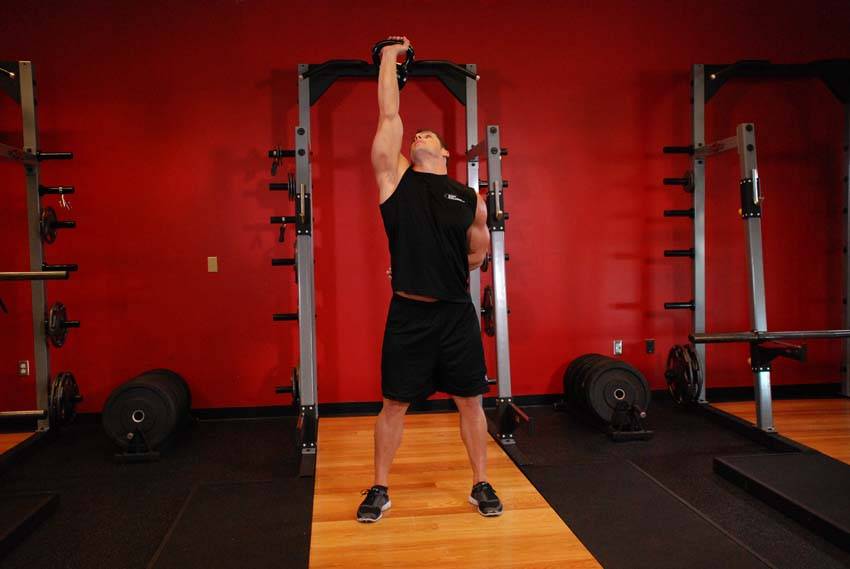
The Advanced Kettlebell Windmill trains the obliques, hips, and shoulder stability while standing beneath an overhead load.
It is much more advanced than alternate heel touchers.
| Alternate heel touchers | Regular crunches |
|---|---|
| Use repeated side bending | Use forward trunk flexion |
| Strong oblique involvement | Greater emphasis on rectus abdominis |
| Alternate right and left | Move straight upward |
| Shoulders remain raised during the set | Shoulders may lower after each repetition |
| Hands reach toward the heels | Hands may rest near the head or thighs |
| Usually use higher repetitions | Can be progressed with external resistance |
Both exercises can be included in the same program.
Use crunches when you want straightforward forward flexion. Use heel touchers when you want more direct side-to-side abdominal work.
Both exercises train the abdominals and alternate between sides.
Heel touchers keep the feet planted and bend the torso toward the same-side heel.
Bicycle crunches lift the feet, extend one leg, and rotate the shoulder toward the opposite knee.
| Alternate heel touchers | Bicycle crunches |
|---|---|
| Same-side reach | Opposite-side rotation |
| Feet remain planted | Legs remain elevated |
| Uses lateral trunk flexion | Uses flexion and rotation |
| Lower coordination demand | Higher coordination demand |
| Less hip-flexor involvement | Greater hip-flexor involvement |
| Usually easier for beginners | Usually more challenging |
The exercises are related but not interchangeable.
Heel touchers are performed lying on your back with your feet planted.
Russian twists are performed while seated and involve rotating the torso from side to side.
Heel touchers mainly challenge lateral flexion. Russian twists mainly challenge rotation.
People who feel lower-back discomfort during seated twisting may find heel touchers more comfortable, although individual responses vary.
The heel toucher is dynamic. You repeatedly shorten one side of the torso.
The side plank is isometric. You hold a stable position and resist gravity.
Heel touchers may be easier to learn and allow more repetitions. Side planks place greater demand on the shoulder and lateral hip.
Using both can provide a broader oblique training stimulus.
Both exercises involve lateral flexion.
Alternate heel touchers train both sides within one continuous set. Side crunches usually train one side at a time.
Heel touchers use a shorter range and sustained raised position. Side crunches may create a stronger contraction on one side but require a separate set for the opposite side.
The 3/4 Sit-Up uses a larger forward trunk movement.
Alternate heel touchers use a smaller side-to-side motion.
Sit-ups generally involve more hip-flexor contribution, while heel touchers keep the feet planted and emphasize the obliques.
Heel touchers work well as a core finisher after your main compound exercises.
Training the abdomen afterward prevents early fatigue from interfering with heavy squats, deadlifts, presses, or rows.
Use heel touchers alongside exercises that challenge other core functions.
For example:
Pair them with squats, push-ups, lunges, bridges, and other no-equipment movements.
Keep the repetitions controlled even when the surrounding circuit moves quickly.
The exercise requires little floor space and no setup.
It can be included in short routines when you do not have access to gym equipment.
A small number of easy repetitions can help you practise abdominal control.
Do not exhaust your core before heavy lifting or demanding athletic activity.
Complete two or three rounds:
Complete three rounds:
Perform:
You do not need a long exercise-specific warm-up.
Try the following:
The warm-up should make the movement feel easier, not fatigue your abdomen.
Most people can perform heel touchers two to four times per week.
A gentle set may be tolerated more frequently, but daily high-volume abdominal training is unnecessary.
Your ideal frequency depends on:
Your abdominal muscles also work during squats, deadlifts, carries, presses, rows, pull-ups, and many athletic movements.
Allow recovery when your abdomen remains sore or your technique declines.
Use the following progression order:
Do not increase every variable at once.
Changing repetitions, distance, speed, weight, and set count simultaneously makes it difficult to measure progress.
Alternate heel touchers can strengthen and develop the abdominal muscles, especially the obliques.
Visible abdominal definition also depends on:
No single exercise guarantees visible abs.
Use heel touchers as one part of a complete resistance-training and nutrition plan.
Heel touchers cannot selectively remove fat from the sides of your waist.
The exercise trains the muscles beneath that area, but fat loss does not occur only from the body part being exercised.
Reducing overall body fat generally requires a sustainable calorie deficit combined with appropriate nutrition, resistance training, physical activity, and recovery.
Heel touchers may improve abdominal strength and muscle development, but they should not be marketed as a direct love-handle removal exercise.
The exercise itself does not guarantee a smaller waist.
Waist size is influenced by:
Strengthening your core can improve muscular control, but it does not automatically reduce circumference.
Normal bodyweight heel touchers are unlikely to create a dramatic increase in waist width.
The obliques can grow like other muscles when trained progressively, but visible changes depend on resistance, volume, genetics, nutrition, and total training history.
Most people should choose core exercises based on strength and function rather than fear of minor muscle development.
Yes.
The exercise has a simple setup, requires no equipment, and keeps the feet supported.
Beginners should focus on:
Use a reduced range when you cannot touch the heels.
Use an easier variation or seek qualified guidance if you experience:
Stop immediately if you experience sharp pain, sudden weakness, breathing difficulty, or unusual symptoms.
People with medical conditions affecting exercise tolerance should obtain individualized advice before beginning a new routine.
Alternate heel touchers are a bodyweight abdominal exercise performed by lying on your back, lifting your shoulders, and reaching each hand toward the same-side heel.
They primarily train the internal and external obliques.
The rectus abdominis and transverse abdominis help maintain the raised crunch position and stabilize the torso.
Yes.
They train the abdominal muscles, with particular emphasis on the sides of the abdomen.
Yes.
The side-bending action directly involves the internal and external obliques.
The exercise is most effective when your torso bends rather than only your arm moving toward the heel.
The terms are often used interchangeably.
However, “heel taps” can also describe a dead bug variation in which one heel lowers toward the floor from a tabletop leg position.
Check the exercise description to confirm which movement is intended.
Usually, yes.
Some people reach toward the ankle rather than the heel because of their body proportions or foot position. The basic side-bending movement remains the same.
No.
Reach as far as you can while maintaining abdominal tension, stable hips, and a comfortable neck.
The torso movement matters more than physical contact.
Begin with two or three sets of 8 to 15 repetitions per side.
Increase toward 20 to 30 per side when you can maintain good technique.
You can count each touch separately or count one right-and-left pair as one repetition.
Record the method clearly and use it consistently.
Yes, during the standard version.
Keeping the shoulders raised maintains continuous abdominal tension.
Beginners may lower them between repetitions as an easier modification.
Keep your lower back controlled and comfortable.
You do not need to force every part of your spine aggressively into the floor. Avoid excessive arching or painful pressure.
Your neck supports your head during the raised position.
Excessive discomfort may mean you are lifting only your head, tucking your chin too hard, or continuing beyond your abdominal endurance.
Lower your shoulders, rest, and use shorter sets.
Your pelvis may be moving, your abdomen may be fatigued, or your foot position may be unsuitable.
Reduce the range, move your heels slightly closer, and maintain gentle abdominal tension.
Stop if pain continues.
You may be moving only your arms.
Focus on bringing your ribs toward the same-side hip. Slow down and pause at each side.
No.
Use a controlled speed that allows you to feel the side of your torso shortening.
Fast repetitions often rely on momentum.
Easy practice may be performed frequently, but hard daily abdominal training is unnecessary.
Two to four sessions per week are enough for many people.
Light resistance can be used after you master the bodyweight version.
Keep your neck comfortable, use a small weight, and stop if resistance causes swinging or joint pain.
They use energy and train the abdominal muscles, but they cannot selectively burn stomach fat.
Overall fat loss depends primarily on long-term energy balance and lifestyle.
They can contribute to abdominal muscle development.
Visible abs also require sufficiently low body fat and are influenced by genetics, nutrition, training, and recovery.
Neither is universally better.
Heel touchers emphasize lateral flexion and the obliques. Regular crunches emphasize forward flexion and the rectus abdominis.
Using both can provide variety.
They train different movement patterns.
Heel touchers use side bending from a supported floor position. Russian twists use rotation from a seated position.
Choose based on your goals and comfort.
They can train the same general region but through a different muscular action.
Heel touchers are dynamic. Side planks are isometric.
A balanced program can include both.
Hard sets are usually best performed after your main strength exercises or during a dedicated core session.
A small number of easy repetitions may be used during a warm-up.
Use the range you can control on the weaker side and match it with the stronger side.
Do not force the weaker side to reach farther.
First improve control and consistency.
Then move your feet farther away, slow the repetitions, add pauses, increase the repetition count, or hold very light weights.
Alternate heel touchers are a practical bodyweight exercise for training the obliques and building abdominal endurance.
Lie on your back with your knees bent and feet planted. Lift your head and shoulder blades, keep your pelvis stable, and bend your torso toward one heel at a time.
The most important part of the exercise is not touching the heel. The useful movement comes from bringing your ribs toward the same-side hip while maintaining the raised crunch position.
Keep your arms relaxed, move slowly, breathe during every repetition, and stop before your neck or lower back takes over.
Begin with short sets and place your feet close enough to maintain control. Progress by increasing the reaching distance, adding repetitions, slowing the tempo, or pausing at each side.
Record your sets, repetitions per side, tempo, and variation so you can progress consistently. You can use Jijibisha routines to include alternate heel touchers in a core, home, upper-body, or full-body workout plan.
Swap it
Different equipment, same muscle
These movements also target the abdominals using something else.
Related
Related movements
Get the app
Add it to a routine, record every completed set, and keep the workout saved on your phone even when the gym has no reception.