Breathing
Exhale through the abdominal effort and inhale during the controlled return. Keep the neck relaxed and do not hold your breath.
Getting your next view ready…
The Ab Crunch Machine primarily works the abdominals. It is a strength movement performed with machine.
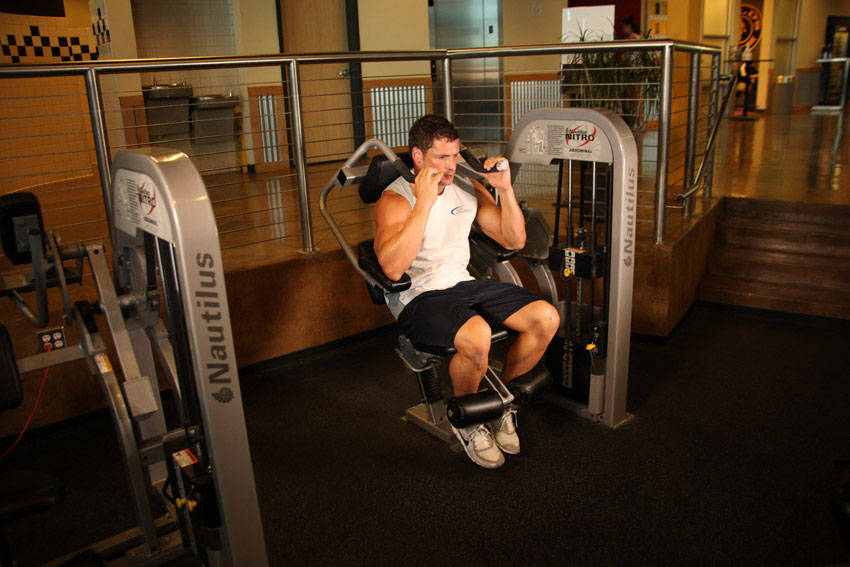 1 / 2
1 / 2How to
Movement instructions
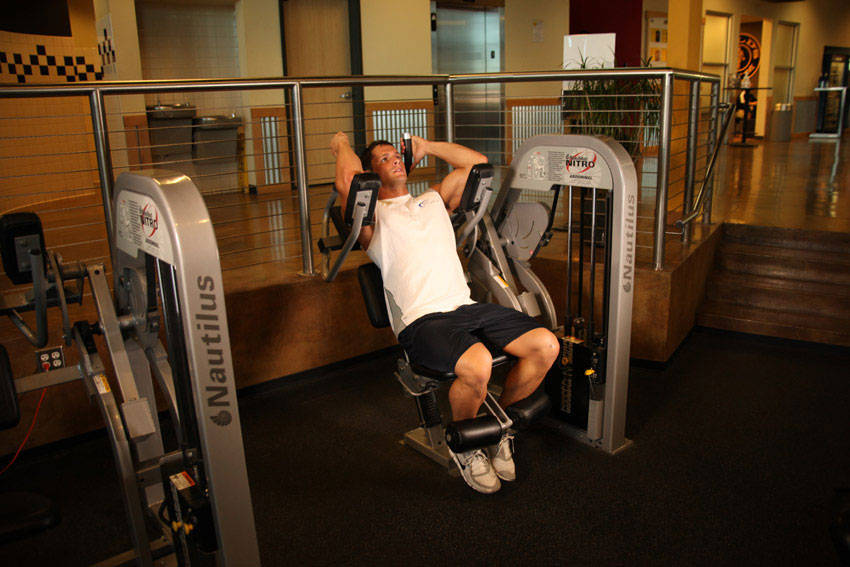
Select a light resistance and sit down on the ab machine placing your feet under the pads provided and grabbing the top handles. Your arms should be bent at a 90 degree angle as you rest the triceps on the pads provided. This will be your starting position.
At the same time, begin to lift the legs up as you crunch your upper torso. Breathe out as you perform this movement. Tip: Be sure to use a slow and controlled motion. Concentrate on using your abs to move the weight while relaxing your legs and feet.
After a second pause, slowly return to the starting position as you breathe in.
Repeat the movement for the prescribed amount of repetitions.
Technique guidance
Exhale through the abdominal effort and inhale during the controlled return. Keep the neck relaxed and do not hold your breath.
General guidance based on the exercise and equipment. It is not personal coaching or medical advice.
Your progress
Keep the same machine setup, range of motion and recording method when comparing Ab Crunch Machine sessions.
Weight, repetitions and completed sets.
Example: 3 sets of 8 reps at 30 kg. Next time, record the actual result, even if it is the same.
Look for more repetitions at the same weight, or a heavier weight for comparable repetitions. Total weight lifted also changes when you add sets, so it is not a strength score.
Read the tracking guideThe examples show how to keep a record. They are not workout targets or a personalised training plan.
See how Jijibisha tracks your progressMuscles
Muscle guide
Abdominals is the primary muscle group. The lighter highlights show the supporting muscles involved in the movement.
In depth
The ab crunch machine is a resistance exercise designed to strengthen the abdominal muscles through controlled spinal flexion. Instead of performing crunches on the floor using only your body weight, the machine provides an adjustable load and a guided movement path. This makes the exercise easier to measure, repeat, and progressively overload as your abdominal strength improves.
When performed correctly, the machine crunch primarily trains the rectus abdominis-the long abdominal muscle commonly associated with a visible “six-pack.” The exercise can be useful for beginners learning to contract their abs, experienced lifters seeking direct abdominal training, and anyone who wants an alternative to high-repetition floor crunches.
However, the machine does not guarantee good technique. Using too much weight, pulling with your arms, driving with your legs, or allowing the resistance to control you can shift tension away from your abs. Proper setup and deliberate movement matter more than the number displayed on the weight stack.
Quick answer: Sit securely in the machine, choose a manageable resistance, brace your abdomen, and curl your rib cage toward your pelvis. Exhale as you crunch, pause briefly in the contracted position, and return slowly without letting the weight stack slam down.
An ab crunch machine-also called an abdominal crunch machine, machine crunch, or seated ab machine-is a piece of gym equipment that adds external resistance to a crunching movement.
Most machines include:
The machine is intended to create spinal flexion: the front of your torso shortens as your rib cage moves toward your pelvis. Your abdominal muscles produce and control this movement.
There are several designs, so the exact setup may differ between gyms.
On this design, your feet remain supported while your upper torso curls forward against the resistance. The handles or arm pads move with your torso.
A dual-action machine combines an upper-body crunch with a small upward movement of the legs. Your torso and knees move toward each other as you contract your abs.
Some machines place you in a kneeling or forward-facing position. Although the body position changes, the objective remains the same: produce a controlled crunch by contracting the abdominal muscles rather than pulling with the arms.
Before beginning, examine the machine’s diagram and adjustment points. Do not assume every ab machine should be used in exactly the same way.
The rectus abdominis is the main muscle trained by the ab crunch machine. It runs vertically along the front of your abdomen, from the pelvis toward the lower ribs and sternum.
Its primary role during the machine crunch is to flex the trunk, bringing the rib cage and pelvis closer together.
The rectus abdominis is one continuous muscle. People often describe “upper abs” and “lower abs,” but these are not separate muscles. You may feel more tension in one region depending on your body position, range of motion, and machine design, but the entire rectus abdominis contributes to the crunch.
Several other muscles may assist or stabilize the movement:
The goal is not to eliminate every supporting muscle. The goal is to keep the abdominals as the main source of movement.
Because machine designs differ, use the following steps as general guidance while following the instructions displayed on the equipment.
Set the seat, pads, and foot supports before selecting a challenging weight.
Your body should feel centered in the machine rather than forced into an awkward position. The arm or shoulder pads should make secure contact without pushing your shoulders toward your ears. Your feet should reach the platform or rollers without stretching.
If the seat is too high or too low, the machine’s pivot may not match your natural movement. This can make the exercise feel uncomfortable or cause you to compensate with your hips, arms, or lower back.
Begin with less weight than you think you need.
You should be able to perform at least 10 controlled repetitions without jerking, pulling with your arms, holding your breath, or losing your position. The final repetitions may feel difficult, but the movement should still look similar to the first repetition.
The weight-stack number is not a universal measure of strength. Two ab machines can feel completely different even when they display the same resistance.
Sit fully into the machine and position your feet according to its design. Keep your hips stable and maintain comfortable contact with the seat or back support.
Place your arms against the pads or hold the handles lightly. The handles are attachment points, not levers for your arms to pull.
Keep your neck in a neutral, comfortable position. Look generally forward or slightly downward instead of forcing your chin onto your chest.
Gently tighten your abdomen as though preparing for someone to press against your stomach.
Do not suck your stomach in as hard as possible. Create firm, controlled tension around your midsection while continuing to breathe.
Exhale as you curl forward.
Think about shortening the distance between the bottom of your rib cage and the front of your pelvis. Allow your spine to flex gradually instead of simply bending forward from the hips.
Your elbows, shoulders, and hands should follow the movement created by your torso. They should not initiate it.
On a dual-action machine, allow the legs to move with the mechanism without aggressively driving your knees upward. The upper and lower portions of the machine should come together because your abs are contracting-not because you are pushing forcefully with your feet.
At the end of the comfortable range, pause briefly and squeeze your abs.
You do not need to fold your torso as far as possible. Stop when you have achieved a strong abdominal contraction without pain, pinching, or loss of control.
Inhale as you reverse the movement.
Allow your torso to open gradually while resisting the pull of the weight. Do not let the machine drag you backward. Keep some abdominal tension as you return and avoid leaning excessively beyond your comfortable starting position.
Stop just before the weight stack crashes into the resting plates. Begin the next repetition while you still control the resistance.
Use one or two cues at a time rather than trying to remember everything during the set.
A useful test is to reduce your grip pressure. If the weight suddenly becomes much harder to move, you may have been relying too heavily on your arms.
Excessive resistance is the most common reason machine crunches become ineffective.
When the load is too heavy, you may pull with your arms, drive with your legs, swing your torso, or shorten the range of motion. The weight moves, but the abdominal muscles receive less focused work.
Reduce the resistance until you can initiate every repetition from your abdomen.
The handles are there to connect you to the machine and help maintain your position. They are not intended to turn the movement into an arm exercise.
Avoid gripping as hard as possible or pulling your elbows down using your lats and triceps. Keep your hands relatively relaxed and imagine that your arms are simply transferring the motion created by your torso.
A hip hinge moves the torso as one rigid unit. A crunch involves controlled spinal flexion.
If your back remains completely straight while your entire torso tips forward, your hip flexors may be doing more work than intended.
Think about curling your upper torso and closing the space between your ribs and pelvis.
This mistake is especially common on dual-action machines.
Pushing forcefully through the feet or lifting the knees using the hip flexors can make the machine move without creating a strong abdominal contraction. Keep your feet secure but avoid turning the exercise into a leg-driven movement.
Fast repetitions make it easier to use momentum.
Slow down enough to feel where the resistance is going. A controlled crunch, brief pause, and deliberate return will usually be more productive than rapidly completing as many repetitions as possible.
The return is part of the repetition.
If you relax after the crunch and allow the weight to pull your torso back, you lose control and may place unnecessary stress on your spine. Resist the machine throughout the return.
More range of motion is not automatically better.
Some machines allow the torso to move into excessive extension at the beginning of each repetition. Going farther back than your comfortable range can create lower-back discomfort without providing a meaningful advantage.
Return until your torso reaches a controlled starting position, not until the machine forces you into the deepest possible stretch.
Your head should follow the natural movement of your torso.
Avoid reaching your chin toward your chest or leading every repetition with your head. This can create unnecessary neck tension and distract from the abdominal contraction.
When the plates crash between repetitions, the abdominal muscles receive a brief rest and the machine experiences unnecessary impact.
Maintain control and reverse the movement before the stack settles completely.
Breath-holding can make the movement feel more difficult and may cause unnecessary pressure or dizziness.
Exhale through the crunch and inhale during the return. You do not need to force every breath, but you should maintain a steady pattern.
One of the main advantages of the ab crunch machine is the ability to change the load.
Bodyweight crunches can become difficult to progress once you can perform many repetitions. A machine allows you to increase resistance in small, measurable steps while keeping the exercise familiar.
You can track the weight, repetitions, sets, tempo, and range of motion over time.
For example, you might progress from three sets of 10 repetitions at one resistance to three sets of 15. You can then increase the load slightly and begin again near the lower end of the repetition range.
The guided path reduces the balance and coordination required by many free-moving exercises.
This can help beginners concentrate on contracting their abdominal muscles. It may also allow experienced trainees to push the target muscle close to fatigue without worrying about maintaining a complex position.
The exercise requires little preparation. Adjust the machine, select the resistance, complete your sets, and record the result.
This makes it practical for people who want direct abdominal training without spending a large portion of their workout setting up equipment.
By adjusting the resistance and repetitions, the machine can be used for abdominal strength, muscle development, or muscular endurance.
The exercise is not reserved for beginners. Advanced trainees can also benefit when they use challenging resistance without sacrificing technique.
The machine is useful, but it should not be treated as a complete core-training system.
The machine primarily trains spinal flexion. Your core also helps resist extension, rotation, and lateral bending while transferring force between the upper and lower body.
A balanced routine may also include exercises such as:
A machine follows a predetermined arc. Depending on your height, torso length, mobility, and the machine’s design, that path may feel natural or uncomfortable.
Adjust the equipment carefully. Choose a different exercise when you cannot find a comfortable setup.
The seat and handles provide several opportunities to generate force using muscles other than the abs.
A heavier number on the stack does not necessarily mean stronger abdominal muscles. Progress only when you can maintain the same controlled technique.
The ab crunch machine strengthens the muscles beneath the abdominal fat, but it cannot selectively burn fat from your stomach.
Fat loss occurs through changes in total energy balance over time, supported by appropriate nutrition, physical activity, resistance training, aerobic exercise, sleep, and consistency.
Building your abdominal muscles may make them more developed. Whether they are visible also depends substantially on how much body fat covers them.
The best repetition range depends on your current ability and training goal.
| Goal | Sets | Repetitions | Effort | Rest |
|---|---|---|---|---|
| Learn the movement | 2–3 | 12–15 | Finish with 2–4 good reps remaining | 60–90 seconds |
| Build abdominal muscle | 3–4 | 8–15 | Finish with roughly 0–3 good reps remaining | 60–120 seconds |
| Improve muscular endurance | 2–4 | 15–25 | Stop before speed or form deteriorates | 45–90 seconds |
| Add light core work | 2–3 | 10–20 | Moderate, controlled effort | 45–90 seconds |
These are starting guidelines, not rigid rules.
A set of eight controlled repetitions can be productive. A set of 20 can also be productive. The important factors are sufficient resistance, consistent technique, a challenging level of effort, and gradual progression.
Avoid selecting a load that turns the exercise into a full-body struggle. Your abs should reach fatigue before your arms, neck, or hip flexors.
Use a resistance that allows you to reach the bottom of your chosen repetition range with clean technique.
For example, when using a 10–15 repetition target:
When you are learning the exercise, finish each set with several technically sound repetitions still possible. You can train closer to muscular failure after you have developed consistent control.
Do not choose your resistance based on what another person uses. Machine design, leverage, friction, maintenance, and range of motion can all affect how heavy the stack feels.
A simple double-progression system works well.
Suppose your target is three sets of 10–15 repetitions:
Your progress might look like this:
| Session | Set 1 | Set 2 | Set 3 |
|---|---|---|---|
| 1 | 12 | 11 | 10 |
| 2 | 13 | 12 | 11 |
| 3 | 14 | 13 | 12 |
| 4 | 15 | 14 | 13 |
| 5 | 15 | 15 | 15 |
| 6 | Increase weight | 11 | 10 |
You do not need to improve in every workout. Progress can occur through:
Record your sets in a workout log so you can distinguish real progress from guesswork. You can use the Jijibisha app to track your resistance, repetitions, and workout history.
There is no single mandatory tempo, but beginners usually benefit from slowing the exercise down.
Try the following rhythm:
This is not intended to make every repetition artificially slow. It is a teaching tool that helps you remove momentum and feel the abdominal muscles working.
Once your form is reliable, your natural speed may vary. Regardless of tempo, remain in control throughout the repetition.
The ab crunch machine can be placed at different points in your workout depending on your priorities.
This is the simplest option for most people. Complete your main compound lifts first, then perform direct abdominal work before leaving the gym.
This prevents abdominal fatigue from interfering with exercises that require strong bracing, such as squats, deadlifts, overhead presses, and loaded carries.
Place the exercise earlier when abdominal development is a major priority.
After your general warm-up, complete a few challenging sets while you are fresh. Be aware that intense abdominal training may temporarily affect your ability to brace during later exercises.
You can combine the machine crunch with anti-extension, anti-rotation, and carrying exercises in a short standalone session.
Most people do not need to train the ab crunch machine every day. Two or three direct abdominal sessions per week can provide a practical starting point, with recovery between harder sessions.
Focus on learning each movement and finishing every set with control.
The machine crunch provides loaded spinal flexion, the knee raise adds a different dynamic pattern, and the Pallof press trains resistance to rotation.
This combination trains dynamic flexion, lateral stability, and anti-extension without requiring a long separate workout.
You can also use Jijibisha’s routine tools to organize exercises, target repetitions, rest periods, and training days.
The floor crunch uses body weight and requires no equipment. It is convenient, but progression often depends on adding repetitions, slowing the movement, or holding external weight.
The machine crunch makes resistance easier to adjust and record. It also provides a stable setup, although its fixed path may not suit every body.
Choose the floor crunch when you need a simple exercise anywhere. Choose the machine when you want measurable external resistance.
Both exercises allow progressive overload.
The machine provides more external support and follows a fixed path. The cable crunch allows greater freedom of movement but requires you to control your hips, knees, and torso without a seat or back support.
The machine may be easier to learn. The cable variation may offer more flexibility once you understand how to produce spinal flexion without turning the movement into a hip hinge.
A sit-up usually includes substantial movement at the hips in addition to spinal flexion. This can increase the involvement of the hip flexors.
The machine crunch is intended to focus more directly on shortening the abdominal muscles through a smaller, controlled range.
Neither exercise is automatically superior. They train related but different movement patterns.
The exercises train different functions.
The machine crunch is a dynamic spinal-flexion exercise. The plank is primarily an anti-extension exercise in which the abdominal muscles prevent the lower back from arching.
A plank is not simply a “safer crunch,” and a crunch is not a replacement for every stability exercise. A complete core program can include both dynamic and isometric movements.
A hanging leg raise requires grip strength, shoulder control, body awareness, and significant stabilization. It can be an excellent exercise, but your grip or hip flexors may fatigue before your abs.
The machine crunch removes most of those limitations and makes the resistance easier to adjust.
The hanging variation is more complex and demanding. The machine is usually more accessible for focused abdominal training.
You may feel your hip flexors when:
Reduce the weight and think about curling your ribs toward your pelvis.
On a dual-action machine, relax the feet and avoid trying to lift the leg section independently. If the sensation continues despite careful setup and light resistance, try a torso-only machine, cable crunch, reverse crunch, or another comfortable abdominal exercise.
Lower-back discomfort may occur when you:
A normal muscular effort in the abdomen is different from sharp, pinching, radiating, or increasing back pain.
Reduce the resistance and range of motion. Recheck the seat and pad positions. Stop the exercise when you cannot find a pain-free setup.
People with diagnosed spinal conditions, persistent back pain, recent abdominal or spinal surgery, or other relevant medical concerns should seek individualized guidance from an appropriate healthcare professional.
The ab crunch machine can be used safely by many people when the equipment fits properly and the resistance remains under control.
However, a guided machine is not automatically risk-free. Safety still depends on:
Stop the set if you experience sharp pain, numbness, radiating discomfort, dizziness, nausea, or a feeling that the machine is unstable.
Inspect the equipment before use and keep your hands, clothing, and personal items away from moving parts.
Yes. The ab crunch machine can effectively train the rectus abdominis when you use an appropriate resistance and create the movement through controlled spinal flexion.
Its main advantage is that the load can be adjusted and tracked over time. It becomes less effective when excessive weight causes you to pull with your arms, drive with your legs, or use momentum.
It can help develop the rectus abdominis, which creates the segmented appearance associated with a six-pack.
However, abdominal visibility also depends on body-fat levels, genetics, muscle development, and where your body stores fat. Training the machine alone will not make the abdominal muscles visible when they remain covered by substantial body fat.
No exercise reliably removes fat from one selected area.
The machine strengthens and develops the abdominal muscles, but reducing belly fat requires an overall fat-loss process. Nutrition, total activity, resistance training, cardiovascular exercise, sleep, and long-term adherence all contribute.
Yes. The supported position and guided movement can make it easier for beginners to learn how a loaded abdominal contraction feels.
Beginners should use a light resistance, move slowly, and stop each set before their form deteriorates.
Start with two or three sets of approximately 12–15 controlled repetitions.
The exact number is less important than maintaining steady breathing, a comfortable range, and a slow return. Increase the resistance only after you can complete the target repetitions without relying on momentum.
Daily use is usually unnecessary.
Like other muscles trained with resistance, your abdominal muscles need an appropriate balance of training and recovery. Two or three sessions per week are enough for many people, although total volume and intensity matter more than a fixed schedule.
Use enough resistance to make the set challenging, but not so much that your technique changes.
Very heavy machine crunches often encourage shortened repetitions, aggressive pulling, and excessive hip involvement. A moderate load performed close to muscular fatigue can be more useful than moving the heaviest possible stack.
No. The purpose of a crunch is controlled spinal flexion.
Keeping the entire torso rigid and straight may turn the exercise into a hip hinge. Curl the torso gradually while staying within a comfortable range. The movement should be deliberate rather than forced.
Exhale as you crunch forward and inhale as you return.
Exhaling during the contraction can help you shorten and brace the abdominal area. Avoid holding your breath through an entire set.
Pulling the handles allows your arms, shoulders, and back muscles to assist the movement.
Although the stack may move more easily, the exercise becomes less focused on the abs. Use a lighter grip and think of the arms as passive connections to the machine.
Neither is universally better.
The machine offers support and a consistent path, making it easier to learn and track. The cable crunch provides more movement freedom and requires greater control of the rest of your body.
Choose the variation that fits your body, equipment, experience, and training goals.
Alternatives include:
Choose an exercise that trains the function you need and that you can perform without pain.
The ab crunch machine is a practical exercise for progressively strengthening the abdominal muscles. Its guided path and adjustable resistance make it easy to learn, measure, and include in a structured gym routine.
For the best results:
Do not judge the exercise by how much weight you can move. Judge it by how consistently you can place meaningful tension on your abdominal muscles while maintaining control.
Explore more movements in the Jijibisha exercise library, build a structured training routine, and track each workout with the Jijibisha app.
Swap it
Different equipment, same muscle
These movements also target the abdominals using something else.
Related
Related movements
Get the app
Add it to a routine, record every completed set, and keep the workout saved on your phone even when the gym has no reception.