Breathing
Breathe slowly and evenly. Exhale as you ease into a comfortable range, and never use the breath to force a deeper position.
Getting your next view ready…
The All Fours Quad Stretch primarily works the quadriceps, with the quadriceps supporting the movement. It is a stretching movement that needs no equipment.
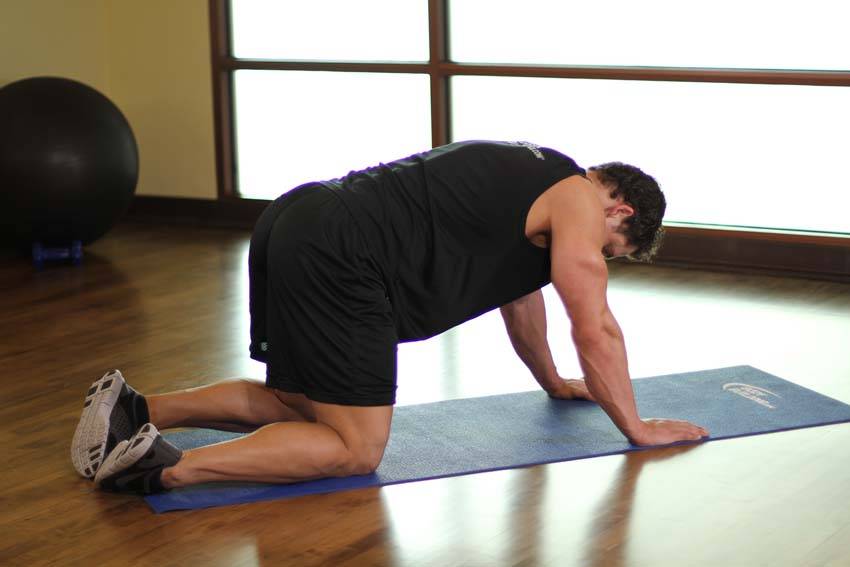
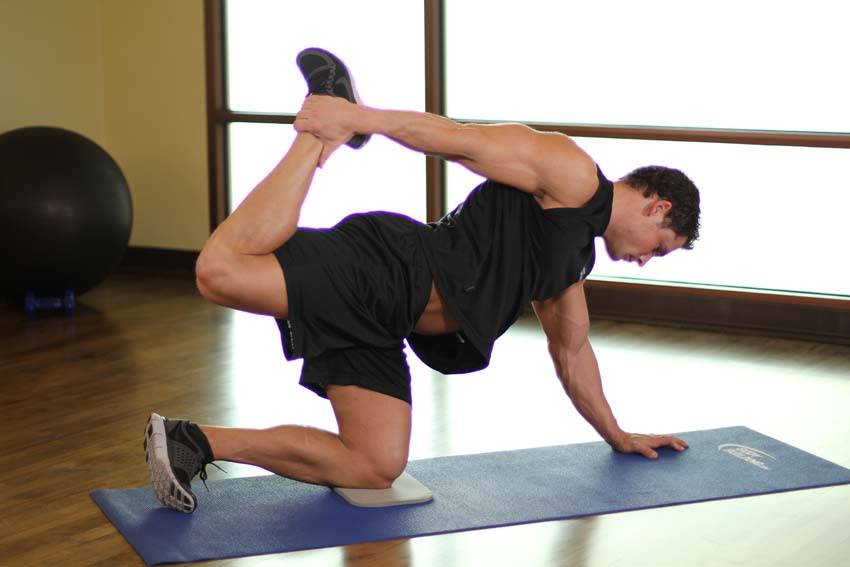 1 / 2
1 / 2How to
Movement instructions
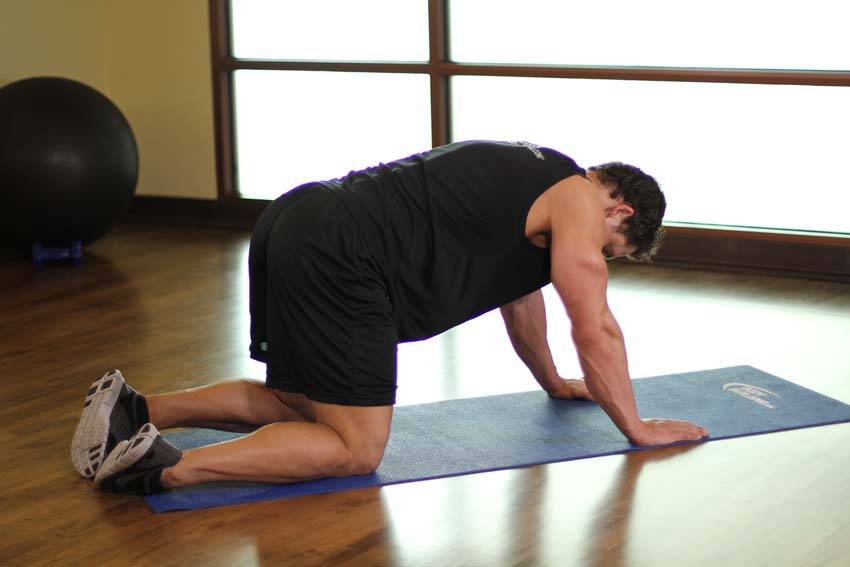
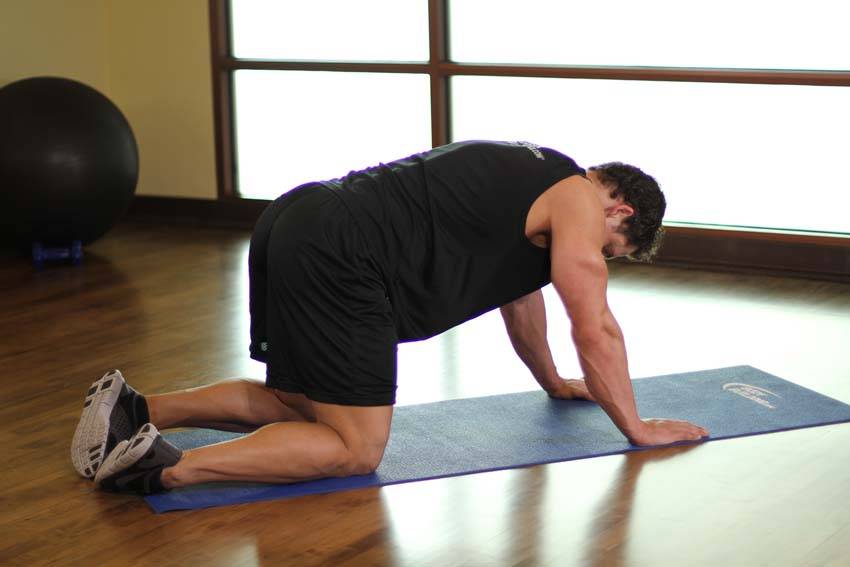
Start off on your hands and knees, then lift your leg off the floor and hold the foot with your hand.
Use your hand to hold the foot or ankle, keeping the knee fully flexed, stretching the quadriceps and hip flexors.
Focus on extending your hips, thrusting them towards the floor. Hold for 10-20 seconds and then switch sides.
Technique guidance
Breathe slowly and evenly. Exhale as you ease into a comfortable range, and never use the breath to force a deeper position.
General guidance based on the exercise and equipment. It is not personal coaching or medical advice.
Your progress
Keep the same exercise variation, range of motion and recording method when comparing All Fours Quad Stretch sessions.
Duration and completed sets.
Example: a 30-second set, followed by a 25-second set. Record the time you completed, not the target.
Review duration alongside your notes about the variation and control. Longer is a recorded result, not an instruction to extend every set.
Read the tracking guideThe examples show how to keep a record. They are not workout targets or a personalised training plan.
See how Jijibisha tracks your progressMuscles
Muscle guide
Quadriceps is the primary muscle group. The lighter highlights show the supporting muscles involved in the movement.
In depth
The all fours quad stretch is a floor-based flexibility exercise that targets the muscles at the front of the thigh. You begin on your hands and knees, bend one leg behind you, hold the foot or ankle with one hand, and gently extend the hip while keeping the knee flexed.
This combination creates a strong stretch through the quadriceps, particularly the rectus femoris. Because the movement is performed on all fours, it also challenges your balance, shoulder stability, core control, and ability to keep your pelvis in a comfortable position.
The exercise is sometimes called the quadruped quad stretch, all fours quadriceps stretch, quadruped hip flexor stretch, or kneeling quad stretch with foot hold. It requires no equipment, although an exercise mat, knee pad, yoga strap, or towel can make the position more accessible.
The all fours quad stretch can be used after lower-body training, during a mobility session, or as part of a general stretching routine. It is more demanding than a basic standing quad stretch, so the goal should be control rather than forcing the heel as close to the glutes as possible.
The all fours quad stretch is a unilateral static stretch performed from a quadruped position.
“Quadruped” simply means that you begin with both hands and both knees on the floor. From this position, you shift your weight onto one hand and the opposite knee, bend the other leg, and reach back to hold the raised foot.
The working leg is placed in two positions at the same time:
This combination is especially effective for stretching the rectus femoris because that muscle crosses both the hip and knee joints.
A basic standing quad stretch mainly bends the knee. The all fours version adds hip extension and makes it easier to adjust the position of the pelvis. For some people, this produces a more focused stretch through the upper part of the front thigh.
The exercise also introduces a balance component because one hand and one knee are lifted or partially unloaded. Your supporting arm, abdominal muscles, and hip stabilizers must help keep your body steady while you hold the stretch.
| Category | Details |
|---|---|
| Primary area stretched | Quadriceps |
| Main muscle emphasized | Rectus femoris |
| Secondary areas | Hip flexors and front of the hip |
| Supporting muscles | Core, shoulders, glutes and hip stabilizers |
| Equipment | None |
| Optional equipment | Exercise mat, knee pad, towel or stretching strap |
| Difficulty | Intermediate |
| Exercise type | Static flexibility and mobility exercise |
| Starting position | Hands and knees |
| Suggested hold | 15 to 30 seconds per side |
| Suggested volume | 2 to 4 holds per side |
| Best used for | Post-workout stretching and mobility sessions |
| Main form priority | Hip extension without excessive lower-back arching |
The all fours quad stretch primarily lengthens the quadriceps, but the exact sensation depends on your hip position, knee angle, pelvic control, and individual mobility.
The rectus femoris is one of the four muscles that make up the quadriceps.
It runs down the front of the thigh and crosses both the hip and knee. It helps flex the hip and extend the knee during movements such as walking, running, kicking, squatting, and climbing stairs.
To place the rectus femoris in a lengthened position, the knee must bend while the hip extends. That is exactly what occurs during the all fours quad stretch.
You may feel the stretch high on the front of the thigh, close to the hip, as well as through the middle of the quadriceps.
The vastus lateralis is the large quadriceps muscle along the outer front portion of the thigh.
It crosses the knee but not the hip. Bending the knee lengthens this muscle, although hip extension does not affect it as directly as it affects the rectus femoris.
Depending on your anatomy and foot position, you may feel some tension along the outer thigh.
The vastus medialis sits along the inner front portion of the thigh and contributes to knee extension and kneecap control.
It is lengthened as the knee bends. The stretch may be felt closer to the inner knee or lower part of the thigh, particularly when knee flexion is limited.
Stretching should create muscular tension rather than sharp pressure around the kneecap.
The vastus intermedius lies underneath the rectus femoris.
Like the other vasti muscles, it crosses the knee and helps straighten the leg. It is lengthened by knee flexion during the stretch.
You will not usually feel this deeper muscle separately, but it contributes to the overall sensation through the front of the thigh.
The exercise may also stretch muscles at the front of the hip.
The rectus femoris is itself a hip flexor, but other hip flexors can be affected when the thigh moves behind the pelvis. The amount of hip flexor stretch depends on whether you keep the pelvis controlled or compensate by arching the lower back.
A gentle glute contraction on the stretching side can help maintain hip extension and make the stretch feel more focused near the front of the hip.
The abdominal muscles are not being stretched, but they help stabilize your trunk.
Light abdominal tension prevents the rib cage from flaring excessively and reduces the tendency to create fake hip extension by arching the lower back.
The glute on the stretching side can be contracted gently to help move the hip into extension.
The gluteal muscles on the supporting side also help keep the pelvis stable while your balance shifts.
One arm supports part of your body weight while the other reaches behind you.
The supporting shoulder, triceps, chest, and upper-back muscles work isometrically to keep your upper body stable. The exercise should not feel like a strenuous upper-body workout, but adequate shoulder and wrist comfort are required.
Regular stretching can help you become more comfortable moving the knee through a greater range of flexion.
The all fours position allows you to adjust the amount of tension gradually by changing how far you pull the foot and how much you extend the hip.
Improved quadriceps flexibility may make kneeling, lunging, and other knee-bending positions feel less restricted.
The rectus femoris is sometimes difficult to stretch fully with a basic standing quad stretch.
If the thigh remains in front of the body, the hip stays flexed and the rectus femoris is not lengthened as much at the hip. The all fours variation allows the thigh to travel behind the torso while the knee remains bent.
This makes it a useful quad and hip flexor stretch for people who can already perform simpler quadriceps stretches comfortably.
The exercise is performed one leg at a time.
You may notice that one side has less knee flexion, more tension near the hip, poorer balance, or greater difficulty keeping the pelvis controlled.
These differences provide useful information, but they do not need to be corrected by forcing the tighter side. Use an appropriate range for each leg and allow changes to occur gradually.
The all fours quad stretch is not completely passive.
Your supporting arm, abdominal muscles, hips, and shoulders must keep you stable while the stretching leg moves behind you. This creates a controlled mobility challenge rather than simply pulling the foot while standing.
A standing quad stretch requires you to balance on one foot.
The all fours version keeps several points of contact with the floor, which may feel more stable for people who struggle with single-leg balance.
However, it still requires some coordination because one arm reaches backward and one leg lifts from the floor.
The stretch can be performed at home, at the gym, while traveling, or beside a sports field.
A padded surface is helpful, but no specialized equipment is necessary.
The intensity can be changed by adjusting:
This makes it possible to build toward the full position without forcing your current range.
The stretch can be used after squats, lunges, cycling, running, leg presses, or other activities that heavily involve the quadriceps.
It will not replace recovery basics such as sleep, nutrition, hydration, and sensible training volume, but it can be a comfortable way to finish a lower-body session.
Use an exercise mat or another stable, padded surface.
The supporting knee will remain on the floor, so additional padding may be useful if kneeling feels uncomfortable. Fold the mat or place a small knee pad under the supporting knee if necessary.
Make sure there is enough space behind you to raise your foot without striking furniture or equipment.
Place your hands beneath or slightly ahead of your shoulders.
Position your knees beneath your hips and keep them approximately hip-width apart. Allow the tops of your feet or toes to rest comfortably on the floor.
Spread your fingers and press through the base of each hand.
Begin with your back in a neutral, comfortable position rather than deliberately rounding or arching it.
Gently tighten your abdominal muscles.
The goal is not to brace as hard as you would during a heavy squat. Use enough tension to keep your ribs and pelvis controlled while still breathing normally.
Keep your neck long and look toward the floor.
Transfer slightly more weight onto one hand and the opposite knee.
For example, when stretching the left quadriceps, your right hand and right knee will provide much of your support.
Do not collapse into the supporting shoulder. Keep the arm active and maintain space between the shoulder and ear.
Lift the left knee slightly from the floor and bend it so the heel moves toward the glutes.
Keep the movement slow. The thigh may remain close to the floor at first.
Do not try to lift the leg as high as possible before you have secured your balance.
Lift your left hand and reach it behind you.
Hold the top of the left foot, the shoe, or the ankle. Use the grip that feels most comfortable for your wrist, knee, and ankle.
If you cannot reach the foot without losing your position, loop a towel or strap around the ankle instead.
Once you have the foot, allow your torso to rotate only as much as necessary.
Keep pressing the supporting hand into the floor. Avoid dumping all your body weight into the wrist.
Your chest may turn slightly toward the stretching side, but you should still feel steady enough to breathe comfortably.
Use your hand to guide the heel toward the back of the thigh.
Stop when you feel moderate tension through the front of the thigh.
Do not pull aggressively. The foot does not need to touch the glutes for the stretch to be effective.
While keeping the knee bent, gently move the thigh backward and slightly upward.
You can think about pressing the front of the hip toward the floor or moving the knee behind the line of your pelvis.
Lightly contract the glute on the stretching side. This can help create hip extension without relying entirely on the lower back.
Keep the front of the pelvis relatively level.
Avoid allowing the ribs to flare or the lower back to arch sharply. A small amount of natural movement is fine, but the stretch should remain focused through the front of the thigh and hip.
If you feel compression in your lower back, reduce the height of the thigh and gently tuck the pelvis.
Maintain the stretch for approximately 15 to 30 seconds.
Breathe slowly and allow the muscles to relax gradually. Do not bounce, jerk the foot, or repeatedly force a deeper range.
The intensity may reduce slightly as you hold. You can make a very small adjustment if it remains comfortable, but depth is not the main goal.
Reduce the pull on the foot before letting go.
Return the hand to the floor, lower the knee under the hip, and reestablish the starting position.
Avoid suddenly releasing the foot while the quadriceps is under strong tension.
Repeat the same steps with the opposite leg.
Use the range available on that side rather than assuming both legs should look identical.
Use this checklist while practising:
Choose one or two cues that improve your position:
Trying to think about every cue at once can make the stretch feel complicated. Focus first on comfort, balance, and a clear stretch through the front of the thigh.
You should feel a gradual pulling or lengthening sensation through the front of the thigh.
The stretch may be most noticeable:
The exact location can vary between people.
You should not feel:
A stretch does not need to be intense to be useful. Aim for mild to moderate tension that allows you to remain still and breathe normally.
Breathe slowly throughout the hold.
Inhale through your nose or mouth without lifting the shoulders excessively. Exhale gradually as you allow the quadriceps to relax.
A simple breathing pattern is:
Do not hold your breath while pulling the foot closer. Breath-holding often creates unnecessary tension and makes it harder to judge whether the range is comfortable.
More pulling does not always create a better stretch.
Aggressively forcing the heel toward the glutes can place unnecessary pressure on the knee and make it difficult to control the hip.
Use the hand only to guide the leg. The sensation should remain muscular rather than joint-specific.
It is possible to bend the knee deeply without extending the hip.
This may stretch the quadriceps, but it reduces the emphasis on the rectus femoris at the hip.
After securing the foot, gently move the thigh behind the pelvis. Do not compensate by sharply arching your back.
Some people create the appearance of greater hip extension by allowing the pelvis to tilt forward and the lower back to arch.
This can shift tension away from the front of the hip and create uncomfortable spinal compression.
Use light abdominal tension, gently contract the glute, and reduce the height of the thigh.
Rib flare often occurs alongside lower-back arching.
Keep the front ribs controlled and avoid lifting the chest as high as possible. Your torso can rotate slightly, but it should not become an exaggerated backbend.
Some rotation is natural when one hand reaches behind you.
However, opening the pelvis fully toward the ceiling can reduce the intended stretch and make the position unstable.
Rotate only as much as necessary to reach the foot. Then try to keep both hip bones directed generally toward the floor.
The supporting shoulder may move toward the ear when the arm becomes passive.
Press the floor away and keep the elbow straight without locking it aggressively. Maintain a stable shoulder blade and long neck.
Dumping all your weight into one hand can make the wrist uncomfortable.
Keep some weight through the supporting knee and distribute pressure across the entire hand. Moving the hand slightly forward or turning it outward a few degrees may feel better.
Use an easier stretch if the wrist remains painful.
Shifting the pelvis too far over the supporting knee may make the position easier to balance, but it can change the stretch and create twisting.
Begin with a small weight shift and keep the supporting hip reasonably aligned over the knee.
The thigh does not need to rise dramatically.
Lifting too high often causes the lower back to arch or the pelvis to rotate. A lower leg position with better pelvic control may create a more useful stretch.
Your heel may or may not reach your glutes.
Body proportions, muscle size, mobility, previous injuries, and knee structure all influence the available range. Physical contact is not a requirement.
Rapid pulling and releasing can make the exercise difficult to control.
Move gradually into the position and hold it steadily. A dynamic variation should still use smooth, deliberate movement rather than bouncing at the end range.
A strong sensation is not proof that the stretch is working better.
Back away when the tension becomes painful, sharp, or difficult to localize. Stretching through pain can irritate the knee, hip, or surrounding tissues.
Letting go while the heel is being pulled strongly can cause the lower leg to swing forward.
Reduce the tension first, guide the foot away from the body, and return the knee to the floor under control.
A hold of 15 to 30 seconds per side is suitable for many general mobility routines.
People who are new to the exercise can begin with shorter holds while learning the balance and hand position.
| Goal | Sets | Hold time | Rest |
|---|---|---|---|
| Learning the position | 1 to 2 | 10 to 15 seconds per side | As needed |
| General flexibility | 2 to 4 | 15 to 30 seconds per side | 15 to 30 seconds |
| Post-workout stretching | 2 to 3 | 20 to 30 seconds per side | Brief transition |
| Dedicated mobility work | 2 to 4 | 30 to 45 seconds per side | 20 to 45 seconds |
| Gentle dynamic preparation | 1 to 2 | 5 to 8 controlled repetitions | As needed |
Longer holds are not automatically better.
Maintain a duration that allows you to keep the knee, hip, back, shoulder, and wrist comfortable. Stop when your form begins to deteriorate.
The all fours quad stretch can be included two to five times per week, depending on the intensity and your response.
A gentle version may be used more frequently when it does not cause pain or excessive soreness.
Consistency matters more than performing one extremely intense session. A few comfortable holds repeated regularly are usually more practical than forcing a deep stretch once every few weeks.
Reduce the frequency or intensity if the front of the knee, quadriceps tendon, hip, wrist, or shoulder becomes irritated.
The stretch can be performed after exercises such as squats, lunges, step-ups, leg extensions, and leg presses.
Your muscles will already be warm, and the stretch can form part of a gradual cooldown.
Try two holds of 20 to 30 seconds per side after your final strength exercise.
Running repeatedly flexes the hip and requires the quadriceps to control and extend the knee.
A gentle quad stretch can be included after an easy cooldown walk. Avoid pulling aggressively when the muscles are already fatigued.
Cycling keeps the hips and knees moving through repeated flexion.
Some cyclists find a quad and hip flexor stretch comfortable after riding, particularly when they spend long periods seated in a forward position.
The exercise can be combined with stretches for the hamstrings, adductors, calves, and hips.
The 90/90 Hamstring Stretch can be used to address the back of the thigh, while the Adductor Groin Stretch can provide additional inner-thigh mobility work.
Long static holds are generally better suited to the end of a session or a separate mobility routine.
Before strength training, running, jumping, or sprinting, use a brief and gentle dynamic version after raising your body temperature.
Bend the knee, move into a mild stretch, and return to the starting position for five to eight controlled repetitions. Do not force the deepest possible range immediately before demanding activity.
The static version involves moving into a comfortable position and holding it.
Use it when your goal is general flexibility, relaxation, or post-workout mobility.
Hold the stretch without bouncing and maintain steady breathing.
The dynamic version involves moving into and out of the stretch slowly.
For example:
The dynamic version should remain smooth. It is not a rapid kicking or pulling exercise.
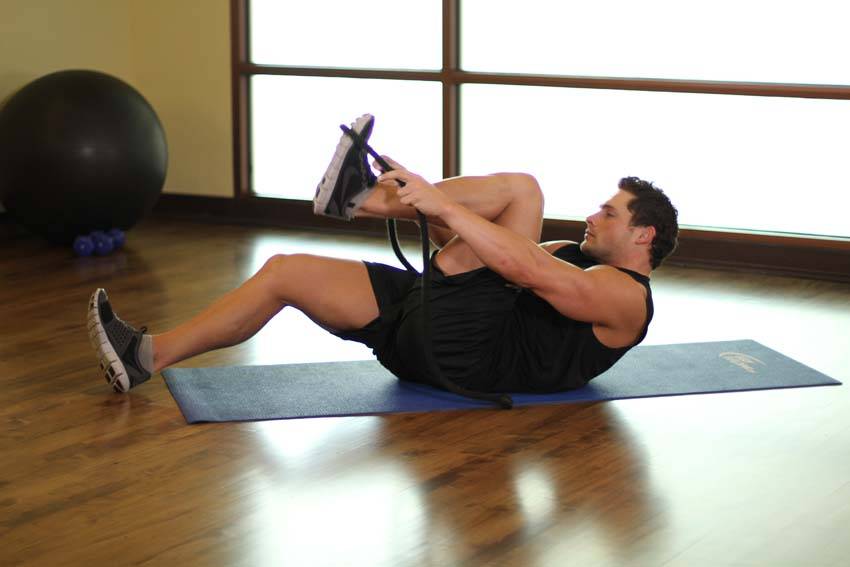
Loop a yoga strap, towel, or resistance band around the ankle.
Hold the strap instead of reaching all the way to the foot. This reduces the amount of shoulder rotation and quadriceps flexibility required.
Keep the strap secure and avoid pulling it abruptly.
Keep the stretching knee close to the floor instead of lifting it high.
Bend the knee and draw the heel inward while maintaining a low thigh position. This reduces the amount of hip extension and can make the stretch easier to control.
Place the supporting forearm on a yoga block or raised surface.
This may reduce wrist pressure, although it changes the height and balance demands. Ensure the surface cannot slide.
Lie on one side and hold the ankle of the upper leg.
Draw the heel toward the glutes while keeping the knees near each other. This removes the supporting-arm and balance requirements.
It is one of the best alternatives for people who cannot comfortably bear weight through the wrist.
Stand beside a wall or stable object and hold one ankle behind you.
Keep the knees near each other and avoid arching the lower back. Use the wall for balance.
This version is easier to set up but may provide less hip extension unless you deliberately move the thigh backward.
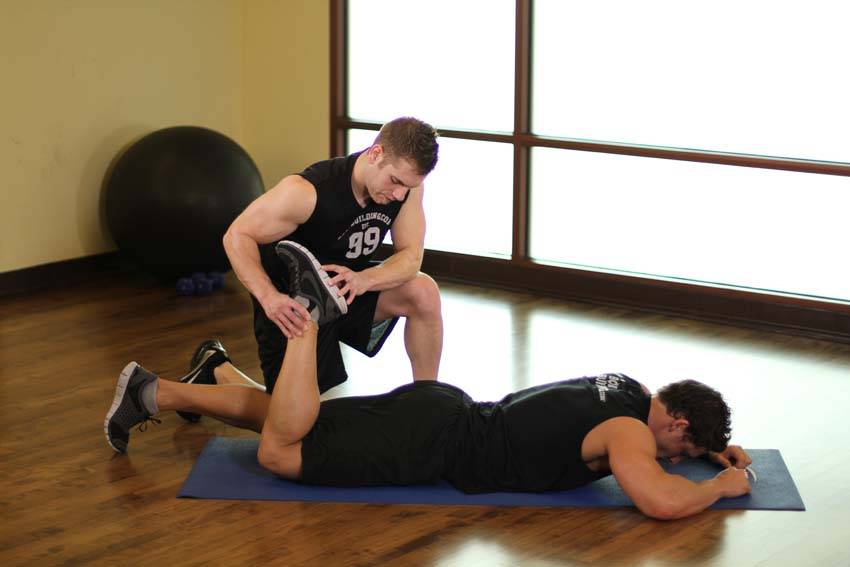
Lie on your stomach, bend one knee, and hold the ankle or use a strap.
Keep the front of the hip near the floor while gently pulling the heel inward. This provides a stable alternative without loading the supporting arm.
Once you are holding the foot, lightly squeeze the glute on the stretching side.
Maintain the contraction while gently moving the thigh backward. This can increase the emphasis on hip extension without requiring a stronger pull from the hand.
Extend the hold toward 30 to 45 seconds while maintaining relaxed breathing.
Increase the duration only when the knee, hip, wrist, and shoulder remain comfortable.
Move into a moderate stretch, then gently press the foot away from the hand for approximately five seconds without allowing the leg to move.
Relax the effort and ease slightly deeper if the range remains comfortable.
Use low effort. This is not a maximal hamstring-curl contraction.
Bend the knee and lift the thigh without holding the foot.
Maintain the position using the hamstrings and glute, then lower the knee slowly. This becomes more of an active mobility and control drill than a passive stretch.
Reach the opposite hand toward the raised foot.
This changes the rotational demand and may be harder to coordinate. It is not necessary for improving quadriceps flexibility, but it can provide variety for experienced trainees.
The standing quad stretch is the most familiar alternative.
It is quick and requires little floor space, but it demands single-leg balance. Holding a wall can make it more stable.
The side-lying variation is comfortable for people who want to avoid kneeling and wrist loading.
It also makes it easier to prevent excessive lower-back movement.
The prone version uses the floor to help keep the pelvis stable.
A strap can be used when the ankle is difficult to reach.
A half-kneeling hip flexor stretch emphasizes the front of the hip with less knee flexion.
It may be more appropriate when deep knee bending causes discomfort.
The couch stretch places the rear knee close to a wall or bench while the rear foot is elevated.
It can create a strong stretch through the quadriceps and front of the hip. Begin with the knee farther from the wall and avoid forcing an upright torso.
In a bilateral kneeling quad stretch, both knees remain on the floor while the hips move forward or the torso leans backward.
This can stretch both thighs simultaneously, but it may place more pressure on the knees and requires careful pelvic control.
| All fours quad stretch | Standing quad stretch |
|---|---|
| Performed on hands and knees | Performed while standing |
| Requires upper-body support | Requires single-leg balance |
| Allows greater hip extension | Often focuses mostly on knee flexion |
| Challenges shoulder and core stability | Minimal upper-body demand |
| Easier to compare pelvic position | Easier to perform almost anywhere |
| May irritate wrists or supporting knee | May be difficult for poor balance |
| More complex setup | Simpler setup |
Neither option is universally better.
Use the version that creates a clear quadriceps stretch without joint pain or unnecessary compensation.
Both exercises combine knee flexion and hip extension, but they feel different.
The couch stretch places the lower leg against a wall, bench, or elevated surface. The rear leg remains supported while the torso becomes more upright.
The all fours quad stretch uses the hand to control the foot. It gives you more direct control over knee flexion but requires more balance and shoulder mobility.
The couch stretch may create a stronger passive stretch. The all fours version may be easier to adjust moment by moment because you can immediately reduce the pull with your hand.
These exercises begin in a similar hands-and-knees position but target different areas.
During child’s pose, the hips move backward toward the heels while both knees remain on the floor. The exercise often stretches the back, hips, shoulders, and ankles.
During the all fours quad stretch, one knee lifts and bends while the thigh moves behind the torso. The main target is the quadriceps and front of the hip.
The two movements should not be treated as interchangeable.
Quadriceps flexibility can influence comfort in deep knee flexion, but it is only one factor affecting squat depth.
Other important factors include:
The all fours quad stretch may help when tightness at the front of the thigh makes deep knee bending uncomfortable. It will not automatically correct every squat limitation.
Combine mobility work with controlled squat practice and appropriate strength training. The Barbell Full Squat page can help you review the movement pattern separately.
Complete the following after a short warm-up or lower-body workout:
Move slowly between exercises and use a moderate stretch intensity.
A cooldown does not need to be long or exhausting. It should help you transition gradually out of the training session.
The exercise may be useful for:
The stretch is not limited to athletes. It can also be used in general mobility routines when the position feels comfortable.
Use an easier variation or seek professional guidance if you have:
A standing, side-lying, prone, or strap-assisted stretch may be more appropriate when the full all fours position is uncomfortable.
Stop immediately if the exercise creates sharp pain, joint pressure, instability, or symptoms that continue after you leave the position.
The all fours quad stretch is a quadriceps flexibility exercise performed from a hands-and-knees position.
You bend one leg behind you, hold the foot or ankle with one hand, and gently extend the hip while keeping the knee flexed.
The primary target is the quadriceps, particularly the rectus femoris.
The exercise may also stretch the front of the hip. Your abdominal muscles, glutes, shoulders, and supporting arm help stabilize the position.
It can be difficult for complete beginners because it requires balance, knee flexion, shoulder stability, and enough mobility to reach the foot.
Beginners can start with a standing, side-lying, prone, or strap-assisted quadriceps stretch.
Begin with 15 to 30 seconds per side.
Use shorter holds while learning the position. Longer holds may be used when you can remain comfortable and breathe normally.
Two to four holds per side are enough for most general flexibility routines.
The exact amount depends on your goals, training program, and tolerance.
A gentle version may be performed daily if it does not create pain or excessive soreness.
More intense stretching does not necessarily need to be performed every day. Two to five weekly sessions are sufficient for many people.
No.
Your heel only needs to move far enough to create a comfortable stretch through the front of the thigh. Forcing contact can irritate the knee or cause your back to arch.
The rectus femoris crosses the hip as well as the knee.
When you bend the knee and move the thigh behind the pelvis, the upper portion of this muscle is lengthened. Other hip flexors may also experience tension.
You may be bending the knee without extending the hip, pulling too hard on the foot, or reaching the limit of comfortable knee flexion.
Reduce the pull, move the thigh backward gently, and keep the pelvis controlled. Stop if the sensation feels sharp or located inside the joint.
Your body may be compensating for limited hip extension.
Lower the thigh, tighten the abdominal muscles gently, contract the glute, and keep the front ribs controlled.
The supporting hand carries part of your body weight.
Spread your fingers, press through the whole hand, keep some weight through the supporting knee, and experiment with moving the hand slightly forward.
Use a side-lying or standing stretch if wrist discomfort continues.
The hand on the same side as the raised leg is commonly used.
For example, the left hand holds the left foot while the right hand remains on the floor. A strap can be used when reaching the foot is difficult.
Use whichever grip feels secure and comfortable.
Avoid applying painful pressure to the ankle or toes. Holding the shoe can also work.
A gentle glute contraction on the stretching side can help extend the hip and limit excessive lower-back arching.
The contraction should be light enough that you can continue breathing.
No. It is a flexibility exercise rather than a primary muscle-building exercise.
Quadriceps growth requires progressive resistance from movements such as squats, split squats, leg presses, and leg extensions.
No individual stretch can guarantee injury prevention.
Training load, strength, technique, recovery, sport demands, previous injuries, and many other factors influence injury risk. Use stretching as one part of a complete training approach.
Stretching may feel comfortable after exercise, but it should not be expected to eliminate delayed muscle soreness.
Use gentle intensity when the quadriceps are already sore. Recovery also depends on time, sleep, nutrition, hydration, and sensible training volume.
It can be included after a cooldown walk when the position feels comfortable.
Use a moderate stretch and avoid forcing tired muscles into an extreme range.
A brief dynamic version can be used during a warm-up.
Save longer static holds for after training or a separate mobility session unless a qualified coach has included them for a specific reason.
Use the controlled range available on each side.
You can begin with the tighter side and repeat the same number of holds on both legs. Do not force the tighter leg to match the other side in one session.
Use a yoga strap or towel around the ankle.
A side-lying, prone, or standing quad stretch can also train the same general area with fewer balance and shoulder demands.
The all fours quad stretch is a useful way to target the quadriceps while combining knee flexion, hip extension, and controlled stability.
Its main advantage over a basic standing quad stretch is the ability to move the thigh behind the pelvis. This can place greater emphasis on the rectus femoris and the upper part of the front thigh.
Set up on a padded surface, keep the supporting shoulder active, hold the foot gently, and move the thigh backward without creating an exaggerated arch in the lower back.
The heel does not need to touch the glutes, and the raised knee does not need to travel high. The best position is the one that produces a clear muscular stretch while your knee, hip, back, wrist, and shoulder remain comfortable.
Begin with short holds and a manageable range. As the position becomes easier, progress through better pelvic control, slightly longer holds, or a gentle glute contraction rather than pulling the foot harder.
Record the variation, hold time, and number of sets you perform so you can develop a consistent mobility routine. You can organize the stretch alongside your strength exercises using Jijibisha routines.
Swap it
Different equipment, same muscle
These movements also target the quadriceps using something else.
Related
Related movements
Get the app
Add it to a routine, record every completed set, and keep the workout saved on your phone even when the gym has no reception.